 Forgotten Kitchen
Equipment
How did an icebox work?
An icebox cooled food with a block of ice inside an insulated cabinet. As the ice melted, it absorbed heat; the water then needed somewhere to go, usually a tray or a drain.
- Refrigeration
- Ice delivery
- Kitchen work
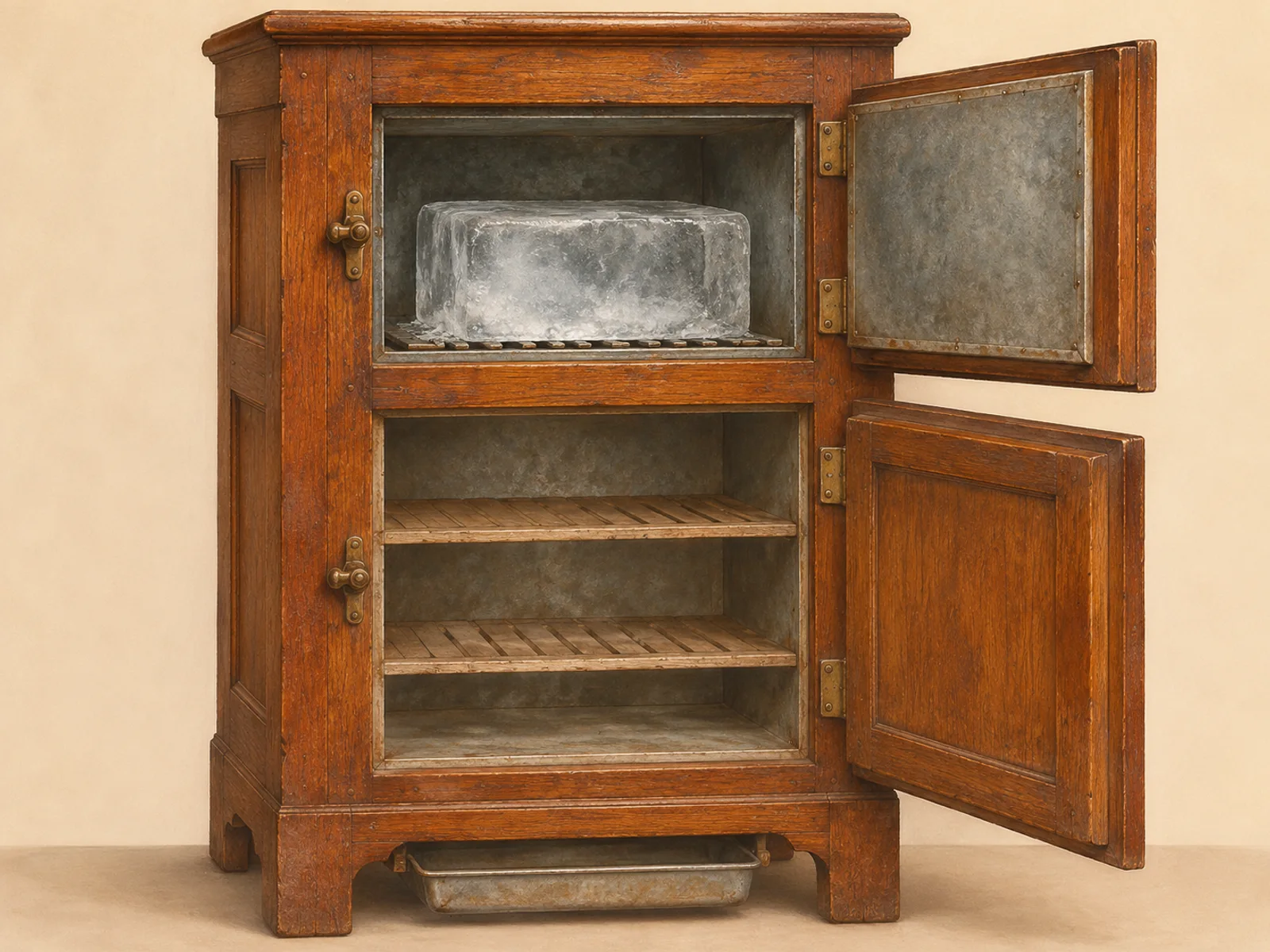
That melting block was doing its job. It was also running out. Keeping food cold meant arranging another delivery, finding room for the ice, and dealing with the water left behind. The cabinet could look like a handsome piece of furniture, but its contents were always changing. An icebox makes more sense when you look beyond its shelves to the work of keeping it supplied.
Ice, food, and a place for the water
Wood and porcelain gave the Monroe refrigerator described by the Smithsonian a familiar household appearance. Inside, the arrangement was quite specific: ice in an upper compartment, with a pull-out tray to catch the meltwater. The ice was a consumable part of the appliance, gradually becoming the water someone would remove. Monroe refrigerator, Smithsonian Libraries and Archives.
A Bohn Syphon icebox at the John Fitzgerald Kennedy National Historic Site shows another arrangement in more detail. Its ice occupied the top of the cabinet. Cooled air circulated to the shelves below, and the coldest space was directly beneath the block. A small lower door gave access to the drip tray. In this model, where a cook placed food and where someone reached for the water were both shaped by the position of the ice. National Park Service, Bohn Syphon icebox.
Those details belong to the particular cabinets. A pull-out tray and the Bohn's airflow pattern shouldn't become a diagram of every icebox ever made. What they share is the need to accommodate food, ice, and meltwater in one insulated piece of equipment. The block took up space while it cooled the cabinet; as it shrank, the household had to think about replenishment.
The drip tray is an especially revealing detail. A display of an old icebox can leave the visitor looking at doors and shelves. The tray points toward the floor and the person who had to empty it. The National Museum of American History's account includes emptying drip pans and mopping up meltwater among the chores of icebox use. Cold storage left wet work behind. National Museum of American History, ice delivery and household chores.
A delivery the kitchen had to be ready for
The block began its household service only after someone carried it indoors. Ice tongs gripped the slippery load with pointed jaws, giving the carrier a way to lift and move it. Period tongs interpreted by the National Park Service help explain this part of the delivery. They are period-appropriate objects, rather than tools known to have belonged to the Kennedy family. National Park Service, ice tongs.
At the Kennedy home in Brookline, Massachusetts, a sign in the front window summoned the ice carrier. The sign belongs to a particular household account, but it makes the arrangement easy to grasp: a cabinet in the kitchen depended on a request visible from outside. The household had to communicate with the person bringing its next supply of cold. National Park Service, icebox and delivery account.
The Smithsonian's refrigeration exhibition includes a 1918 photograph of women delivering ice during World War I, along with delivery tongs from the 1930s. The photograph and tools bring different parts of that work into view: the people carrying the load, the equipment used to hold it, and the household chores that followed. National Museum of American History, delivery photograph and tongs.
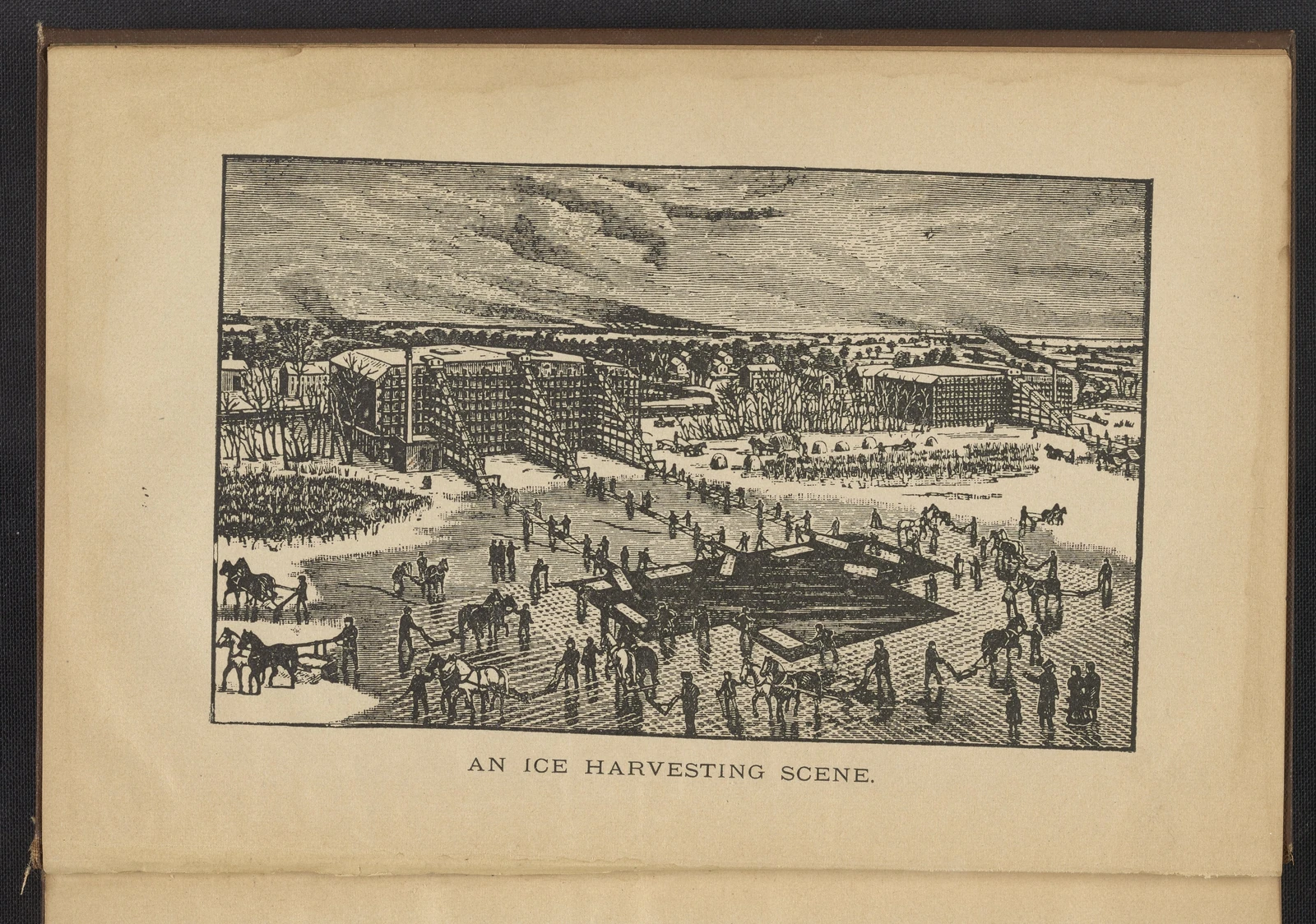
An illustration at the front of Theron L. Hiles's The Ice Crop (1893) pulls the view farther back. It depicts an ice harvest by the Knickerbocker Ice Company of Chicago. The book's subtitle, How to Harvest, Store, Ship and Use Ice, names the stages between a frozen surface and a useful block. Before there was water to empty from the tray, there was ice to harvest, store, and move. Hiles, The Ice Crop, 1893, frontispiece, Science History Institute.
When the refrigerator offered a setting
An electric refrigerator removed the need for a fresh delivery block. Its manufacturers also wanted cooks to see cold as something they could control while making food. The 1928 Frigidaire Recipes compared regulating a refrigerator with regulating an oven. Its Cold Control chapter distinguished the ordinary food-preservation setting from settings for freezing a dessert and holding it until serving. Frigidaire Recipes, 1928, pp. 11–14.
A control on the machine didn't settle every question about the dessert. The book gave separate directions for the mixture: some desserts needed stirring or beating, while others froze undisturbed. Even a mixture that needed no stirring sent the reader back to the holding instructions. The setting and the handling of the food were different decisions. Frigidaire Recipes, 1928, pp. 13–16.
A July 1929 Frigidaire advertisement offered a free recipe book and promoted quicker freezing of ice and desserts. These were advertising promises, but the choice of appeal is telling. A prospective customer was being offered a machine to prepare dishes with, as well as a place to keep food. The accompanying recipe book put the controls to use: freeze the dessert, attend to its texture, then hold it for serving. Frigidaire advertisement, July 1929, object 2008.105.13, The Henry Ford.
A note on the Monroe advertisement
The Smithsonian object record gives a publication date of 1913, while its image-gallery citation identifies volume 8, dated 1911. Those catalog details conflict. The cabinet description above follows the object notes, without assigning the advertisement a settled year. Smithsonian object record · Smithsonian image-gallery record.