 Forgotten Kitchen
Ingredients
What was isinglass in old recipes?
In many old dessert recipes, isinglass meant a setting material prepared from fish swim bladders. Cooks had to dissolve it and remove scum or sediment as well as judge how firmly a mixture would set.
- Isinglass
- Gelatin
- Jellies
A jelly could leave the mold perfectly firm and still disappoint its maker. In Mrs. Beeton's 1861 blancmange, sediment left in the jug must stay there: poured into the mold, it would spoil the appearance when the dessert was turned out. Getting the milk to set was only part of the work.
Fish behind the blancmange
Beeton describes isinglass as coming from the “sounds or swimming-bladders” of certain fish, chiefly sturgeon. She connects its whiteness with its use in blancmange and similar dishes. The fish material belonged in a sweet kitchen, alongside milk, cream, almonds and lemon peel. Beeton, The Book of Household Management, London: S. O. Beeton, 1861, p. 696.
Her blancmange is a good place to see its job. Milk, isinglass, lemon rind and sugar stand near the fire to take up flavor; pounded almonds join them before the mixture is strained into a jug. Cream is added, the mixture cools, and only then is it poured into a prepared mold. The cook must leave the sediment behind. The finished dessert is supposed to have a smooth, glossy surface. Beeton, recipe 1408, p. 707.
This was an ingredient for structure, but the directions also attend closely to the surface that would face the diners. A pale molded dessert made specks and sediment conspicuous. The jug and strainer mattered as much to its appearance as the decorated mold.
Clear liquid took work
A short entry in the 1873 New Housekeeper's Manual makes preparation unusually visible. In the appended Handy Cook-Book, Catharine Beecher gives separate directions to clarify isinglass: dissolve it in boiling water, remove the scum and drain it through coarse cloth. “Clarified isinglass” in a later ingredient list could therefore refer the reader back to work already done. Beecher, “To clarify Isinglass,” p. 518.
The wine jelly on the preceding page has another sequence. Its “American isinglass or gelatine” is soaked in cold water, drained and dissolved with boiling water. Egg whites enter the mixture before it passes through a jelly bag; the wine is added afterward. Those steps separate preparing the setting ingredient from clearing the flavored liquid. Beecher, “Wine Jelly,” p. 517.
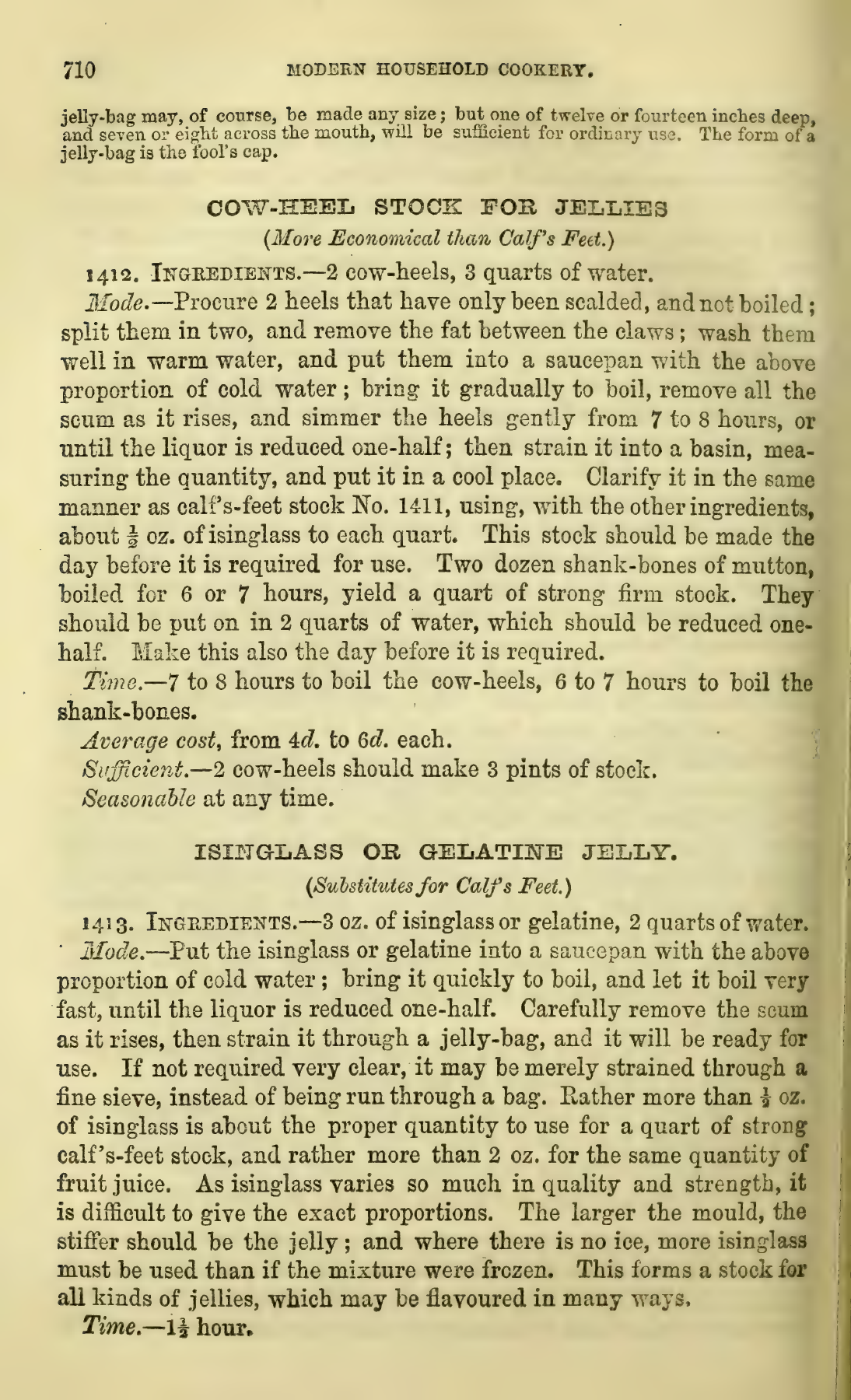
Beeton likewise distinguishes the desired clarity from the ability to set. Her recipe 1413 boils isinglass or gelatin with water, skims it and sends it through a jelly bag. When great clarity isn't required, she allows a fine sieve instead. The choice depends on the result the cook wants to see. Beeton, p. 710.
Isinglass also appears in accounts of clarifying beer and wine, where it serves as a fining agent. That use has its own processing context; it doesn't supply a dessert substitution rule. Food Standards Australia New Zealand, isinglass assessment, 2009.
The same name didn't guarantee the same strength
Beeton's isinglass-or-gelatin jelly carries a warning that deserves to survive any modernization: isinglass varied considerably in quality and strength, making exact proportions difficult to give. She also connects the firmness required with the size of the mold and the availability of ice. Her printed quantity belongs to those conditions, rather than establishing the power of every ounce sold under the name.
The liquid matters, too. On that same page she calls for much less isinglass in strong calf's-foot stock than in fruit juice. The stock already has setting substance from its preparation. Reading only the added isinglass weight would miss what the rest of the mixture contributes.
Beecher supplies a different caution about names. Her simple lemon jelly lists gelatin, then calls it isinglass in the directions. The wine jelly offers “American isinglass or gelatine.” This is evidence of overlapping kitchen vocabulary in that book, rather than proof that every product mentioned was identical fish material.
Read the author's definition and preparation directions alongside the ingredient list. Neither a historical ounce nor a historical sheet establishes a universal conversion to a present-day packet.
A packet changes the handling
Modern unflavored gelatin can perform the setting role, but an adaptation must account for its own strength and instructions. Gelatin manufacturer GELITA identifies both Bloom strength and concentration as factors in firmness, with time and temperature also affecting the gel. An old ingredient name doesn't tell us those specifications. GELITA, “Gelatin Know-How: Gelling Power”.
The method needs attention as well. E. D. Smith's Canadian Knox guidance calls for hydrating its powder in cold liquid before dissolving it, and warns against boiling the gelatin mixture. That differs from Beeton's instruction to boil her jelly stock down by half. Replacing the ingredient while retaining that reduction would combine directions written for different preparations. Knox, working with unflavored gelatin.
Agar is a further change of material. It comes from seaweed, and its dissolving and melting behavior differs from gelatin's. The extended name “Japanese isinglass” is one of agar's recorded synonyms, another reason to read the whole ingredient name. FAO/JECFA, agar specification. FAO's account describes agar dissolving in boiling water and forming a gel as it cools, with a higher melting temperature than gelatin. It needs a recipe developed for agar, rather than an assumed ounce-for-ounce exchange. FAO, A Guide to the Seaweed Industry, “Agar”.
Fish-derived isinglass is an animal ingredient. Its source also matters to anyone avoiding fish: Health Canada includes gelatin among possible food sources of fish and advises obtaining manufacturer information when a product's ingredients are uncertain. Health Canada, fish and food ingredients.
For the historical cook, access to cold was another ingredient in the result. Our account of the icebox follows the work behind that supply. Beeton's concern about ice brings it back to the dessert table: a molded jelly depended on the setting material, the liquid around it and the conditions in which it had to hold its shape.