 Forgotten Kitchen
Preserving Food
How Did People Keep Food Cold Before Refrigerators?
The furnace warming a house could make its vegetable cellar too warm and dry. James H. Beattie's Home Storage of Vegetables, published in August 1917, treats that conflict as a problem of building design. A house needed warmth; the root crops beneath it needed a different environment.
- Cold storage
- Icehouses
- Kitchen work
For households without a refrigerated cabinet, cold storage depended on available spaces, outside weather and, where it could be obtained, stored ice. A larder, a vegetable cellar and an ice repository offered different arrangements. Each required someone to manage it.
A cellar could have competing jobs
Beattie proposes partitioning a storage room from the rest of the basement. Its shape would depend on the cellar, and outside windows would help regulate conditions. His drawings show bins and shelves within the separated space. The cellar's location below the house wasn't enough to make every part suitable for vegetables. Beattie, Home Storage of Vegetables, Farmers' Bulletin 879, August 1917, p. 4.
The furnace example is especially revealing. The same building could have uses that worked against each other: warming the rooms above and keeping stored roots cool below. Partitioning was an attempt to give the stored crop a more suitable part of the building.
Beattie was writing in 1917, when refrigeration already existed. His bulletin addresses vegetable storage available to households and farms; it isn't evidence that all kitchens were waiting for refrigerators to be invented.
An earlier household manual puts a related emphasis on selecting the space. Beeton recommends a dry, shady, well-ventilated larder and describes an airy hanging safe. Shade and air are explicit parts of the arrangement, rather than qualities automatically conferred by a room's name. Beeton, The Book of Household Management, 1861, p. 37, §75.
The room had to be managed
Beattie's cellar requires attention after construction. He prefers movable containers because they can be taken out for cleaning. Raised storage allows air to circulate beneath containers. His ventilation discussion also distinguishes admitting cooler outside air from allowing warmer air into the space. Beattie, 1917, p. 6.
These details bring work back into a picture that can otherwise look static. A cellar photograph shows a building. The accompanying text describes containers to move, openings to manage and conditions that change with the weather.
Distance from the kitchen matters as well. Beattie distinguishes an outdoor cellar serving the table from one chiefly holding roots for livestock. The first needs to be accessible from the kitchen; the second belongs conveniently near the stable. Apples and vegetables can also require separate compartments. Beattie, 1917, p. 7.
Storage was part of a household or farm's working layout. A structure's capacity meant little if its position made the daily movement of food awkward.
Protection from cold, as well as heat
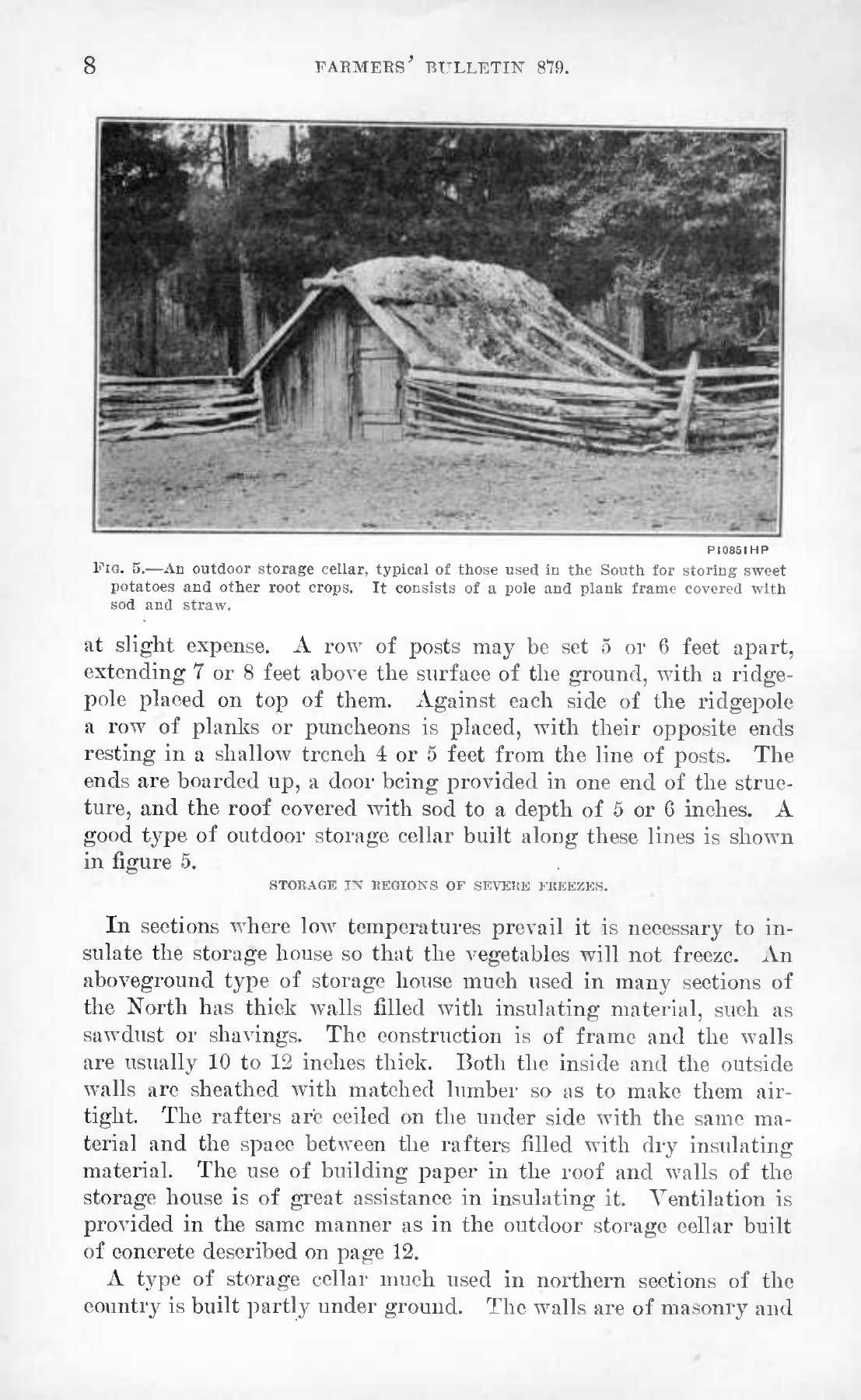
The bulletin describes different structures for different regions. Southern examples could stand above ground beneath protective coverings; northern ones might be built largely below ground or given substantial insulation. In regions of severe freezing, the stored vegetables needed protection from the cold outside. Beattie, 1917, pp. 7–8.
The aim wasn't simply to make a space as cold as possible. A storage room had to suit its contents and climate. The same opening that admitted useful cool air at one time could expose a crop to damaging conditions at another.
These are historical vegetable-storage arrangements, not refrigerator substitutes for today's perishable meals. For food requiring refrigeration, the FDA advises an appliance temperature of 40°F or below, checked with a thermometer. A room that feels cool doesn't establish that condition. FDA refrigerator-thermometer guidance.
Winter ice carried into another season
Ice storage offered a different resource: winter cold could be collected and held for later. George Washington's diary records preparation and filling of two repositories in January 1785, with river conditions affecting the work. A June entry reports that one store's ice had disappeared while the other still held a substantial quantity. Washington's diary, January 7–11 and June 5, 1785, in the 1978 scholarly edition, vol. IV, pp. 74–75 and 148–149.
The entries follow a supply across months. Filling a repository was only the beginning; whether ice remained later was another question. In November, Washington returned to boards, straw and concerns about dampness in the storage arrangements. Washington's diary, November 9–10, 1785, vol. IV, pp. 220–221.
That comparison records the outcome of two stores, without isolating a single reason for their different performance. It also puts materials and recurring work behind the apparent luxury of having ice after winter.
Mount Vernon's account identifies enslaved workers in the estate's ice supply and discusses later reports from 1792. That labor belongs in the history alongside the surviving structures and the owner's diary. Mount Vernon, “Ice, A Most Luxurious Crop”.
Our icebox article follows the work of bringing a block into a household cabinet and dealing with its meltwater.
The crop could change the answer
Near the end of his bulletin, Beattie returns to a surprising location. For small quantities of sweet potatoes, he suggests places including a basement near the furnace, a shelf near the kitchen stove or an attic. His sweet-potato discussion favors warm, dry conditions. Beattie, 1917, p. 21.
The furnace that made the cellar unsuitable for other roots now appears among possible storage locations. This isn't a reversal about whether the house should be warm or cold. It's a change in the crop being considered.
That detail is worth keeping beside any romantic picture of a universal root cellar. Beattie's storage plan starts with the building, but its answer depends on what goes inside.