 Forgotten Kitchen
Ingredients
What Is MSG, and Where Did It Come From?
MSG is monosodium glutamate, the sodium salt of glutamic acid. It's used as a seasoning for umami, the savory taste that Kikunae Ikeda investigated in kombu. Umami names the taste; MSG names a compound; Ajinomoto names a brand. They belong to the same history without meaning the same thing. FDA, “Questions and Answers on Monosodium Glutamate”.
- MSG
- Umami
- Ingredient history
The seaweed was the starting material for Ikeda's investigation. Early manufacture drew on protein, including wheat protein. Later researchers developed microbial production from carbohydrate. Following those materials explains how a study of a familiar food became the basis of a manufactured seasoning.
What Ikeda separated from kombu
In his 1909 paper, Ikeda describes investigating dried kombu to identify the chemical basis of its distinctive taste. He proposed the name umami and identified the acid he recovered as glutamic acid. His conclusions concerned the taste of its salts, including the sodium salt. Ikeda, “New Seasonings,” 1909, pp. 822–828.
Glutamic acid was already known. The National Diet Library's account distinguishes Ikeda's investigation from Ritthausen's earlier work on the acid, published in 1866. Ikeda's contribution here was to connect the taste with glutamates and pursue their use as seasonings. National Diet Library, “The Discovery of Umami”.
Recovering an acid from kombu and making a sodium-salt seasoning were therefore different parts of the work. The first material isolated shouldn't be pictured as a ready-filled jar of commercial MSG.
This also separates MSG from a concentrated broth. Our portable-soup reference describes meat broth reduced to jelly or dried pieces. Ikeda was identifying a particular compound associated with taste, rather than concentrating the entire broth into a smaller package.
“Glutamic taste” in a short English abstract
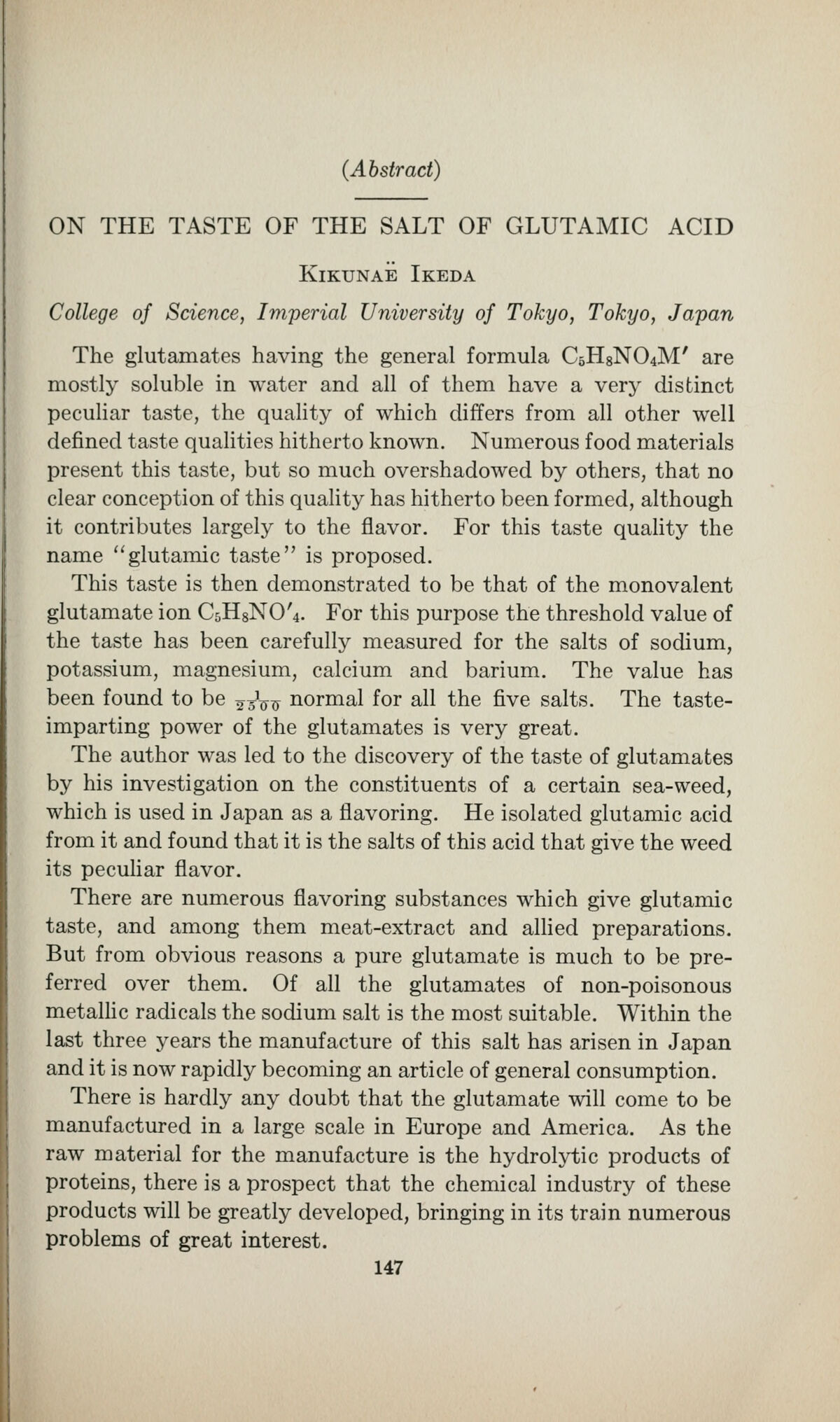
At the 1912 International Congress of Applied Chemistry, Ikeda proposed the English expression “glutamic taste.” His abstract mentions meat extract among preparations with this taste, while arguing for the usefulness of a purified glutamate seasoning. Ikeda, “On the Taste of the Salt of Glutamic Acid,” congress abstract, p. 147.
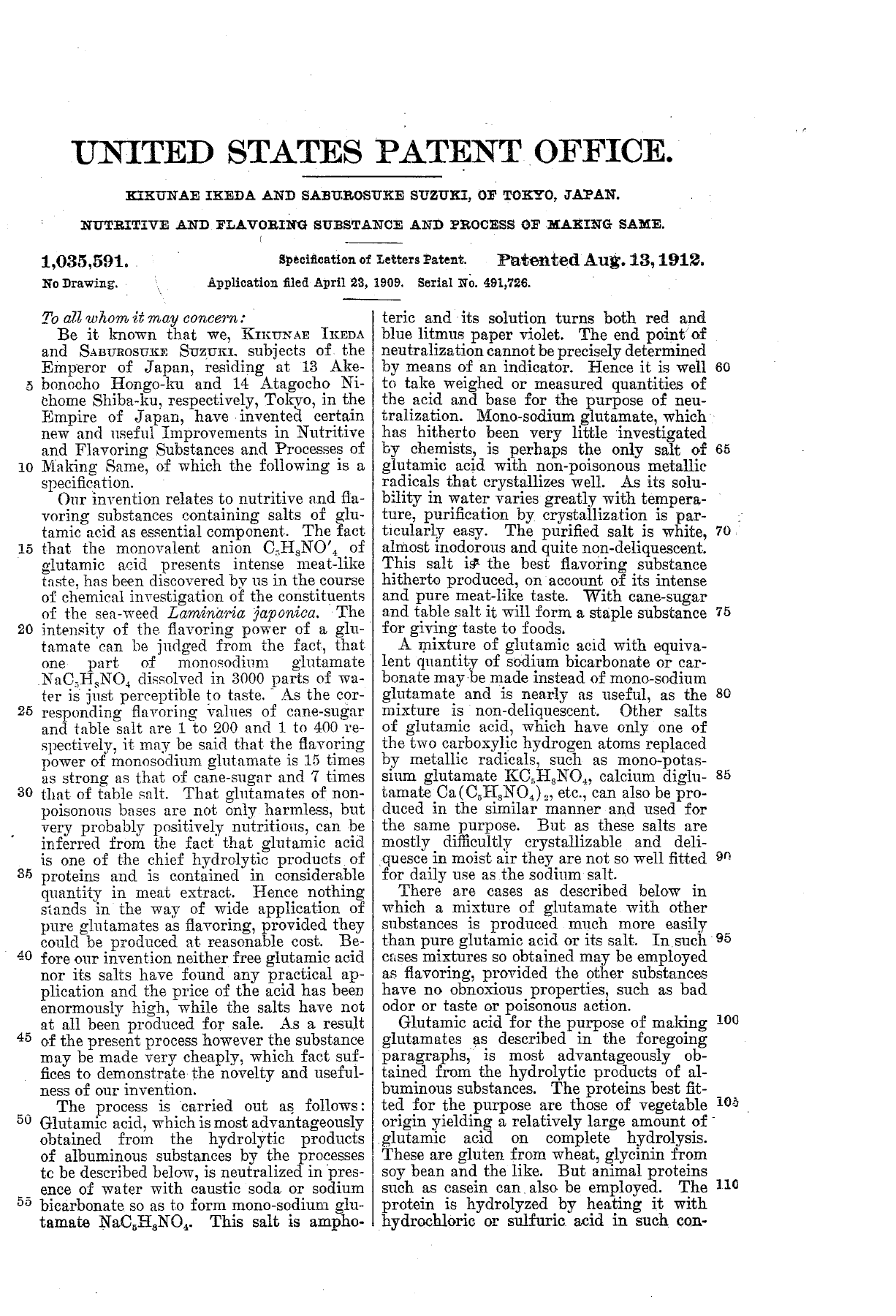
The abstract calls the sodium salt the most suitable. The joint US patent supplies a practical explanation: the inventors describe monosodium glutamate as easy to purify by crystallization. The patent describes many other glutamate salts as harder to crystallize and liable to take up moisture in damp air, making them less suited to daily use. US Patent 1,035,591, p. 1.
At the end of the abstract, Ikeda identifies products of protein hydrolysis as manufacturing raw material. His seaweed investigation and the route toward supplying the seasoning sit together in the same short document.
Protein supplied another route to glutamic acid
The Japanese process patent, applied for in April 1908 and patented that July, describes breaking down protein material with acid and producing glutamate salts through neutralization. Its examples include wheat gluten, milk casein and soybean protein. Japanese patent 14,805, pp. 3–5.
In plain terms, the process obtained glutamic acid from protein and then made a salt suitable for the intended seasoning. That's a different starting point from extracting material from kombu.
A patent specification tells us what the inventors described and claimed. Its examples don't establish which ingredients went into a factory's first batch. The National Diet Library's later history identifies wheat protein and acid in early commercial production, distinguishing that manufacture from the kombu investigation. National Diet Library, commercialization section.
The United States patent provides another documentary view. Filed on April 23, 1909, and patented on August 13, 1912, it names both Kikunae Ikeda and Saburosuke Suzuki. Its opening page discusses glutamate salts and protein materials including wheat gluten, soybean protein and casein. This is the 1912 American document, separate from the Japanese patent of 1908. US Patent 1,035,591, p. 1.
A seasoning on sale in 1909
In 1909, Suzuki was manufacturing and selling the seasoning. Ikeda's paper discusses that work and thanks his assistant, Kurihara Yoshikata. Ikeda, 1909, pp. 835–836. The National Diet Library dates commercialization under the Ajinomoto name to the same year. National Diet Library, commercialization section.
Microorganisms made glutamic acid from carbohydrate
A different production route appears in a 1957 paper by Shukuo Kinoshita, Shigezo Udaka and Masakazu Shimono of the Tokyo Research Laboratory of Kyowa Fermentation Industry Company. Their experiments investigated microorganisms producing L-glutamic acid from carbohydrate and ammonia sources. A new Micrococcus gave the highest glutamate accumulation they reported. Kinoshita, Udaka and Shimono, “Studies on the Amino Acid Fermentation. Part I,” 1957, pp. 193–205.
The chemical task had changed. Protein hydrolysis breaks down an existing protein material to obtain its components. In this research, microorganisms made glutamic acid using the supplied nutrients. Carbohydrate had become a starting material for producing the amino acid.
The authors acknowledged recent reports by Asai while describing their work as independent. Their paper supports a specific account of the Kyowa research, not a claim that one group alone established every part of microbial production.
Nor was publication the same event as universal industrial adoption. Later technical histories distinguish research announcements, purification difficulties, supply arrangements and technology transfer. Producing glutamic acid in a laboratory culture was one achievement; recovering and supplying a commercial product involved further work. Nakamori, technical-history survey, 2008, pp. 12–13 and 29.
The FDA's production overview describes fermentation of carbohydrate raw materials as the method used for MSG manufacture. The 1957 paper helps explain the research behind that route without becoming a date when every manufacturer changed processes. FDA, “How is it made?”.
The 1957 paper's title names L-glutamic acid, while the seasoning is named for its sodium salt. A crop, a microbial culture and a jar of MSG identify different stages of manufacture.