 Forgotten Kitchen
Ingredients
Baking Powder Had More Than One Beginning
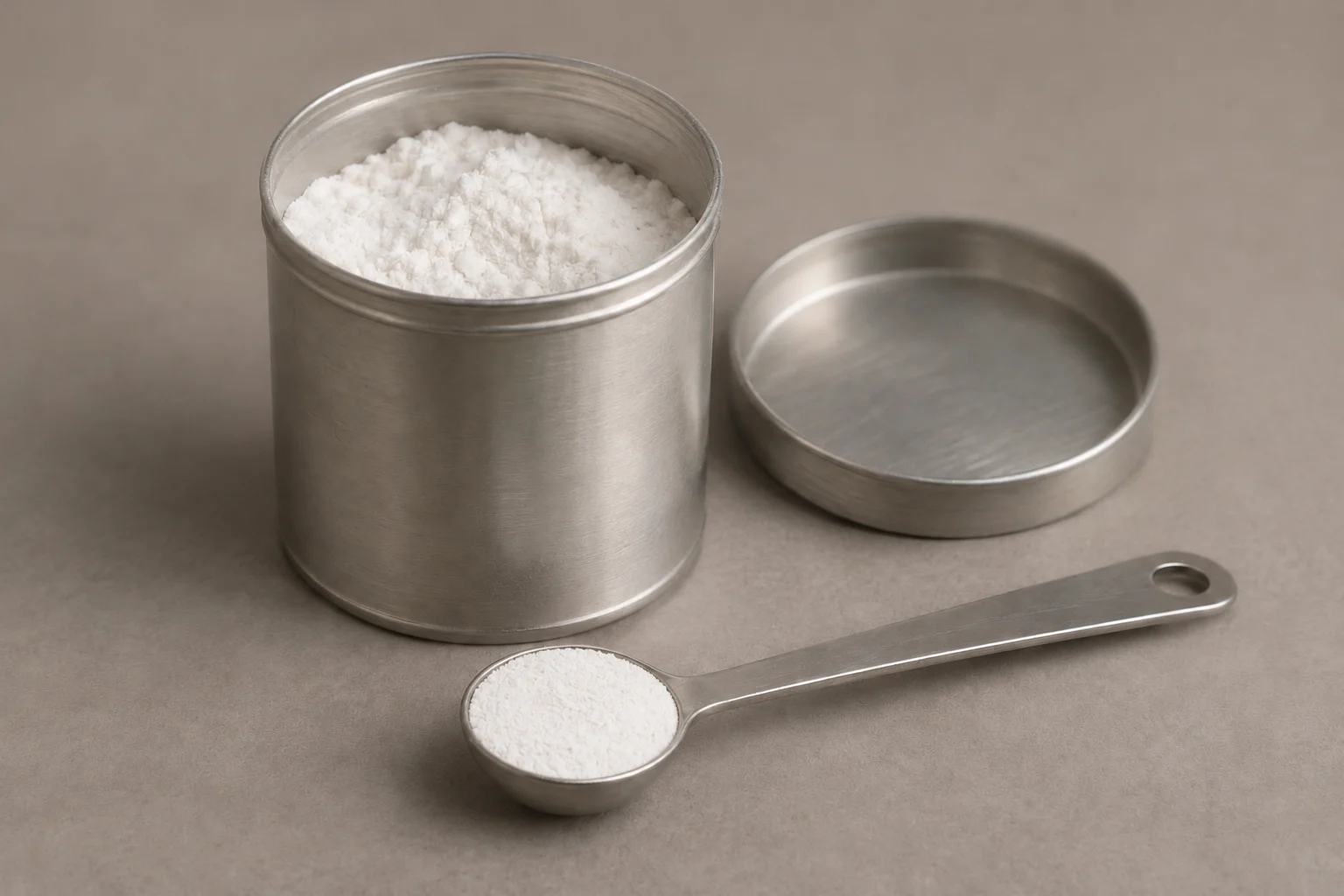
Baking powder supplies both the alkaline leavener and an acid to react with it. Add it to a suitable wet mixture and it releases carbon dioxide, helping dough or batter rise. That convenience hides several choices: which acid to use, how to keep the powder dry, and when the gas should be released. The modern biscuit recipe below uses commercial baking powder.
- Baking powder
- Leaveners
- Biscuits
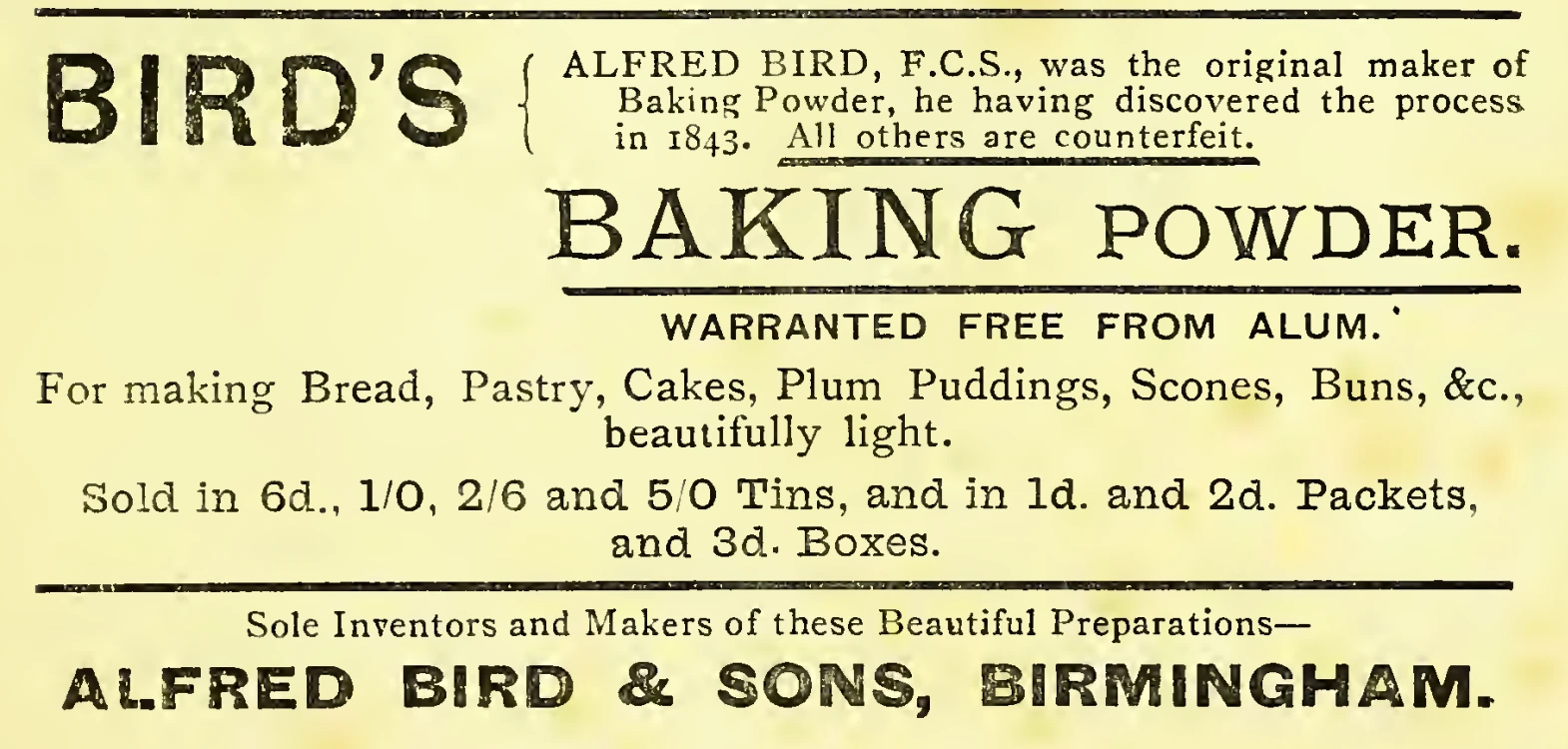
Those choices give its history more than one starting point. A British advertisement credits Alfred Bird with an invention; an American patent describes a way to prepare an acid; a later commercial date marks the manufacture of a prepared product. Following what each one actually offered is more revealing than trying to fit them all into a single birthday.
An acid ready for the mixing bowl
Baking soda is sodium bicarbonate. On its own, it leaves a recipe to supply acid from another ingredient, such as sour milk. Baking powder brings an acid with it, commonly along with a dry material such as starch. In the wet mixture, the acid and bicarbonate react to release gas. The expanding cells must be held by the dough or batter long enough for it to set during baking. NC State's explanation of baking soda and baking powder describes that basic reaction.
Cream of tartar, one of the ingredients found in old household formulas, is an acid salt associated with winemaking deposits. Despite the name, it isn't dairy cream; it isn't identical to tartaric acid either. Pearlash and soda belong on the alkaline side of the story: pearlash is chiefly potassium carbonate, while baking soda is sodium bicarbonate. Our guide to saleratus explains why older alkaline ingredients can be hard to identify from the name alone.
Eben Norton Horsford's American patent of April 22, 1856, concentrated on making a dry phosphoric-acid material to replace other solid acids in baking powder and related preparations. He was working on an ingredient that could be made, kept and mixed with an alkali. The specification's starting material was processed bones, a strikingly different supply from the wine-related material behind cream of tartar. Horsford's US Patent 14,722 sets out the preparation.
Flour and starch appear in the patent as diluents, with cornstarch explicitly allowed. Moisture protection is there too. That matters when reading the later history: starch didn't suddenly enter this account when a commercial powder arrived. It was already part of Horsford's acid preparation in 1856.
The American Chemical Society's history dates Rumford's commercial baking-powder manufacture to 1869, thirteen years later. Preparing an acid and manufacturing a packaged acid-and-soda powder are different stages of the work. Its history also records a move from bones to mined phosphate in the late 1880s. A nineteenth-century feedstock doesn't tell you the dietary status of a present-day tin; that question calls for the current product information and any relevant manufacturer declaration or certification.
A bold claim in a British advertisement
Bird's advertisement in the 1895 Mrs. Wilkinson's Cookery Book looked much further back. It credited Alfred Bird with discovering the process in 1843 and called every rival counterfeit. Baking powder was offered for bread, puddings and more, among advertisements for other Bird preparations, including custard and egg powders.
The language is briskly commercial. The company wanted the reader to recognize its name and trust its product, and the invention claim helped sell that trust. Printed more than fifty years after the date it named, the advertisement gives us the manufacturer's own retrospective account. It doesn't settle a worldwide priority question. The advertisement on PDF page 173 is worth seeing for that emphatic claim alongside the range of foods the powder promised to serve.
Four teaspoons, then a judgment call
By the time Fannie Merritt Farmer published the 1896 Boston Cooking-School Cook Book, baking powder could appear as an ordinary measured ingredient. Her “Baking Powder Biscuit I” calls for four teaspoons, with flour, salt, butter, lard, milk and water. The prepared powder takes care of one part of the mixture. The cook still has to decide how much liquid to add.
Farmer asks for a soft dough and explains that differences in flour make an exact liquid quantity impossible to determine. She has the cook add it gradually, mixing with a knife, then pat and roll the dough lightly. At the oven, another judgment matters: too slow a heat allows the gas to escape before it has done its work. The convenience of a prepared powder sits beside instructions that depend on observing the dough and managing the bake. Farmer, 1896, p. 70.
Home powder-making continued too. Carolyn Putnam Webber's Two Hundred and Seventy-Five War-Time Recipes (1918) combines soda, cornstarch and cream of tartar in a 1:1:2 ratio by volume, with repeated sifting. The household measures and distributes the components that a commercial preparation has already combined. Her formula is a useful historical comparison, not a spoon-for-spoon substitute for any modern tin.
What double-acting means
Double-acting powder releases gas during mixing and again during baking. The name describes that behavior; it doesn't ask for a double measure. It also doesn't necessarily mean the label must list two differently named acids. Rumford's current regular product lists cornstarch, sodium bicarbonate and monocalcium phosphate, a single named acid ingredient, while its maker describes it as double-acting. Rumford's product information gives the ingredients for that product.
Other formulations differ. Dr. Oetker's UK powder lists diphosphates, sodium carbonates and starch. Its instructions include keeping the measuring spoon dry and closing the lid after use. A dry spoon is a small detail, but it addresses the same practical concern found in the older preparations: keeping the powder usable until it reaches the mixture. Dr. Oetker's product instructions.
The biscuits below use commercial baking powder and retain Farmer's instruction to add liquid gradually. Measure the powder with a level measuring spoon, and leave Webber's household formula as a separate historical example. TuneMyRecipe's guide to how old cookbooks filled a spoon explains why the old spoon count and the defined modern measure need to be distinguished.
Butter-and-lard baking-powder biscuits
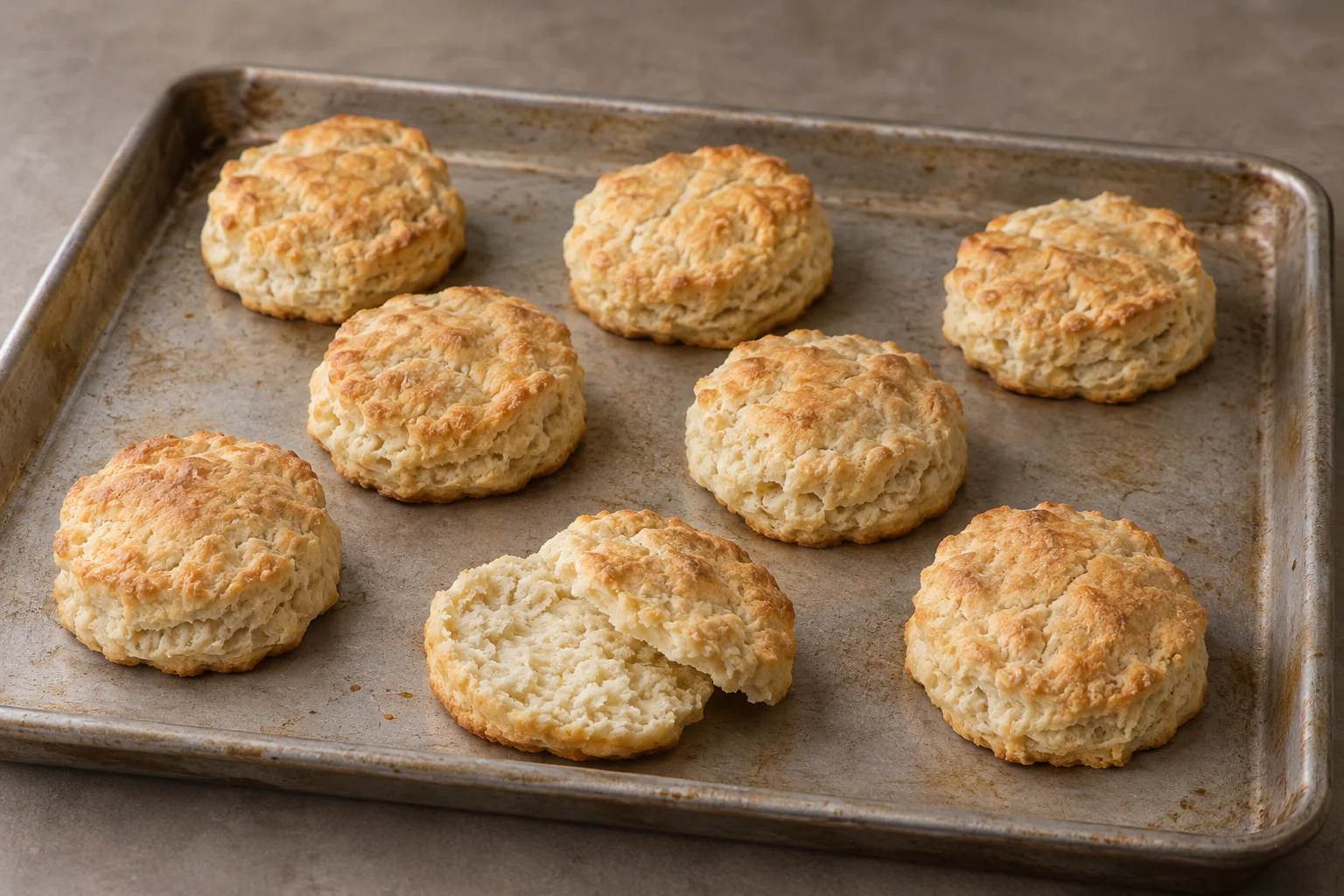
These are American-style quick biscuits, cut from a soft dough. Farmer uses two fats and an equal mixture of milk and water; her advice to judge the liquid survives in this modern adaptation.
Yield and preparation and baking times are estimates for this modern adaptation.
Estimated yield: about 8 biscuits. Estimated preparation: 20 minutes. Estimated baking: 12–15 minutes. Heat: conventional oven at 220°C or 425°F, practical rounded settings.
Ingredients
- 240 g all-purpose flour, also called plain flour, plus a little for the board
- 4 level teaspoons commercial baking powder, using 5 ml measuring teaspoons
- 3 g fine salt
- 15 g cold unsalted butter, plus a little for the baking sheet
- 15 g cold lard
- 90 ml milk mixed with 90 ml water; add up to 180 ml of the mixture gradually
Equipment
A fine sieve, a baking sheet and a round biscuit cutter about 6 cm (2 3/8 inches) across. An ordinary table knife is used to mix the dough.
Method
- Heat the conventional oven to 220°C or 425°F. Lightly butter a baking sheet. Combine the milk and water, keeping the mixture ready to add gradually.
- Sift the flour, baking powder and salt together twice. Rub in the cold butter and lard with your fingertips, leaving small fat fragments.
- Add the milk-and-water mixture a little at a time, cutting and turning the dough with a table knife. Stop when it is soft and cohesive. You may not need all 180 ml.
- Turn onto a lightly floured board. Pat and roll lightly to about 13 mm (1/2 inch) thick. Cut rounds with the biscuit cutter; gather scraps lightly to cut further rounds.
- Place on the baking sheet and bake for an estimated 12–15 minutes. Look for risen, golden biscuits with centers that are baked through, not wet dough; continue baking if needed. Serve warm.
Recipe notes
The flour weight uses a chosen 120 g per historical cup, giving 240 g, and the equal milk-and-water portions use a chosen 240 ml cup, giving 180 ml total. These are modern working measures. The four teaspoons of commercial powder retain Farmer's count, defined here as level 5 ml spoons; the two fats are set at 15 g each, and the salt is deliberately reduced to 3 g. The cold-fat specification, oven setting, cutter size and approximate yield are modern choices.
Yield and times are estimates, and flour absorption governs the final liquid amount. Use commercial baking powder, not baking soda or Webber's homemade mixture. Contains wheat and milk, and lard is pork fat. Don't taste the raw dough; the FDA explains why flour needs cooking.
Farmer's original wording
Fannie Merritt Farmer, The Boston Cooking-School Cook Book, Boston: Little, Brown, 1896, “Baking Powder Biscuit I,” printed p. 70. Ingredient columns are resolved into a line and line breaks are regularized.
2 cups flour. 4 teaspoons baking powder. 1 teaspoon salt. 1 tablespoon butter. 1 tablespoon lard. ¾ cup milk and water in equal parts.
Mix dry ingredients, and sift twice. Work in butter and lard with tips of fingers; add gradually the liquid, mixing with knife to a soft dough. It is impossible to determine the exact amount of liquid, owing to differences in flour. Toss on a floured board, pat, and roll lightly to one-half inch in thickness. Shape with a biscuit-cutter. Place on buttered pan, and bake in hot oven twelve to fifteen minutes. If baked in too slow an oven, the gas will escape before it has done its work.
Sources
- Mrs. Wilkinson's Cookery Book, London: John Davis & Co Ltd, 1895, third-edition preface signed Rose Brown; unnumbered Bird advertisement: the manufacturer's retrospective 1843 claim. Digitized advertisement, PDF page 173.
- Eben Norton Horsford, US Patent 14,722, April 22, 1856, Improvement in Preparing Phosphoric Acid as a Substitute for Other Solid Acids, two leaves: the acid preparation, historical feedstock, flour and starch. Patent and original scan.
- American Chemical Society, Development of Baking Powder: Rumford's commercial development and later phosphate supply. Its patent date differs from the date printed on Horsford's patent; the patent's April 22 header is followed here. Landmark history.
- Fannie Merritt Farmer, The Boston Cooking-School Cook Book, Boston: Little, Brown, 1896, pp. 56 and 70: leavener discussion and the complete Biscuit I recipe above. Digitized book.
- Carolyn Putnam Webber, Two Hundred and Seventy-Five War-Time Recipes, Bedford, Massachusetts, 1918, p. 51: “Home-Made Baking Powder,” a historical comparison.
- NC State, The Difference Between Baking Soda and Baking Powder, for the basic reaction; current manufacturer information from Rumford and Dr. Oetker UK for their respective products and handling instructions.