 Forgotten Kitchen
Preserving Food
Preserved Provisions at Sea: Early Tins and Ready Meals
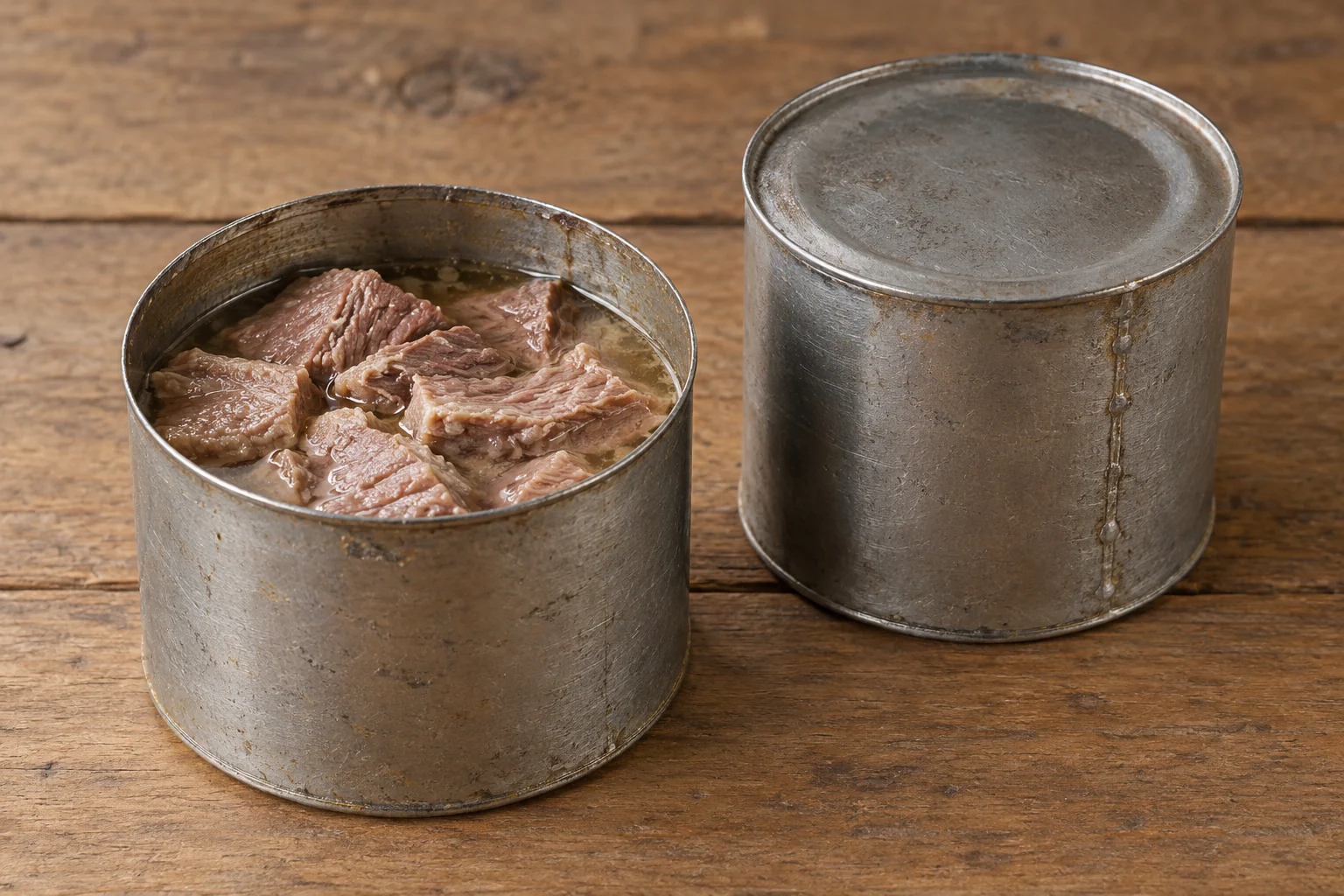
Early preserved provisions could carry cooked meat and broth to sea in tin cylinders, sparing ships some of the work of keeping livestock aboard. The modern hash below uses commercially canned corned beef and follows a later Farmer recipe, rather than recreating these early provisions.
- Preserved provisions
- Canned food
- Hash
Captain Basil Hall's dinner had an unusual advantage: it couldn't get its legs broken. In the endorsement printed in Fredrick Accum's Culinary Chemistry in 1821, preserved meat neither ate nor drank, died nor tumbled overboard. The comparison was with live animals taken to sea. A provision could cost more by the pound yet spare a ship the burdens of keeping its future meals alive.
Hall's list was an argument about readiness. Cooked food could go into a boat quickly and be eaten hot or cold; it also offered an alternative to buying at an expensive port. Preserving had changed when and where work was done. The apparently effortless meal had already required preparation ashore. Accum, 1821, pp. 213–215.
What traveled instead of livestock?
Hall reported having £88 worth of preserved provisions during a voyage to China without one failure. He praised preserved milk too, distinguishing earlier corked bottles from tin cases he had subsequently tried. Accum gives no full contents list or container count for Hall's provisions.
Accum's preceding description gives the provision a physical form. He credited Appert's process and the London work of Donkin and Gamble. Meat was freed from bone, cooked beyond simple parboiling, and packed with broth in a tin cylinder. Further heating, soldering, cooling, and a proving period followed. The product described here contained meat and liquid; it wasn't the firm corned-beef loaf familiar from a modern grocery can. Accum, pp. 210–212.
The sequence also complicates a simple comparison with butcher's meat. Boning and cooking had already happened before purchase. Accum argued that cooked boneless provisions represented twice their weight of raw meat, allowing for bone and cooking losses. But he supplied no weighing trial reconciling cuts, cooking losses, and the broth. His equivalence was a commercial argument, not a measured yield we can use to prove a cheap meal.
This industrial preparation differs from pounding cooked meat into a household pot under fat or treating it with salt. The tin was part of a supply system: food prepared ahead, packed for transport, and sold with assurances about keeping. Hall's enthusiasm belongs to that supply system.
A month in the test chamber
Accum's manufacturing account included at least a month in a warm test chamber at 90–110°F. Cooling was said to draw the cylinder's ends inward; failure during proving could make them bulge outward. That waiting period belongs beside the quicker meal at sea. Readiness for the customer had a preparation time of its own.
These details describe historical manufacture. They aren't a usable home-canning process: Accum didn't supply food-specific validated heating times or a measured center temperature. His assurance that provisions surviving the test would keep in any climate for any length of time went far beyond the finite observations he printed. A flat lid alone doesn't establish that preserved meat is safe.
A modern commercially canned product arrives with its own processing and handling requirements. Once opened, it becomes perishable. Food Standards Australia New Zealand explains both commercial processing and care after opening. Opening the can ends one stage of protection; it doesn't remove the need to handle the meal properly.
The advertisement kept the spoiled soup
An advertisement at the back of Godwin's Emigrant's Guide to Van Diemen's Land (1823) made the promise of provisions available to prospective voyagers. It printed a Hall letter dated November 5, 1819, from H.M. Sloop Lyra. He praised meat, soups, and milk carried to China and the East Indies. This is another printing of the same observer's testimony, without the £88 figure. Advertisement, p. 3, PDF leaf 108.
Immediately below came Captain William Edward Parry's December 9, 1820 report. He praised the meat canisters but excepted four or five bottles of vegetable soup and two or three of concentrated gravy soup as unfit for use. Surgeon John Edwards also reported some fermented vegetable-soup bottles, probably, he thought, through imperfect corking. Their accounts may overlap; adding them would manufacture a larger tally.
A manufacturer footnote claimed that putting soup in tin canisters now prevented the trouble. The advertisement supplies no later trial of that remedy. It preserved the failures while presenting them as a packaging problem that could be solved. Successful meat canisters and spoiled soup bottles remained different reported outcomes.
Even the prices resist a tidy savings story. The list dated August 1, 1822 put fresh boiled beef at 1s. 3d. per pound. A later paragraph in the same advertisement used 1s. 6d. Its cooked-to-raw comparison depended on the asserted doubling of useful weight. Neither the conflicting price nor that assumption can establish what Hall saved.
From prepared meat to hash
Nearly a century later, Fannie Merritt Farmer's revised Boston Cooking-School Cook Book offered another useful view of readiness. Its 1918 corned-beef hash started with cooked meat, then required chopping, potatoes, moistening, browning, and serving. Farmer didn't specify canned beef. The fresh-serving version below chooses it deliberately, to make visible the work still left between opening a prepared ingredient and putting dinner on a plate.
Canned-corned-beef hash. Modern adaptation. Suggested yield: two small servings. This is a later cookbook companion, not Hall's meal or a home-preservation recipe.
Ingredients
- 200 g commercially canned, ready-to-eat corned beef from a sound, newly opened can
- 200 g freshly boiled or properly refrigerated cooked potato, diced
- 10 g butter
- 30–50 ml pasteurized milk
- Pepper to taste
- A parsley sprig
- Salt only if needed after tasting the fully heated dish
Use a product labeled ready to eat and follow its handling instructions. Before opening, check the can for swelling, leakage, damaged seams, rust, or dents; don't use or taste food from a damaged container. FSANZ's canned-food guidance explains these checks.
Equipment
Use a frying pan wide enough to spread the mixture in a shallow, even layer, a spatula and a food thermometer.
Method
- Break the corned beef into small pieces and mix with the potato.
- Melt the butter in a frying pan over moderate heat. Add the mixture and 30 ml milk; stir until hot throughout, adding the remaining milk only if needed.
- Spread in a shallow, even layer and cook until the underside browns. Turn in portions if a single fold is impractical. Check with a food thermometer that the reheated mixture reaches 165°F/74°C throughout before serving; continue heating as needed. FoodSafety.gov gives this endpoint for reheated leftovers.
- Taste the fully heated hash and add pepper and salt only as needed. Serve immediately with the parsley.
Commercial canned beef is a modern choice, not a container Farmer named. The 200 g batch amounts, equal-weight interpretation, milk and butter quantities, and reheating endpoint are supplied assumptions. A modern pan replaces the range's different heat zones. No reliable clock estimate is established for this pan method; use the heating, browning and thermometer cues instead.
Transfer unused opened beef to a clean covered container and refrigerate according to its label. Refrigerate cooked leftovers promptly in shallow containers within two hours, or one hour above 90°F/32°C; keep the refrigerator at 40°F/4°C or below. FoodSafety.gov's cooling guidance applies. This method makes a fresh meal; it doesn't reseal meat or give it shelf life.
Farmer's original, kept separate
The Boston Cooking-School Cook Book, revised edition, Boston: Little, Brown, and Company, 1918, p. 213, PDF leaf 285. The recipe supplies a ratio but no absolute batch, measured butter or milk, or stated mass basis. A public 1918 revised-edition copy is available through Internet Archive.
Corned Beef Hash
Remove skin and gristle from cooked corned beef, then chop the meat. When meat is very fat, discard most of the fat. To chopped meat add an equal quantity of cold boiled chopped potatoes. Season with salt and pepper, put into a hot buttered frying-pan, moisten with milk or cream, stir until well mixed, spread evenly, then place on a part of the range where it may slowly brown underneath. Turn, and fold on a hot platter. Garnish with sprig of parsley in the middle.