 Forgotten Kitchen
Ingredients
Soy without Soy: A Sauce Name in Old European Cookbooks
“Soja” in one Amsterdam cookbook of 1769 was a beef-and-beer extract, with salt and cloves but no soybeans. It borrowed the name of an imported condiment for a different kitchen preparation.
- Soy sauce
- Seasonings
- Extraction
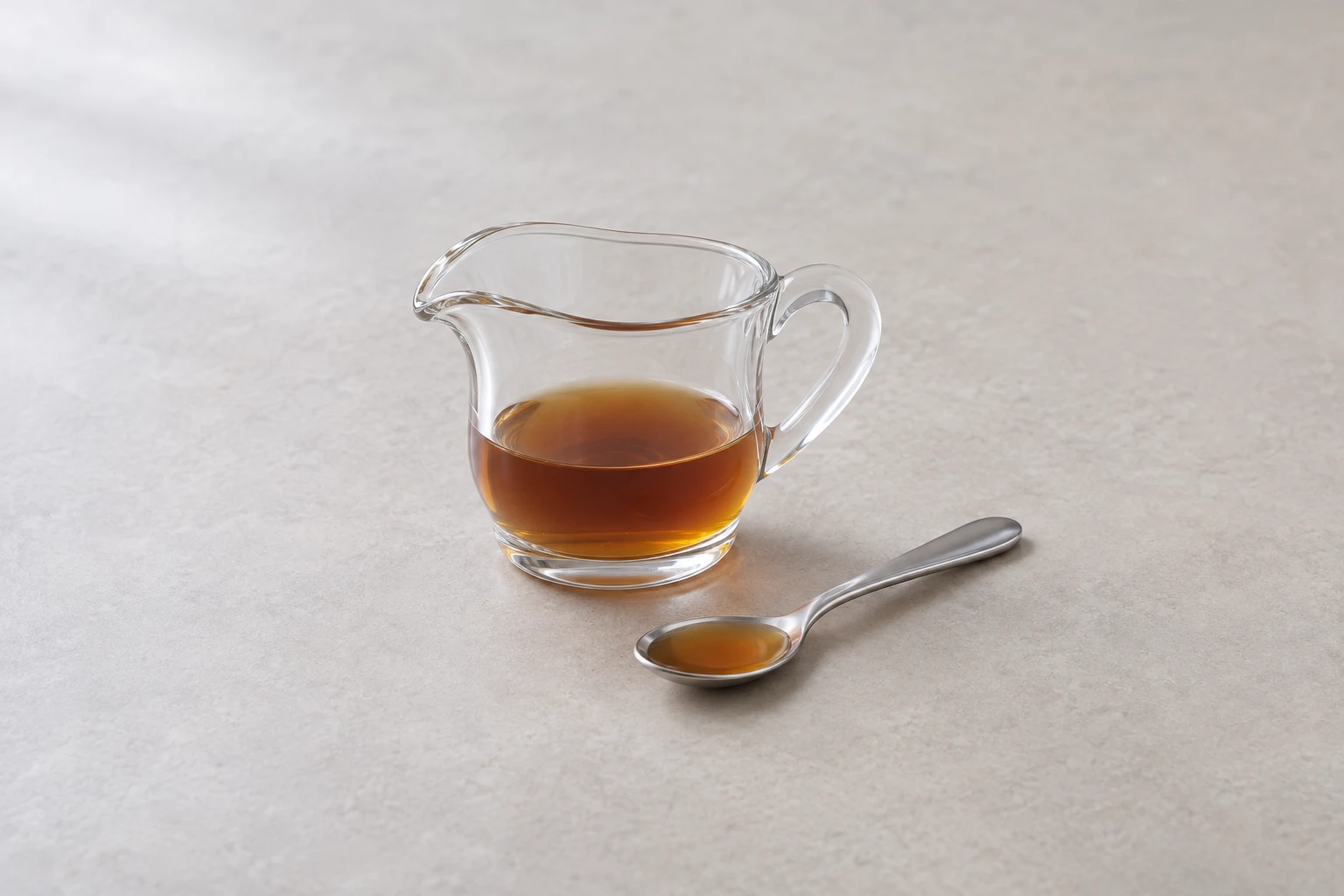
The recipe's destination was a bottle of recovered liquid. Reading the steps, rather than stopping at the surprising ingredient list, shows what its cook was actually asked to make.
From a piece of beef to a liquid seasoning
Recipe 146 in Volmaakte grond-beginzelen der keuken-kunde, published in Amsterdam by Steven van Esveldt, begins with thick beef loin and all its fat. Salt, ground cloves and a good quantity of Brunswick mum accompany it. The cook supplies little heat below and much above, waits for the juices to be extracted and presses the meat.
The next operations change the product again. After cooling, the fat is lifted off. The liquid is wrung through cloth and put into bottles. That makes defatting a later step, rather than permission to trim every bit of fat away before cooking. The object being kept is the strained liquid, not the roast itself. Anonymous, 1769, recipe 146, printed p. 67, scan leaf 89.
No meat weight, beer volume, cooking time or reduction target appears. “A good quantity” of beer cannot become a reliable ratio without an editorial decision. Nor can the endpoint be turned into a specified sauce yield. The modern beef recipe below therefore identifies its quantities and oven arrangement as choices.
Mum was a named beer, not an instruction to add generic brown coloring. The City of Braunschweig's historical account describes Mumme as rich in malt. A modern dark malt beer can provide a declared ingredient for an adaptation, but it cannot establish the composition of the beer used by a particular eighteenth-century cook. City of Braunschweig, “Hansestadt”.
“Better” was the recipe's claim
The Dutch instruction ends by calling the preparation better than Indian soy. It does not explain the criterion. Strong flavor, familiarity, appearance and ease of obtaining ingredients would be different judgments, and the text does not choose among them. The claim belongs to the cookbook rather than to a surviving taste comparison.
The book's title offers broad kitchen competence through cooking, roasting, stewing, baking, salting and preserving. This sauce sits inside that instructional promise. Its unnamed author is identified through an association with the Hollandsche Keuken-Meid, not by a personal name that can safely be supplied today.
An imported benchmark could therefore be recognizable while its manufacturing process was replaced with a different sequence. Nothing in recipe 146 instructs fermentation of soybeans. Equally, its use of an imported name does not tell us whether the author understood Asian production, repeated a familiar formula or sought a particular effect in finished dishes.
Imported sauce had a commercial route
A VOC report dated January 31, 1739, names Japanese soy in return cargo. In J. van Goor's modern source edition, the transcription gives an allocation of four containers to Delft and Rotterdam. A separate italic editorial cargo summary lists 36 containers of Japanese soy. These are distinct parts of the page, not two transactions to add together. Generale missiven, volume X, printed pp. 252–254, especially p. 253.
The report makes a claim that soy was wholly unavailable in the Netherlands untenable on this evidence. It does not establish arrival, retail distribution or access in a specific kitchen thirty years later. A cargo container also supplies no defensible number of household servings without knowing its capacity and contents.
This trade record and the cookbook answer different questions. One concerns consignments; the other offers an operation and a claim of superiority. A connection to an identifiable buyer or cook would need another kind of record. The curious beef formula is already recognized in Anne Gerritsen's scholarship on Dutch soy-sauce history; its soybean-free ingredients are not a new discovery. Gerritsen, Aziatische Kunst 45(3), 2015, pp. 24–33.
A mushroom comparison from the same year
Elizabeth Raffald's The Experienced English Housekeeper, also published in 1769, offers another way to bottle a savory extracted liquid. Her mushroom catchup begins with full-grown caps crushed by hand and salted overnight. They spend twelve hours in a “quick” oven, then pass through a hair sieve.
Raffald measures the next additions against the strained liquor: four spices and more salt. She then gives a clear reduction endpoint, boiling until half the liquor is lost. That endpoint is absent from the Dutch beef recipe. Her mushroom catchup is a contemporary English comparison, not evidence that the Dutch recipe came from it or tasted like it. Raffald, printed p. 318, scan leaf 330.
The two preparations share a practical destination while preserving distinct ingredients, extraction and concentration. Today's versions are fresh cooked seasonings. Neither is a method for producing commercial fermented soy sauce or a shelf-stable bottle. In a modern kitchen, refrigeration replaces the historical assumption that cooling and bottling complete the job.
Fresh beef-and-beer extract
Modern adaptation of the Dutch recipe. Makes a small batch of seasoning; recovered liquid varies and should be measured. Estimated preparation: 15 minutes; cooking: about 90 minutes plus chilling. Equipment: snug 1.5-liter covered ovenproof casserole, food thermometer, sieve, clean fine cloth and shallow containers.
Ingredients
- 500 g beef sirloin in one thick piece with its attached fat
- 200 ml commercial dark malt beer
- 3 g fine salt
- 0.15 g ground cloves, weighed on a suitable fine scale
Method
- Heat the oven to 320°F/160°C. Put all ingredients in the casserole and cover. Cook for about 90 minutes, checking after 45 minutes and periodically thereafter that liquid remains. If the pan approaches dryness, stop cooking rather than scorch the extract.
- Check that the beef reaches at least 145°F/63°C at its center and allow a three-minute rest. Press it gently in the sieve over the cooking liquid. Reserve the cooked meat separately for another use.
- Transfer the liquid to a shallow container and refrigerate promptly. Once chilled and the fat has set, lift off the fat. Strain through the clean cloth and measure the liquid recovered.
- Use small spoonfuls to season a cooked dish. Refrigerate at 40°F/4°C or below and use within three days, or freeze. Bring refrigerated extract to a rolling boil when reheating.
All quantities and the covered-oven method are modern choices. The meat and removed fat are excluded from the liquid yield.
Fresh mushroom seasoning
Modern adaptation of Raffald's catchup. Makes a variable small batch. Estimated hands-on time: 25 minutes; refrigerate 12 hours, cook about 45 minutes, then allow roughly 10–30 minutes for reduction. Equipment: covered 1.5-liter casserole, sieve, measuring jug, small saucepan and fine scale.
Ingredients
- 500 g cultivated large flat-cap mushrooms, cleaned and gritty stem ends removed
- 10 g fine salt for extraction
- For each 250 ml strained mushroom liquid: 0.5 g each ground cloves, ground allspice, ground black pepper and ground ginger, plus 3 g additional fine salt
Method
- Chop or crush the mushrooms and mix with the 10 g salt. Cover and refrigerate at 40°F/4°C or below for 12 hours.
- Heat the oven to 320°F/160°C. Put the mushrooms and all their juice in the covered casserole. Cook about 45 minutes, until fully cooked and releasing liquid. Stop if drying occurs; do not add water to manufacture an expected yield.
- Press through the sieve and measure the strained liquid. For 200 ml, for example, add 0.4 g of each spice and 2.4 g additional salt. Discard the pressed mushroom solids.
- Simmer the seasoned liquid gently toward half its measured starting volume, stirring and checking frequently as it concentrates. Use the jug to check the volume; actual recovery will also reflect handling loss.
- Transfer to a clean shallow container and refrigerate promptly. Use within three days at 40°F/4°C or below, or freeze. Bring refrigerated seasoning to a boil when reheating.
The quantities, lighter spice proportions, refrigerated extraction and shorter oven cooking are modern choices. Only the half-volume reduction follows a specified historical target. Initial salt retained in the strained liquid is unknown. For both recipes, refrigerate within two hours, or one hour above 90°F/32°C, following FDA safe-handling guidance.
Related distinctions
Read about MSG's separate history, the concentrated ingredient called portable soup, and the historical keeping methods potting and salting.