 Forgotten Kitchen
Equipment
Raffald's Pickled Beans: Brine, Brass and the Pan's Surface
Elizabeth Raffald named a brass pan when she wanted young beans to turn green. In her 1769 recipe, the beans are heated in their earlier brine, then drained before a separately prepared spiced vinegar is applied. The vinegar comes after the brass stage. The modern companion below is a same-day chilled dish of fully cooked bean pods, without metal greening or preservation.
- Pickling
- Kitchen equipment
- Food preservation
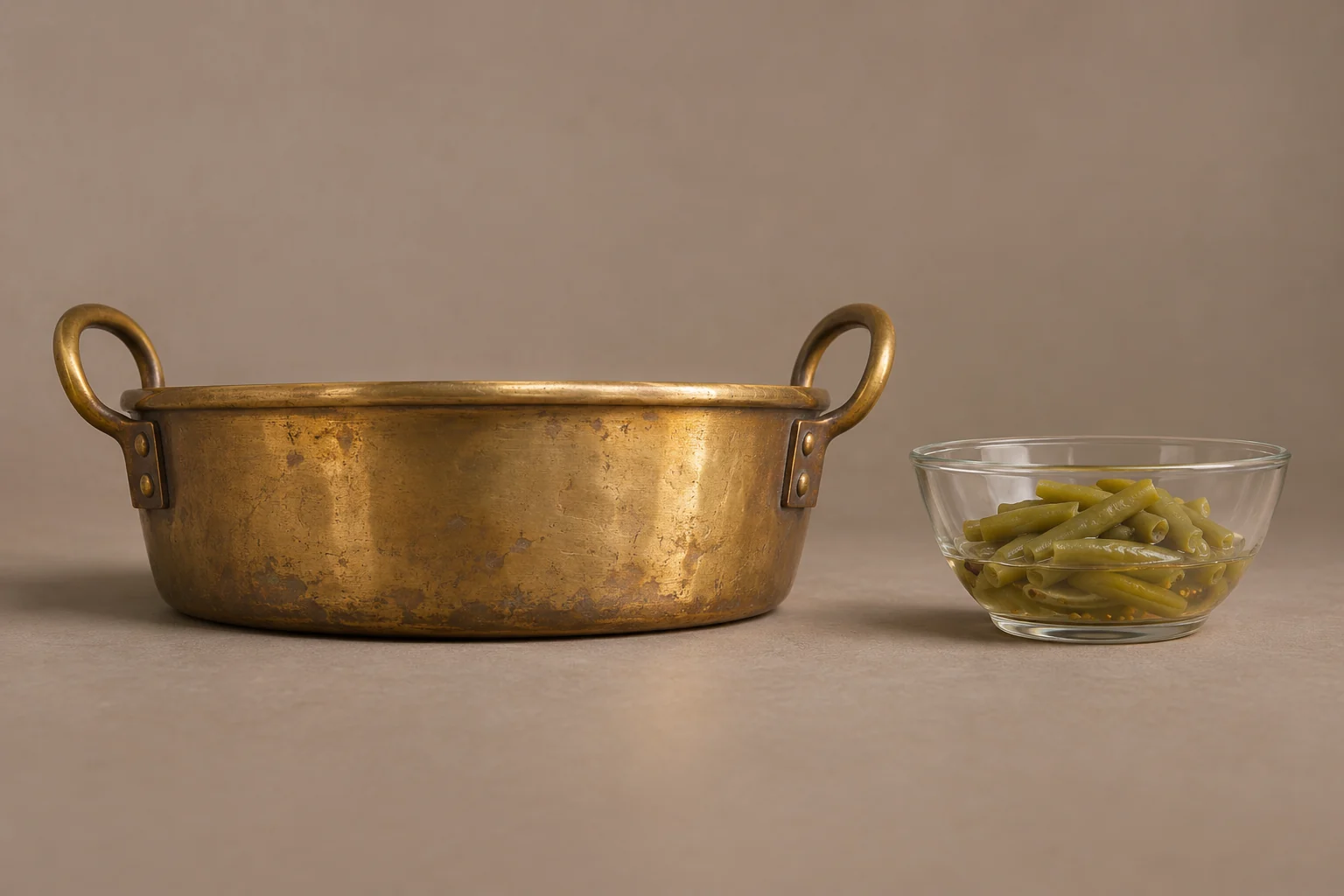
Her general pickling directions warn against brass or copper that isn't well tinned. The bean recipe leaves its pan's lining unstated. Following the two liquids through the recipe tells us what happened in the named pan, while the missing surface detail sets a limit on what we can know about contact with its metal. The Experienced English House-keeper, pp. 321 and 325–326.
The pan's name isn't its whole surface
Raffald's “Observations on Pickling” objects to making food please the eye through pernicious means. She connects brass pans with the wish for green pickles, says brass and verdigris can be avoided and cautions against brass or copper “that is not well tinned.” The qualification matters as much as the warning.
A tinned vessel has a tin contact surface over the underlying metal; brass is a copper alloy. Raffald's general warning may have been intended to govern the brass directions that followed, but the bean recipe neither names its lining nor records its condition.
Follow the liquid through the beans
The title “To pickle Kidney Beans” needs care too. Raffald asks for young, small beans to be greened, read here as immature pods rather than dried red kidney beans. No particular cultivar is established.
Her direction begins with three days in strong salt water, with stirring two or three times each day. The brass pan enters next, with vine leaves beneath and above the beans. The crucial phrase is “pour on the same Water as they came out off.” Covered, slow heating pursues the green color; draining ends that stage.
The pickle liquid that follows may use white-wine vinegar or fine ale allegar. Mace, Jamaica pepper, long pepper and sliced ginger season it. Raffald tells the cook to boil this liquid and pour it hot onto the beans, then close them with a bladder. She does not name the vessel used to boil the vinegar. These are historical directions to examine, not a modern keeping method. Complete recipe, pp. 325–326/PDF 337–338.
The recipe supplies no bean weight, measured brine strength or duration for the greening heat.
The container belonged to the operation
Nearby recipes make the equipment choices more visible. Sliced cucumbers and shallots go into a stone jar after salting and draining; hot spiced ale vinegar is applied repeatedly, with cooling between. Codlins, by contrast, enter brass during greening. One chapter names different vessels for different operations, though the vinegar's heating vessel remains unnamed. These are historical keeping procedures, not modern storage instructions. Sliced cucumbers, p. 323; codlins, p. 325.
For a modern meal, there is no reason to reproduce the unresolved contact. The FDA's model Food Code restricts copper and copper-alloy contact with foods below pH 6, explicitly including vinegar, with a specified brewing exception. It addresses retail and food service and is offered for jurisdictional adoption. It does not diagnose a historical household or measure what entered Raffald's beans. The serving recipe below keeps the spiced-vinegar comparison in a food-safe bowl and leaves metal greening behind. FDA, §4-101.14, printed p. 92/PDF 120.
Modern companion: cooked green-bean pods with spiced vinegar
Modern fresh-serving analogue. Suggested yield: 4 small side portions. Use commercially canned plain green-bean pods that are already fully cooked. This is a chilled dish for the same day, not a storage pickle, canning recipe or method for raw or dried beans.
Ingredients and equipment
- 300 g drained, commercially canned, already fully cooked plain green-bean pods, weighed after draining
- 150 ml commercial white-wine vinegar labeled 5% acidity
- 50 ml drinking water
- 3 g salt
- 3 g peeled fresh ginger, finely grated
- 0.1 g ground mace
- 0.2 g ground allspice (Jamaica pepper)
- 0.2 g ground black pepper
- A clean food-safe glass or stainless-steel bowl, cover and refrigerator
- A precision scale capable of accurately weighing the 0.1–0.2 g spice quantities
Method
- Drain the fully cooked canned green beans and weigh 300 g.
- Stir the vinegar, water, salt, ginger and measured ground spices together in the bowl. Gently fold in the beans.
- Cover and refrigerate at 4°C or colder for 30 minutes.
- At service, gently turn the beans through the dressing, then lift them out with a slotted spoon, letting excess dressing drain back into the bowl. Divide into four small side portions and discard the remaining dressing. Keep chilled until service and serve the same day. Limit total time outside refrigeration to two hours, or one hour above 32°C ambient temperature, following FDA chilling guidance.
Changed purpose and assumptions: The cooked pods, bean weight and every liquid and spice amount are supplied choices. They do not convert an original with no batch size. Ground allspice and mace replace unquantified historical spices; black pepper replaces long pepper, without claiming identical flavor. The ginger amount does not translate a historical “race” into grams. The three-day brine, vine leaves, brass contact, greening, hot vinegar application and storage closure are omitted. Commercial vinegar with stated acidity replaces unassayed vinegar or allegar; refrigeration and same-day service replace the keeping purpose.
The vinegar-and-water input is 200 ml, before liquid retained by the beans; excess dressing is drained at service. This same-day dish has no established storage life and is not a preservation method.
Source note
Fredrick Accum's 1820 Treatise on Adulterations of Food, and Culinary Poisons attributed halfpence or a twenty-four-hour stay in copper or brass to Raffald, citing pages 352 and 354 without an edition. The specified pages checked in four printings, 1769, 1771, 1782 and 1795, do not authenticate his exact wording. The later two contain related brass advice for elder buds; another edition, a faulty reference or a mistaken attribution remain possible. This is a bounded comparison, not a search of every printing. Accum, Philadelphia edition, pp. 217–219.
Elizabeth Raffald, The Experienced English House-keeper (Manchester: J. Harrop for the author, 1769), pp. 321, 323 and 325–326/PDF 333, 335 and 337–338. Digitized edition. Quotations normalize long s to s and join source line breaks. The 1771 second and 1782 eighth editions supply the limited page comparison described above; the 1795 new edition is a fourth witness and advertises additions by other authors. The 1795 printing retains the warning and bean sequence, on pp. 342 and 346/PDF 356 and 360; the compared pages 352 and 354 are PDF 366 and 368. None of these passages establishes a particular poisoning or the condition of a particular pan.