 Forgotten Kitchen
Equipment
Why Were Copper Pans Lined with Tin?
A preserving ladle could wear the tin from a pan. Maria Eliza Rundell names that ordinary kitchen action in her 1819 manual: scraping with the sweetmeat ladle gradually removes the lining.
- Copper pans
- Tin linings
- Kitchen equipment
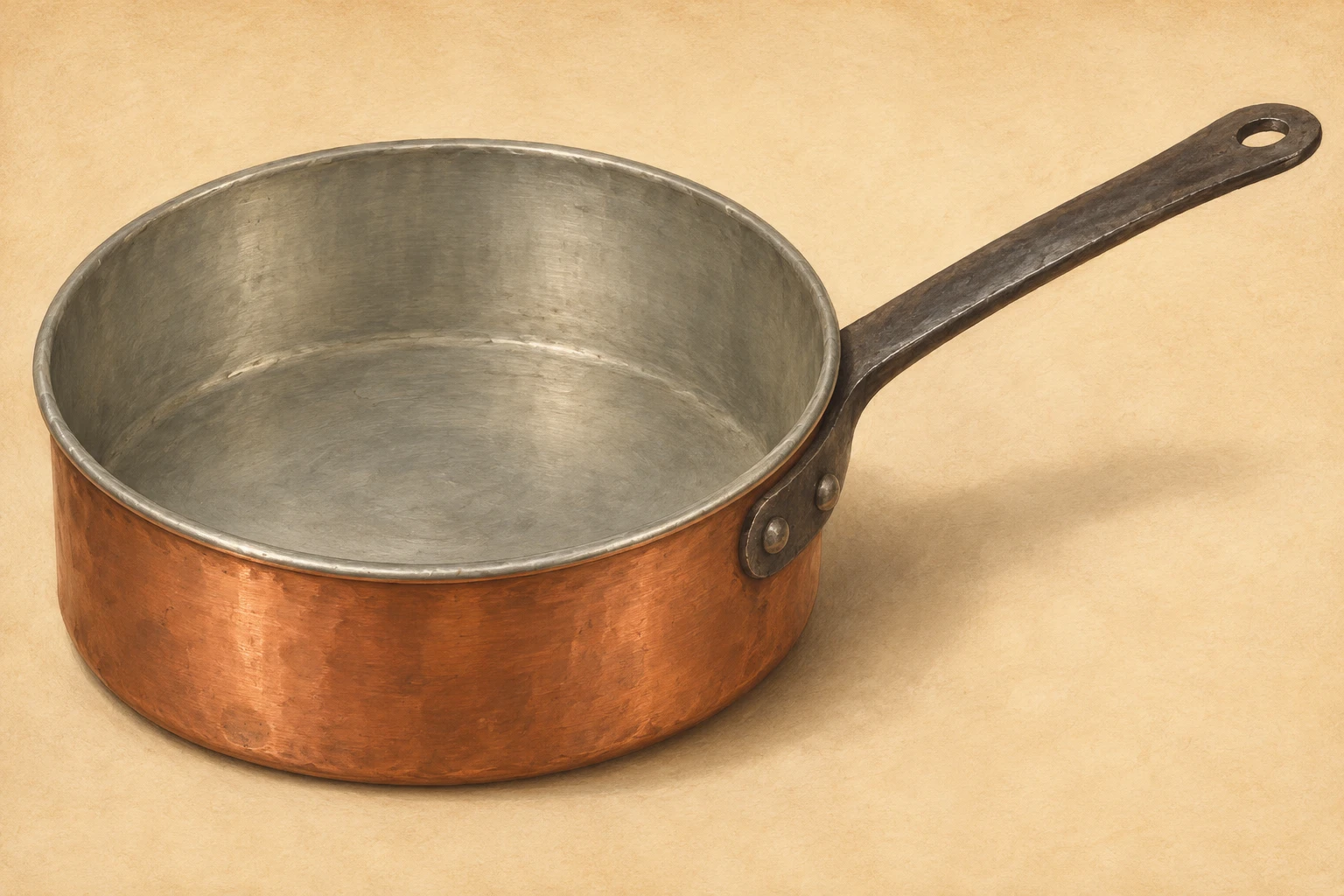
Tin put an inner surface between the food and the copper body. Warnings about worn linings show why maintaining that separation mattered to the writers discussed here. They also distinguished cooking in a vessel from leaving food standing in it. Particular recipes specified untinned copper, so the history needs more detail than a rule that every copper pan was always lined. Rundell, A New System of Domestic Cookery, 1819, p. 225.
A copper body with a tin interior
Beeton's 1861 household manual defines tinning as covering another metal with a thin coating of tin. She distinguishes tinned sheet iron from vessels of copper or iron tinned on the inside. The coating doesn't make the whole vessel solid tin. Beeton, The Book of Household Management, 1861, p. 30, §71.
Beeton also discusses the material used for that coating. She calls for pure grain tin and condemns the addition of lead. The existence of a lining wasn't her only concern; what went into it mattered too. Beeton, 1861, p. 31.
The ladle enters the maintenance story
Rundell's general household advice also warns against rubbing the tin off and calls for renewal when defects appear. Rundell, 1819, p. xl. Beeton later gives related advice about renewing worn tinning. Beeton, 1861, p. 32, §72.
A recipe might name a copper pan while relying on these general care directions. Neither the equipment list nor the advice establishes the condition of a particular pan's lining.
Cooking and leaving food in the pan
Beeton separates another pair of operations: cooking and holding. Her directions say that soup or gravy shouldn't remain unnecessarily in the vessel and name separate holding containers. Beeton, 1861, p. 32.
Eliza Acton describes acidic fruit cooling in a pan with areas of its lining gone. Her account brings the food, worn surface and cooling period together without measuring how much copper entered the batch. Acton, Modern Cookery, in All Its Branches, 1845, pp. 191–192.
The brass-pan reference follows the brine and vinegar stages of Raffald's beans, whose pan lining is unstated.
Acton didn't choose on metal alone
Acton considers thick, well-tinned iron adequate for ordinary cookery, while recognizing the convenient forms of copper vessels for more elaborate work. She isn't simply ranking all copper above all iron. Acton, 1845, p. 192.
Her preserving-pan discussion adds handling to the comparison. She criticizes handles that become hot and favors enameled vessels for acidic preparations. The shape of the equipment and the way the cook has to hold it enter the judgment alongside its material. Acton, 1845, p. 554.
An explicitly untinned skillet
Rundell also prints “A Carmel Cover for Sweetmeats,” specifying a copper untinned skillet for sugar, water and a few drops of lemon juice. The absence of tin is explicit in this particular instruction. Rundell, 1819, p. 195.
The caramel direction isn't a modern exemption allowing any acidic mixture in bare copper, and it doesn't establish a threshold for safe contact. The few drops of lemon juice are part of the historical recipe, not evidence for a general material rule.