 Forgotten Kitchen
Equipment
Why an Old Dutch Oven May Not Be Your Pot
The dish comes off when the cheese is hot. Then the cheese browns. Those two actions in Maria Eliza Rundell's 1806 recipe are easy to overlook until you try to picture them happening inside a heavy, tightly lidded pot. The modern cheese-toast adaptation below uses a conventional oven and broiler to supply those two stages.
- Dutch ovens
- Cooking heat
- Cheese toast
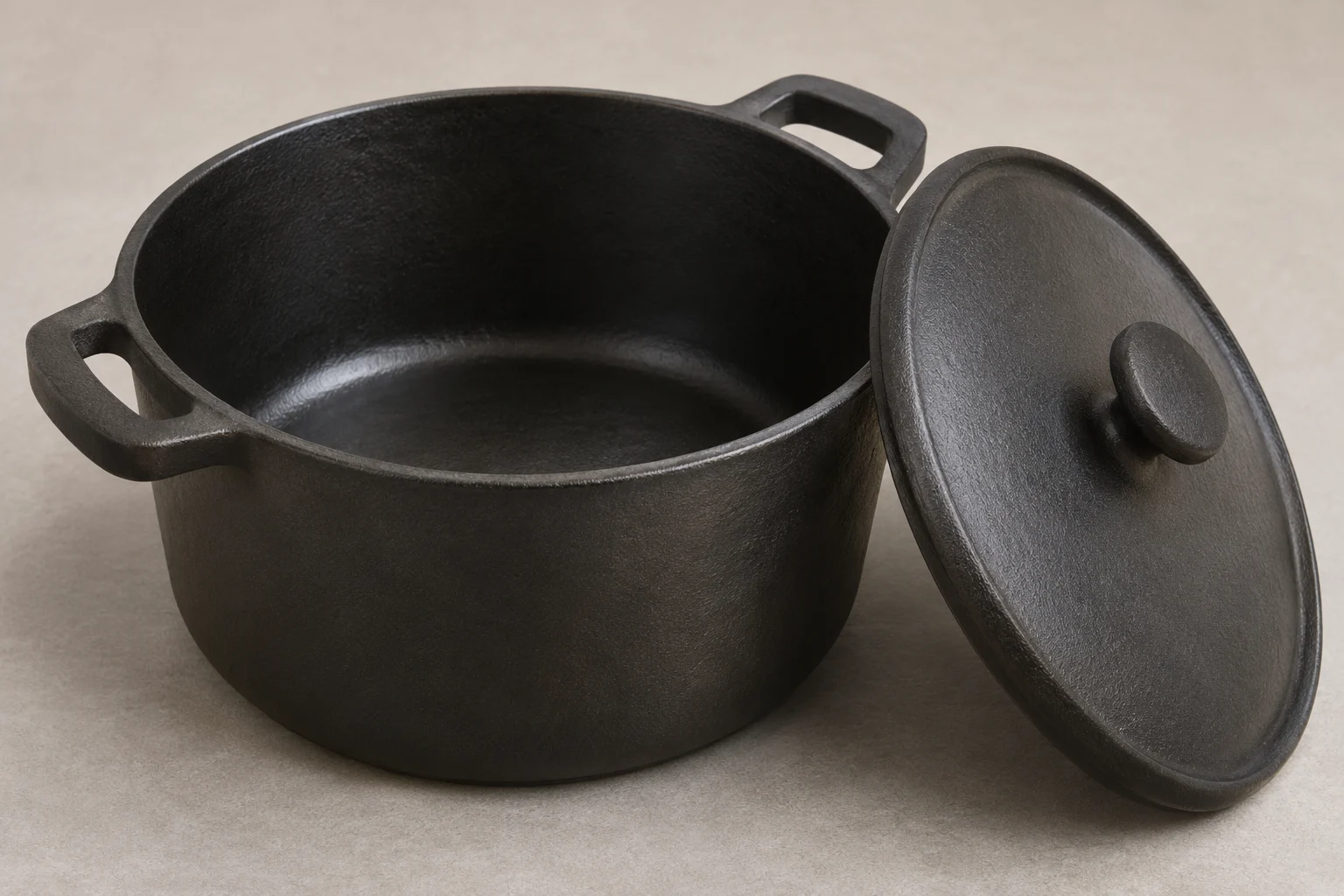
Rundell calls her apparatus a Dutch oven. Today that name usually brings to mind a substantial pot, often cast iron or enameled cast iron, with a close-fitting lid. Earlier writers could mean equipment facing an open fire, ovens set into brickwork, or portable ovens heated with coals above and below. To understand the recipe, follow the heat before choosing the vessel.
What the cheese toast needs
Rundell's “To roast Cheese, to come up after dinner” starts with grated Cheshire cheese, egg yolks, breadcrumbs and butter, seasoned with mustard, salt and pepper. The ingredients are beaten together and spread thickly on toast. This is a paste that needs heating through, with a surface the cook will brown afterward.
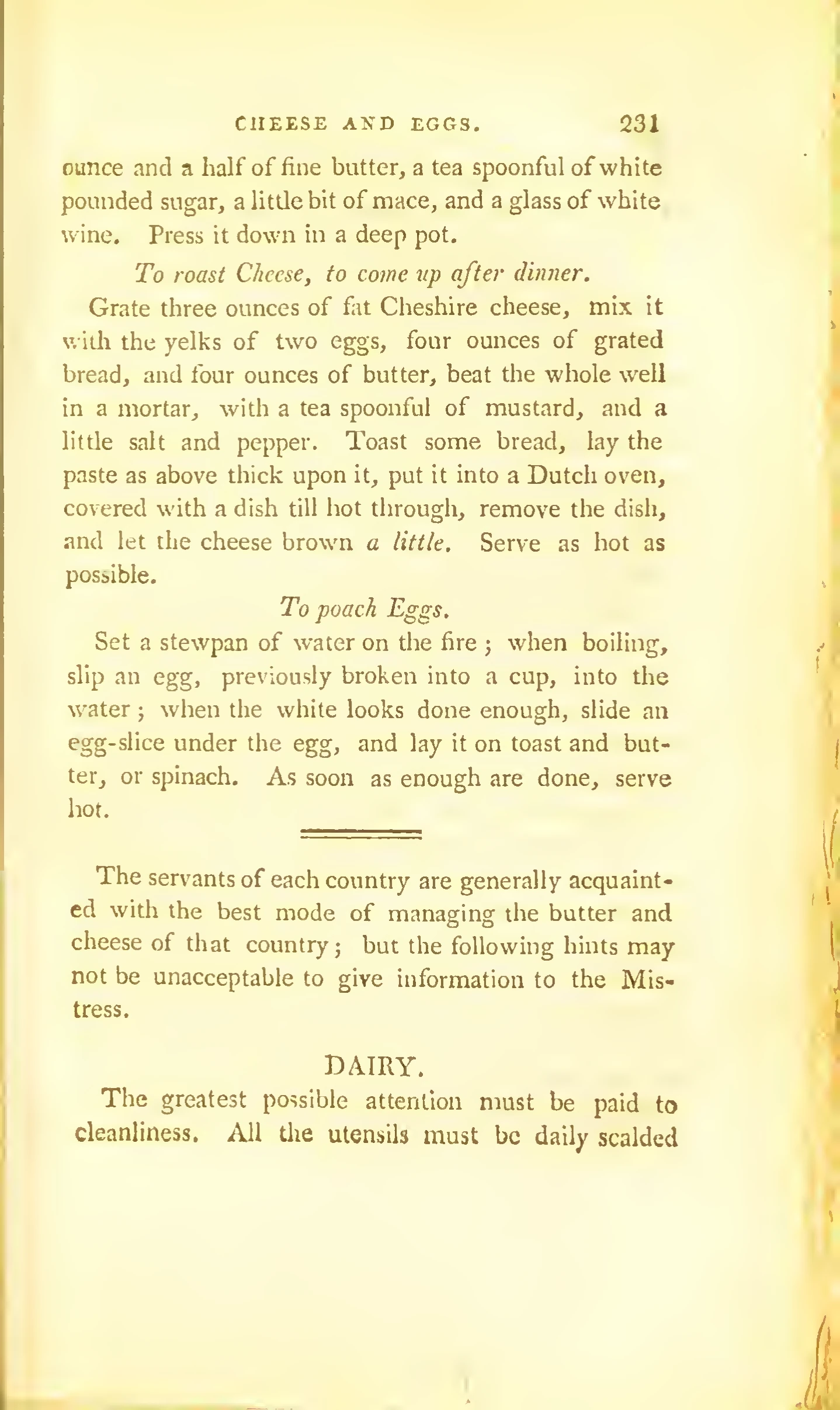
Her direction on p. 231 of A New System of Domestic Cookery is precise about that sequence: put the toast into a Dutch oven, cover it with a dish until hot through, remove the dish, then let the cheese brown a little. The temporary cover and the final exposure both matter. A modern pot's lid may seem to match the first part, but its name doesn't explain how the uncovered topping will receive browning heat.
The exact apparatus Rundell intended remains uncertain. We can still preserve the two jobs she describes. The adaptation below uses a conventional oven for covered heating, followed by a brief broiler finish on a suitable metal baking sheet. Its modern settings and food-temperature check belong to that adaptation; they aren't temperatures recovered from her words.
The fire beside the food
A tin-and-iron reflector roasting oven in The Henry Ford's collection offers a useful way to picture a different oven arrangement. Dated 1825–1850, it had an open side facing the fireplace. Reflective surfaces directed heat toward meat turning on a spit. Food received heat from the fire beside it, rather than sitting enclosed in a pot over a burner.
That surviving roasting oven is later than Rundell's book and doesn't identify her equipment. It does make the act of exposing a surface to the fire much easier to imagine. Removing a cover can have a very different effect when the heat faces the food.
Brickwork supplied another setting for the name. In the 1802 edition of his Essays, Count Rumford describes experimental ovens fixed beside a central fireplace, with flues arranged around them. They didn't heat as he expected. He blamed cold air accompanying the diverted flame. The difficulty lay in getting heat through an installation, not in the weight or lid of a portable cooking pot.
With a coal-heated oven, the lid could supply heat itself. The 1896 Manual for Army Cooks describes heating the ovens and their lids, setting the ovens in coals, and covering the lids with coals and hot ashes. Heat arrived from above as well as below. Its corn-bread recipe also offers thin cakes cooked in a frying pan, a different arrangement for cooking the mixture. The manual's pp. 160–161 and 231–232 connect the food to the equipment and fuel available.
Where Darby's pots enter the story
Abraham Darby's name is often brought into Dutch oven history through iron casting. His patent concerns the making of pots. The official abstract in Bennet Woodcroft's 1855 compilation records a process for casting iron pots in sand without loam or clay; the accompanying index dates the patent to April 18, 1707.
The petition promised finer pots, easier production and lower prices. Those promises concern manufacturing, with pots already being made and imported as the comparison. The abstract and index, printed pp. 46 and 86, don't establish that Darby invented every kind of iron pot, a fitted-lid baking pot, or the name Dutch oven.
Samuel Smiles supplies a Dutch connection in his 1864 Industrial Biography. He describes Darby going to Holland in 1706, learning about fine sand molds and bringing skilled Dutch workmen back to make pots in Bristol. Written more than a century after the journey it describes, this account concerns the movement of manufacturing skill. Smiles also gives 1708 as the patent year, differing from Woodcroft's official record. His pp. 109–110 don't settle where the cookware's name began.
Before choosing modern equipment
Look for where the heat comes from. Coals beneath a vessel, a fire facing its open side and hot coals on its lid describe different conditions. Then look at the cover: does it stay in place, hold fuel, or come off for the final browning? Rundell's cheese toast gives us that last instruction even though it leaves the apparatus unclear.
A modern oven and separate broiler can supply its two stages without recreating a fireplace. Keep the equipment's limits in view. A historical direction to surround an oven with coals isn't permission to put an indoor enameled pot into a fire; follow the vessel manufacturer's heat-source and temperature limits. For the adaptation below, the baking sheet must also tolerate the broiler.
If an old recipe leaves you with an unfamiliar heat word as well as an unfamiliar oven, our slack oven article considers how pastry and its icing could need different heat. TuneMyRecipe's guide to slow, moderate and hot ovens takes up modern temperature choices.
Cheshire cheese toast for a modern oven
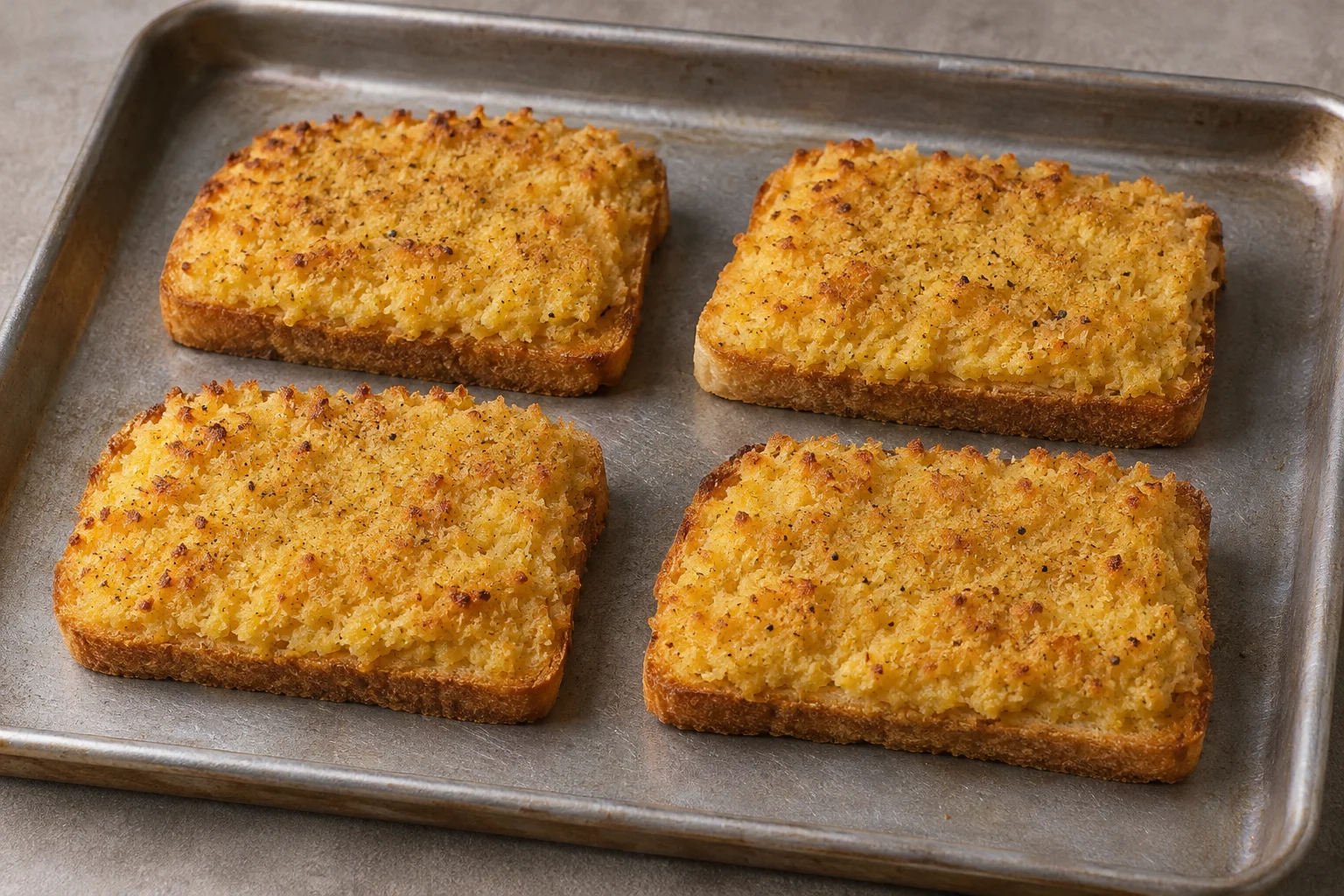
Cheshire cheese, mustard and a breadcrumb-and-yolk paste make this quite different from laying cheese slices on bread. The covered stage heats the thick topping before its surface is browned.
Yield and baking time are estimates for this modern adaptation.
Estimated yield: 4 small cheese toasts. Heat: conventional oven at 180°C or 350°F, followed by a brief broiler finish. These are practical rounded settings.
Ingredients
- 43 g Cheshire cheese made from pasteurized milk, finely grated
- 1 egg yolk
- 57 g fine dry breadcrumbs
- 20 g softened butter
- 1/2 level teaspoon prepared mustard, using a 5 ml measuring teaspoon
- A little freshly ground black pepper
- 4 small slices of bread, toasted
Equipment
A grater, a broiler-safe metal baking sheet and a thin-probe food thermometer. Check the baking sheet's heat limits; keep foil clear of heating elements.
Method
- Heat the conventional oven to 180°C or 350°F. Mix the grated cheese, egg yolk, breadcrumbs, softened butter, mustard and pepper thoroughly.
- Divide the paste evenly over the four toasts. Set them on the metal baking sheet and cover loosely with foil.
- Bake for an estimated 12–18 minutes. Check the center of the thick topping with a thin-probe thermometer: it must reach 71°C (160°F). If it hasn't, continue cooking and check again; the temperature governs, not the estimated time.
- Remove the foil. Brown briefly under the broiler, keeping within the equipment's heat limits and watching continuously. Serve immediately.
Recipe notes
The cheese, breadcrumbs, yolk and mustard follow approximately half Rundell's batch. The butter is deliberately reduced from a proportional 57 g to 20 g, prepared mustard supplies her unspecified mustard, and extra salt is omitted. Four small toasts, the modern heat settings and the two-stage oven-and-broiler method are supplied for this adaptation.
Yield and baking time are estimates; the egg-temperature check follows FDA guidance for egg dishes. Contains milk, egg, wheat and mustard.
Rundell's original wording
A New System of Domestic Cookery, London: J. Murray and J. Harding, 1806, attributed to Maria Eliza Rundell, published “By a Lady”; “To roast Cheese, to come up after dinner,” printed p. 231. Line breaks are regularized.
Grate three ounces of fat Cheshire cheese, mix it with the yelks of two eggs, four ounces of grated bread, and four ounces of butter, beat the whole well in a mortar, with a tea spoonful of mustard, and a little salt and pepper. Toast some bread, lay the paste as above thick upon it, put it into a Dutch oven, covered with a dish till hot through, remove the dish, and let the cheese brown a little. Serve as hot as possible.
Sources
- Bennet Woodcroft, Appendix to Reference Index of Patents of Invention, London: Great Seal Patent Office, 1855, printed pp. 46 and 86: Darby's patent abstract and dated index. The compilation preserves a later official abstract, not an illustrated 1707 specification. Digitized book.
- Samuel Smiles, Industrial Biography: Iron-workers and Tool-makers, Boston: Ticknor and Fields, 1864, pp. 109–110: the later Dutch-transfer account and its differing patent date. Digitized book.
- Benjamin, Count of Rumford, Essays, Political, Economical, and Philosophical, new edition, vol. III, London: T. Cadell jun. and W. Davies, 1802, Essay XIV, pp. 460–461: the brickwork ovens and flue experiment.
- The Henry Ford, “Reflector Roasting Oven, 1825–1850,” object 00.103.287: surviving apparatus and its fire-facing operation. Collection record.
- Maria Eliza Rundell, attributed, A New System of Domestic Cookery, London: J. Murray and J. Harding, 1806, p. 231: the complete cheese-toast recipe above. Digitized book.
- US War Department, Manual for Army Cooks, Washington: Government Printing Office, 1896, pp. 160–161 and 231–232: corn bread and Dutch-oven heating instructions. Digitized book.