 Forgotten Kitchen
Equipment
How Fireless Cookers Worked: A Pudding's Fuel Account
A fireless cooker trapped heat already supplied elsewhere. Food and its vessel were heated before being enclosed in insulation; surrounding hot water, and sometimes a separately heated plate, supplied a reserve of heat. Insulation slowed the loss rather than creating new heat. The modern pudding below uses continuous stovetop steaming and follows Mitchell's separate recipe, rather than the pudding in the reported fuel comparison.
- Fireless cookers
- Puddings
- Fuel
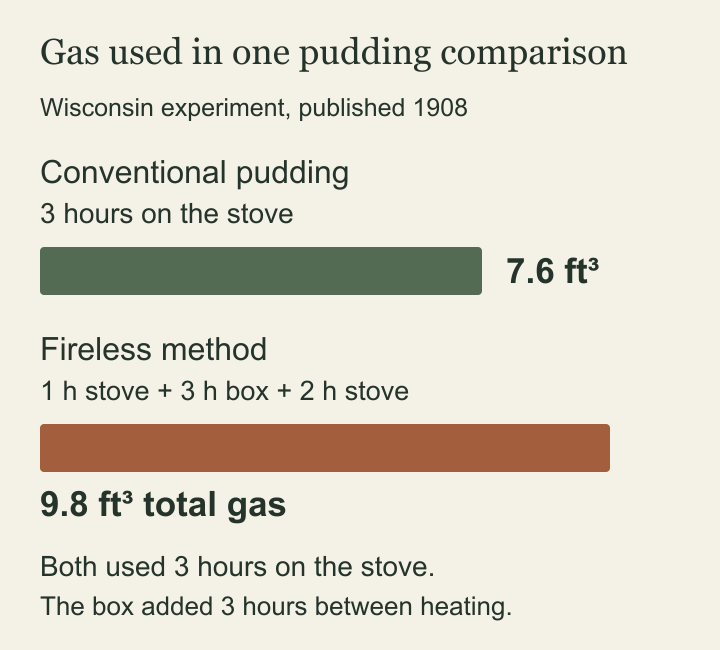
One pudding spent three hours in a fireless cooker, then needed two more hours back on the stove. In a Wisconsin report published in 1908, its journey away from the flame made the process longer without removing any of the stove cooking. This particular pudding used more gas than its ordinary boiled companion.
To understand what the appliance saved, follow the heating before the box and after the lid came off.
The pudding that went back on the stove
Ellen Alden Huntington's The Fireless Cooker, a University of Wisconsin bulletin, records one experiment in steaming a suet pudding. It was boiled for an hour before entering the cooker. After three hours inside, the surrounding water was at 63°C and the pudding was “not at all well done.” Two further hours of boiling finished it. An equal weight of pudding cooked conventionally had needed three hours on the stove. Huntington, 1908, pp. 34–36.
The fuel readings counted the inconvenient return journey. The ordinary pudding used 7.6 cubic feet of gas. The fireless version used 4.00 in its first hour and 9.8 over the complete process, including reheating: 2.2 cubic feet more, or about 29% more in this comparison. Its three hours in the box were extra elapsed time. They weren't three hours saved from the original stove method, and elapsed time isn't a measurement of the cook's labor.
This is one reported comparison, with no range of repeated results. Huntington also described good results with other foods and acknowledged an army report of satisfactory pudding and brown bread. The complete pudding formula, exact mass and surrounding water volume aren't supplied, so the report doesn't establish why this attempt failed. It does show why stopping the fuel account at transfer to the box would miss the reheating that followed.
The water was part of the equipment
Margaret J. Mitchell's The Fireless Cook Book gives a particularly revealing pudding prescription in 1909. Her suet and molasses mixture goes into a buttered one-quart mold or watertight covered can. That vessel stands in a six-quart-capacity cooker pail, with warm water reaching two-thirds up the inner can. She directs half an hour's boiling followed by five hours in the cooker, for six or eight people. Mitchell, 1909, pp. 157–158.
Six quarts describes the pail, not a measured dose of water. The water level and the room around the inner vessel determine how much water actually surrounds the pudding. Read as equipment instructions, the passage describes more than a small covered dessert: a substantial hot bath goes into the insulation with it.
Mitchell's preceding directions discuss deep molds, space for expansion, and racks for smaller vessels. Changing the basin or reducing the batch changes that arrangement, even if the ingredient proportions stay the same. Her recipe is a separate procedure with no metered gas total, but it makes the hot water's place in the equipment easy to see.
Cornell's 1920 Fireless and Steam-Pressure Cookers adds another easily overlooked input. Its cranberry pudding is boiled for ten minutes, then the kettle is placed on a hot radiator inside the cooker for three hours. The radiator is a heat-storing plate, not a source of free warmth. Heating it belongs in a complete fuel account. Cornell, 1920, p. 72.
Cheap beans had a similar problem
Twenty-five years after Huntington's bulletin, a USDA radio script approached economy from the ingredient shelf. On March 27, 1933, Beans for Economy Meals reported navy beans at a low-end price of two or three cents a pound, then warned that long cooking could raise their expense. If the stove was going all day anyway, its advice treated fuel differently from a kitchen firing a stove for that dish. It also suggested retained heat, pressure cooking, or buying already cooked canned beans. USDA, first text leaf.
The script's baked mashed beans shortened the final oven occupation by starting with tender beans. Before browning came soaking, simmering, draining, pressing through a colander, and cooking salt pork and onions. A short final bake didn't account for all that preparation, and the script supplied no measured fuel saving.
The same distinction matters for the covered pudding basin: count the first heating, the heat carried into the enclosure, and any return to the fire before deciding what “fireless” saved.
Continuously steamed molasses pudding
Modern adaptation. Suggested yield: six small portions. This fresh-serving companion derives from Mitchell's different 1909 recipe. It uses continuous attended stovetop steaming, not insulated cooking, and makes no fuel-saving claim.
Ingredients
- 190 g all-purpose flour
- ¾ teaspoon baking soda
- ¾ teaspoon fine salt
- ¼ teaspoon ground ginger
- ¼ teaspoon ground nutmeg
- ⅛ teaspoon ground cloves
- ⅛ teaspoon ground cinnamon
- 60 g chilled butter, grated, plus a little for the basin
- 160 g molasses
- 120 ml commercially cultured buttermilk
Method
- Grease a heatproof pudding basin of about 1 liter. Put a rack in a deep saucepan and prepare a fitted lid. Use a basin large enough that the batter fills no more than two-thirds of it.
- Mix the flour, baking soda, salt, and spices. Rub in the grated butter lightly. Mix the molasses with the buttermilk and stir into the dry ingredients just until combined. Don't taste raw batter; flour is a raw food.
- Spoon into the basin. Cover with baking parchment and foil, allowing expansion, and secure around the rim. Set on the rack; add hot water to two-thirds of the basin's height without letting it enter the food.
- Cover the pan and keep at a gentle continuous simmer for approximately 2 hours. Check the water regularly and replenish with boiling water. Aim for a firm, set center and a skewer without wet batter; extend cooking if necessary. Keep the pan attended.
- Let stand 10 minutes, uncover carefully away from your face, and turn out. Serve warm as dessert.
The metric quantities are editorial kitchen equivalents, not a weighed reconstruction of Mitchell's cups. Butter replaces chopped suet and changes the pudding's flavor and structure; commercial cultured buttermilk replaces unspecified sour milk. Don't use spoiled milk. Cinnamon is reduced from her ½ teaspoon to ⅛ teaspoon. The basin, continuous simmer, and estimated steaming time replace her covered can and insulated interval.
Refrigerate leftovers promptly in shallow containers, within two hours, or one hour above 90°F/32°C, with the refrigerator at 40°F/4°C or below. FoodSafety.gov's cooling guidance applies; a lukewarm cooker isn't leftover storage.
Mitchell's original, kept separate
The Fireless Cook Book (1909), pp. 157–158; the ingredient columns below are linearized. This is a historical recipe, not the modern method above.
Suet Pudding
½ cup chopped suet; ½ cup molasses; ½ cup sour milk; 1½ cups flour; ¾ teaspoon soda; ¾ teaspoon salt; ¼ teaspoon ginger; ¼ teaspoon grated nutmeg; ⅛ teaspoon ground cloves; ½ teaspoon ground cinnamon.
Mix and sift the dry ingredients and add the suet. Mix the milk and molasses and add them to the dry mixture. Put the dough into a buttered, one-quart bread mould or water-tight covered can, and stand it in a six-quart cooker-pail of warm water which reaches two-thirds of the way up the can. Boil it one-half hour and put into the cooker for five hours.
Serves six or eight persons.