 Forgotten Kitchen
Equipment
Soyer's Paper-Bag Cookery: The Bags Behind the Method
Paper-bag cookery enclosed prepared food in suitable paper and cooked it in an oven. Nicolas Soyer's 1911 American book proposed replacing many pots and pans with this arrangement. The wrapper had to hold liquid, survive the heat and leave dinner tasting of dinner. The modern mackerel recipe below uses oven-rated parchment and present-day handling directions.
- Paper-bag cookery
- Kitchen work
- Cooking heat
Soyer promised that the method would abolish kitchen drudgery. On the same page, he listed what the cook still needed: an oven, a support for the bag and the bag itself. Dinner had acquired a disposable cooking vessel, with part of its success depending on how the paper was made. Soyer, introduction, pp. 7 and 14.
An old principle, offered in new bags
This was Nicolas Soyer, whose title page identifies him as a former chef of Brooks's Club in London, rather than Alexis Soyer. He disclaimed invention at the start: “I claim no novelty for the principle.” What he claimed was a more extensive application. The distinction matters. Cooking in wrappers did not need to be newly invented for a book and a bag supplier to find a commercial opportunity in it.
The American edition's opening notice advertised specially prepared bags from the Union Bag & Paper Company. Its reviser, Virginia Terhune Van de Water, explained that she had adjusted the text for American readers and substituted American culinary terms. This was a particular edition selling a particular approach, not a timeless instruction to cook in whatever paper came home with the groceries. Soyer, opening notice, PDF 8; title, PDF 9; American-edition note, pp. 5–6/PDF 13–14.
The fish carries its sauce
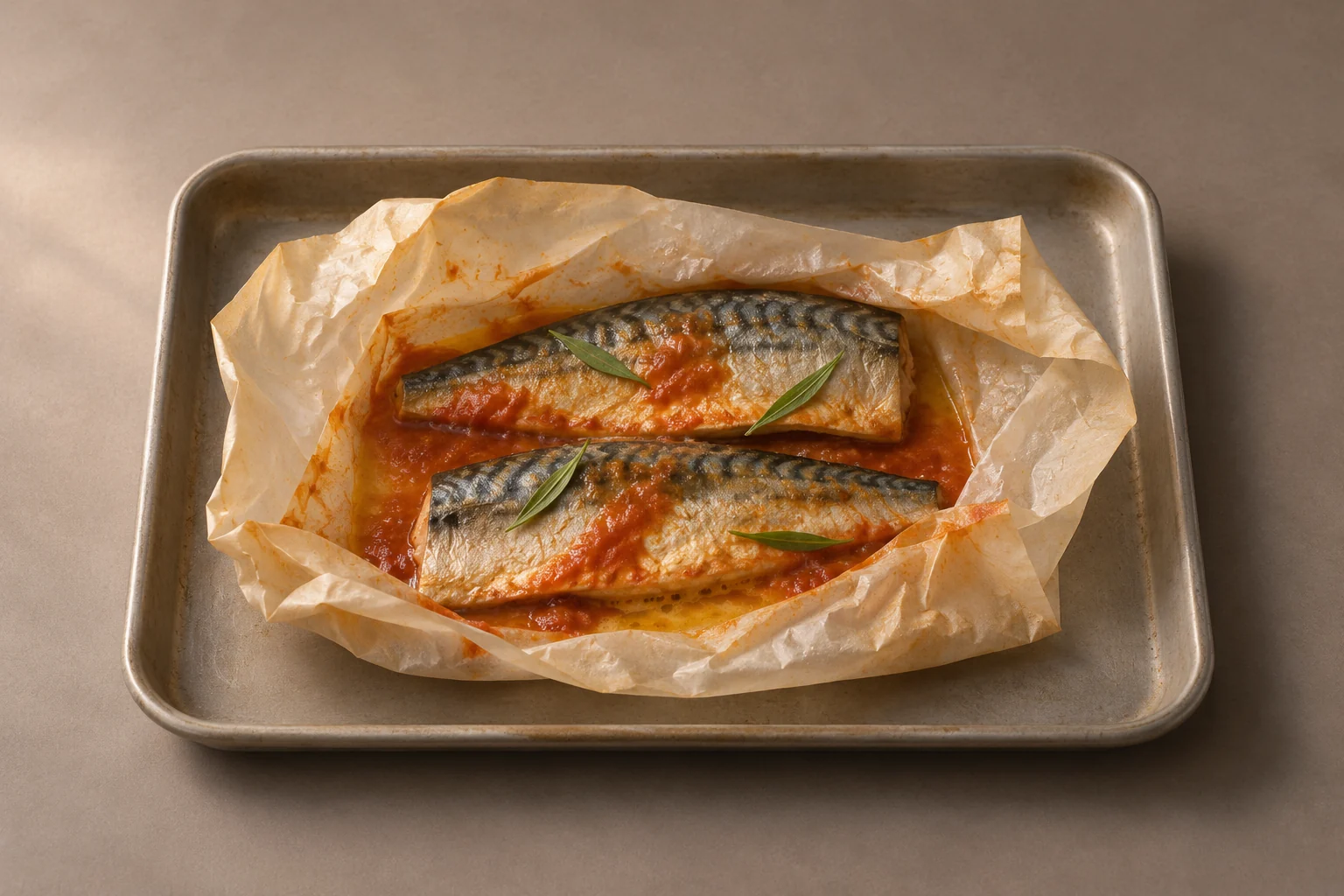
The mackerel recipe makes the bag's task unusually clear. Soyer starts with two filleted mackerel, lays fresh tarragon along each fillet and seasons the fish. A thickly buttered bag receives the fillets, each topped with a large tablespoonful of tomato catsup. After cooking, the cook carefully turns out the fish and pours its sauce over it.
The wrapper is holding part of the meal. Soyer permits more sauce but says the stated amount is sufficient for cooking. He prefers American catsup to the English variety: the sauce's character mattered alongside the paper's performance.
The unusual printed timing, “18 to 20–25 minutes,” depends on fish thickness; the entry gives no oven temperature or fish weight. The measured quantities and temperature endpoint in the modern companion are supplied choices. “Mackerel à la Napolitaine,” pp. 33–34.
Three spoonfuls for the potatoes
New Potatoes uses the same enclosing idea for a different purpose. Soyer asks for enough peeled, halved potatoes for three people, three tablespoonfuls of cold water, one mint leaf and a little salt. The added water is a small measured input rather than a saucepanful to discard.
The recipe calls for a hot oven and 30–35 minutes, with the bag resting gently on a broiler. In this context the support lets heat reach around the bag; it is not permission to put modern parchment under a broiling element. New Potatoes, p. 69; equipment explanation, p. 14.
A paper flavor was a manufacturing problem
The paper industry saw a potential market. In August 1911 the Paper Trade Journal reported that Union had experimented successfully with imported paper, while its domestic paper still gave cooked food a paper flavor. Elsewhere in the same feature, an unnamed firm was credited with producing a tasteless bag for Soyer. That firm's reported success left Union's domestic-paper difficulty unresolved in the account.
An unnamed Union officer described the venture as a gamble requiring consumer education. The feature reported newspaper coupon distribution of thousands of bags, but its continuation said prices were not yet out. Distribution and optimistic forecasts show promotion underway; they cannot tell us how many households kept cooking this way or what a meal actually saved. “Paper Bag Cookery,” Paper Trade Journal, LIII, no. 8, August 24, 1911, pp. 8 and 50/PDF 10 and 52.
The promised disappearance of the saucepan made suitable paper more consequential. Soyer's cook still prepared ingredients, chose heat, closed a vessel and judged readiness. What changed was the vessel, with some of its performance now depending on a paper manufacturer.
Modern companion: mackerel with tarragon and tomato ketchup
Modern adaptation. Suggested yield: 2 main-course portions, four small fillets. This version adapts Soyer's mackerel recipe for oven-rated parchment. The modern wrapper, fish weight, seasoning amounts and oven setting are supplied choices, not recovered historical measurements.
Ingredients and equipment
- 400 g boneless mackerel fillets, four fillets about 100 g each, thawed if frozen
- 10 g unsalted butter, softened
- 8 small sprigs fresh tarragon, leaves picked
- 60 ml commercially prepared tomato ketchup
- 1/8 metric teaspoon fine salt
- Freshly ground black pepper, to taste
- Food-grade oven-rated baking parchment, a rimmed baking sheet and a food thermometer
Keep the fish refrigerated at 4°C / 40°F or colder until preparation. Thaw frozen fillets in the refrigerator, following the package's thawing and use-by instructions. FDA's seafood guidance explains cold storage and thawing.
Method
- Heat a conventional oven to 180°C / 355°F. Follow the parchment manufacturer's temperature and appliance limits. Set two roomy sheets on a rimmed baking sheet. Divide the butter over their centers.
- Check the fish for remaining pin bones and remove them. Arrange two fillets in a single layer on each sheet. Divide the salt, pepper and tarragon evenly over them, then add 15 ml ketchup to each fillet.
- Fold and crimp the paper into enclosed packets, leaving room around the fish and keeping seams upward to contain liquid. Keep all paper on the baking sheet and clear of oven walls and heating elements.
- Bake for approximately 15–25 minutes. Open a fold away from your face and hands to release steam, then check the thickest part of the fish in each packet with a thermometer. Each packet must reach 63°C / 145°F. Reclose and continue baking any packet that needs longer; time alone does not establish readiness.
- Open carefully and serve immediately, spooning the packet juices over the fish.
Adaptation notes: Two historical filleted fish are interpreted as four small fillets totaling 400 g. The large historical spoonful becomes 15 ml per fillet, while the butter, herb and seasoning quantities are supplied. A metric teaspoon is 5 ml; the salt quantity is a volume, not an inferred weight. Keep the small fillet size and add packets rather than stacking fish for a larger batch. Don't multiply temperature or time. The source's catsup preference identifies no surviving brand.
Use parchment explicitly sold for oven cooking. Reynolds' product guidance, for example, permits up to 425°F in a conventional oven and excludes a broiling unit, toaster oven, flames and contact with oven sides or bottom. Follow the product actually bought. USDA advises against grocery bags for cooking; wax paper is not a substitute here. The thermometer endpoint follows FoodSafety.gov's fish guidance.
Source note
Nicolas Soyer, Soyer's Paper-Bag Cookery (New York: Sturgis & Walton, 1911, American edition revised by Virginia Terhune Van de Water), opening notice and pp. 5–7, 14, 33–34 and 69; PDF leaves 8, 13–15, 22, 41–42 and 77. Edition record and digitized book. The quoted historical cooking interval describes the source, not the modern safety endpoint. The contemporary trade feature is separate evidence for marketing and manufacturing claims, not independently measured adoption or savings.