 Forgotten Kitchen
Equipment
What Was a Pudding Cloth?
Eliza Leslie preferred a pudding cloth that could open out flat. Spread inside a deep dish for filling, then gathered and tied, the fabric became the container around a boiled pudding. Elsewhere in old cookbooks, a cloth covered a basin instead. A pudding cloth was reusable cooking equipment, but its shape and job depended on the recipe.
- Pudding cloths
- Puddings
- Kitchen equipment
The dish supported the filling
Leslie's boiled bread pudding gives the cloth a clear sequence of jobs. After preparing the mixture, she directs the cook to dip the cloth in hot water, shake it out and spread it inside a deep dish or pan. Flour goes over the cloth before the filling is poured in. The dish supports this stage of the work; it isn't identified as the vessel in which the pudding will boil. Leslie, Directions for Cookery, 1837, p. 298.
The cook then gathers and ties the cloth, leaving room for the pudding to swell. Leslie wants the string firm and the opening guarded against water. Those are separate concerns: fastening the closure securely doesn't mean drawing the fabric tight against every part of the mixture.
By the serving direction, she calls the enclosure a bag. On the next page, however, she says she prefers a thick square cloth that can be opened out, rather than a bag. Her own vocabulary overlaps, so the word bag alone can't establish whether a particular object was sewn. Leslie, 1837, pp. 298–299.
The opening square is the useful physical detail. It can lie in a dish while being filled and open again when the cooked pudding comes out. Reading only the final instruction to turn the pudding out of its bag would conceal the preparation that preceded it.
What the tie tells us
A cloth-enclosed pudding wasn't necessarily sweet or associated with Christmas. Hannah Glasse's 1747 “Stake-Pudding” puts a filled suet crust into cloth. Here, the enclosure belongs to a savory preparation. The suet reference explains the separate ingredient in that crust. Glasse, The Art of Cookery, Made Plain and Easy, 1747, p. 69.
Glasse's general pudding rules distinguish the tie for bread pudding from that for batter pudding: the first is loose and the second close. Her discussion also includes wooden bowls and china dishes. Several arrangements were already being described together. Glasse, 1747, p. 70.
Eliza Acton's 1845 directions give batter room to swell in its cloth. Her Christmas pudding, meanwhile, is tied tightly in a thickly floured cloth. These instructions remain attached to her particular mixtures; they don't combine with Glasse's brief rule to form one universal tying method. Acton, Modern Cookery, in All Its Branches, pp. 436 and 456–457.
Our Christmas pudding ingredient comparison follows Acton's fruit, crumbs and suet. The equipment detail adds another part of her recipe: its mixture is enclosed in a prepared cloth with a specified tie.
A cloth could cover a basin
In Acton's custard-pudding discussion, the cloth sits above a basin or mold containing the mixture. It is a covering, not the flexible container directly surrounding the whole pudding. In nearby paragraphs, batter and plum puddings are enclosed in cloth. Acton, 1845, p. 436.
That difference changes what we should picture. A basin with a cloth tied over it and a pudding tied directly in cloth both contain fabric, but the fabric occupies a different place. The basin supplies the rigid sides in the first arrangement.
Acton also comments on molds as customary equipment for plum puddings while preferring stout, buttered and floured cloths for some mixtures, especially those containing bread. She describes the cloth versions as lighter and less dry.
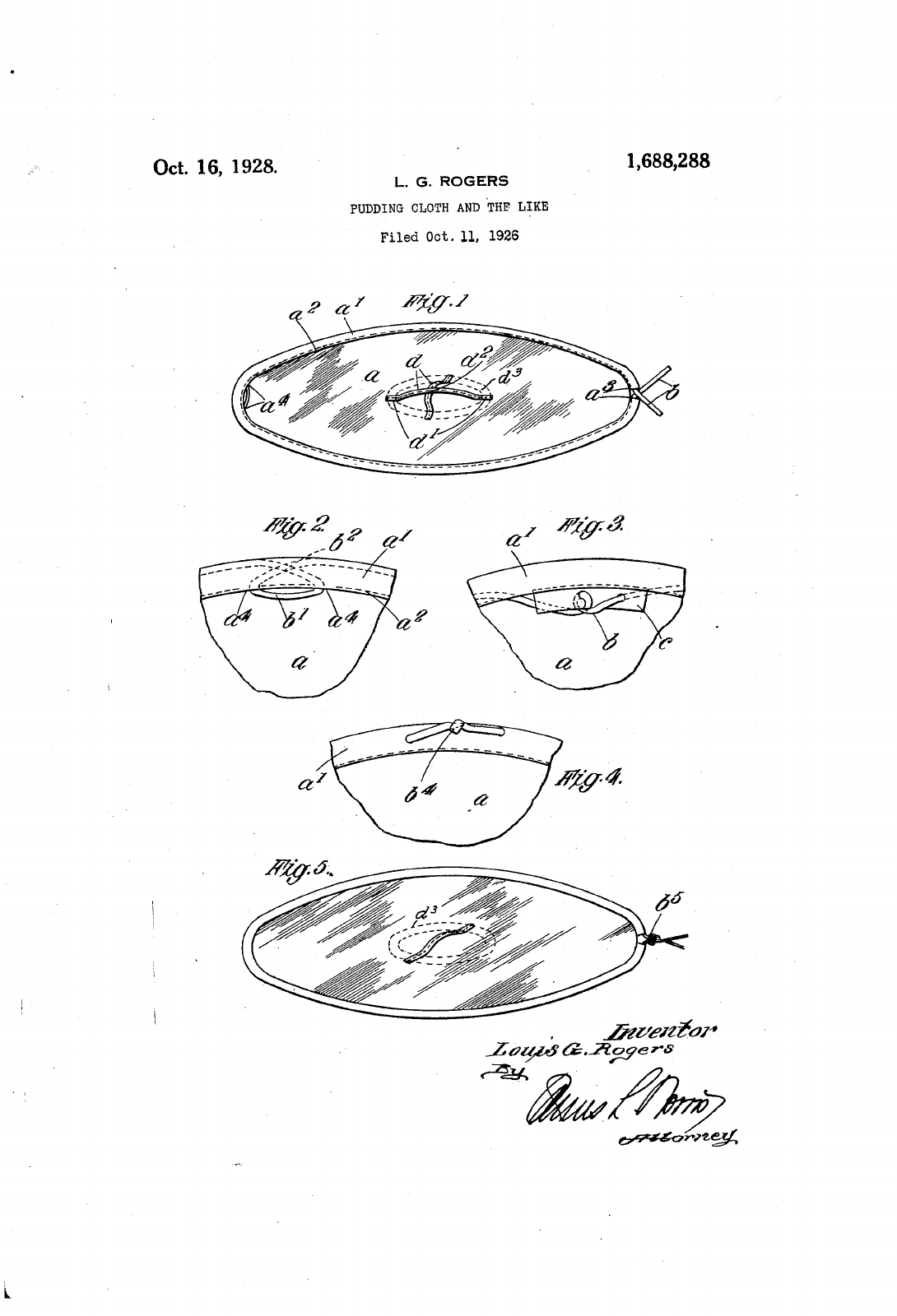
Louis Gerald Rogers proposed a different arrangement in his 1928 pudding-cloth patent: a circular cloth with tape around its edge and straps across the center. His specification describes fastening the cloth to a basin and using the straps to lift it. Rogers, US Patent 1,688,288, drawing and specification, 1928.
Linen, hems and attached strings
Leslie gets particularly specific in a footnote to her rice dumplings. She describes hemmed squares of coarse, thick linen with tape strings sewn to them. This is a prepared piece of kitchen equipment, with its own edges and fastenings. Leslie, 1837, p. 308.
That source supplies more information than the broad word cloth. It doesn't establish that every author intended the same textile or that any modern fabric with a familiar household name would be equivalent.
The rice-dumpling footnote also follows the cloth beyond cooking. Leslie calls for washing, drying and ironing before it goes into a kitchen drawer. Acton's directions similarly include washing, prompt drying, folding and clean storage. She complains about the unpleasant flavor associated with cloths left wet. Acton, 1845, p. 437.
These are historical accounts of maintaining the object, not a modern textile-treatment or sanitation procedure. They do make its reuse explicit.
Leslie's cloth returns to the drawer with its hem and attached strings. The square that opened inside the filling dish was meant to be kept, readied and brought out again.