 Forgotten Kitchen
Ingredients
What Was Bean Cake in an Old Chinese Cookbook?
Bean cake in Shiu Wong Chan's 1917 Chinese Cook Book is a purchased bean-curd ingredient: tofu. His chop suey cuts it into pieces with pork and onion; his omelet gives it a separate frying and boiling stage before it joins the eggs.
- Tofu
- Ingredient names
- Chinese cookbooks
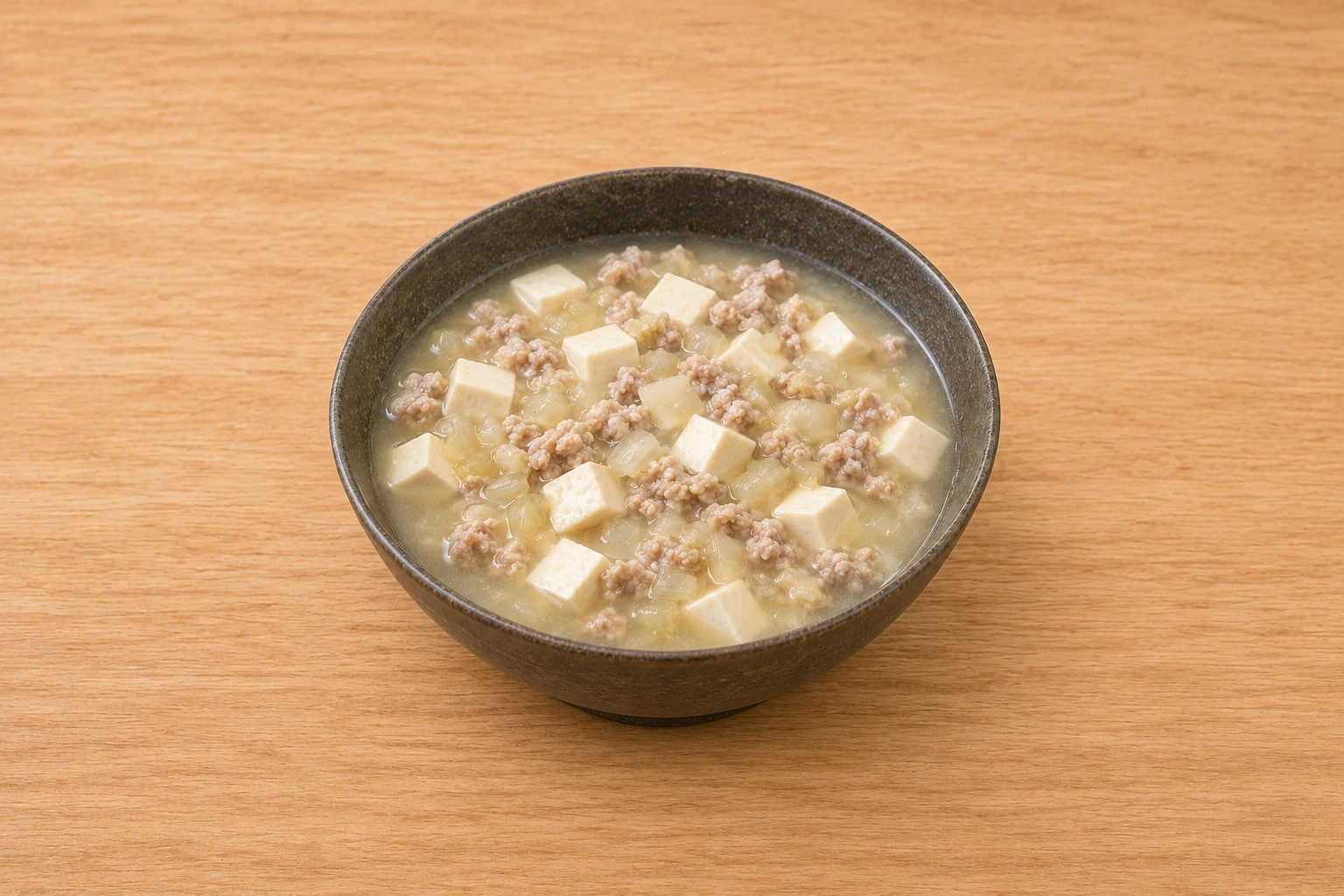
For the adaptations below, choose plain, water-packed firm tofu, drained before weighing. Silken tofu, fried tofu puffs and flavored blocks are different products. House Foods, for example, lists firm and silken tofu separately. Firm tofu is the chosen form for these two modern recipes.
A cake was a counted purchase
Chan lists ten pieces of bean cake for Bean Cake Chop Suey and six for Bean Cake Omelet. He supplies no standard weight per piece. The modern recipes use drained weights instead: 250 g for the pork dish and 100 g for the omelet. Chan, pp. 134 and 148.
His bean-cake discussion acknowledges preparation outside the household recipe: its brief manufacturing sketch would need a separate volume to develop fully. For these dishes, the cook begins with purchased tofu.
Pork in the pan, ham on the eggs
The chop suey lists a pound and a half of pork alongside its ten cakes and two cups of onion. Its gravy also leads back to meat-based preparations. Bean cake is part of a combination with meat.
The omelet has another meat ingredient. Eggs and bean cake form the cooked mixture, with Chinese ham dice and parsley for garnish. Our version specifies ready-to-eat cooked ham, suitable for scattering over the finished eggs. Neither dish is vegetarian.
Three ingredients led to an earlier gravy
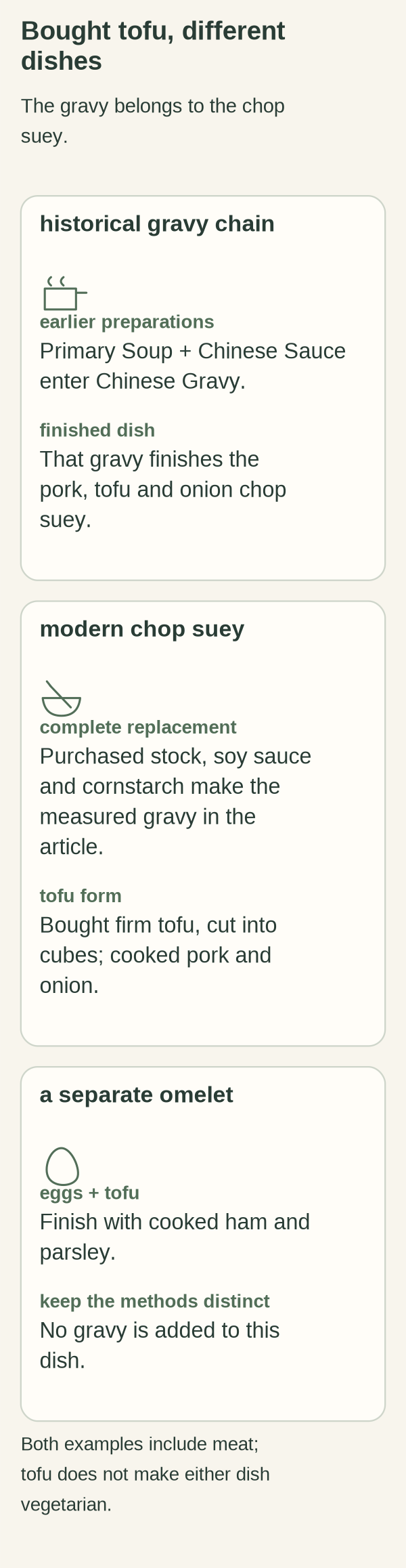
Bean Cake Chop Suey looks short: cut pork, bean cake and onion; fry; add water and cook covered; finish with Chinese gravy. That last instruction points to a separate recipe near the front of the book. Bean Cake Chop Suey, p. 148.
Chinese Gravy combines primary soup, cornstarch, Chinese sauce, salt, sugar and sesame oil. Primary Soup and Chinese Sauce have their own earlier entries. The main dish inherits those preparations. Chan, pp. 8–11.
The modern pork recipe makes its gravy from purchased chicken stock and soy sauce, with the full measured method included below. Choose plain low-sodium chicken stock and ordinary soy sauce, checking labels for soy and wheat as appropriate.
The omelet has its own order
Chan fries the bean cakes, adds water and boils them ten minutes. Eggs cook in a separately well-oiled pan before the prepared bean cake returns. Ham and parsley finish the dish. Bean Cake Omelet, p. 134.
The adaptation retains that preliminary tofu cooking. Its draining and pan-drying step separates the boiling stage from the egg cooking. The resulting egg-and-tofu dish has its own complete method, without the pork recipe's gravy.
The cooking temperatures and refrigeration instructions below follow FDA safe food handling guidance.
Bean-cake chop suey with pork
Modern adaptation. Estimated yield: 4 small main-course portions. Estimated time: 15 minutes preparation and 35 minutes cooking, about 50 minutes total.
- 340 g raw ground pork
- 250 g plain water-packed firm tofu, drained and cut into 1 cm cubes
- 160 g peeled onion, chopped
- 15 ml neutral oil
- 250 ml water initially, plus more only as needed to just cover
- 240 ml purchased low-sodium chicken stock, for the gravy
- 1 metric teaspoon cornstarch
- 15 ml cold water, for the cornstarch slurry
- 1/2 metric teaspoon soy sauce
- 1/8 metric teaspoon white sugar
- 1/8 metric teaspoon toasted sesame oil
- Up to 1/4 metric teaspoon fine salt, only if needed after tasting the cooked dish
Equipment: Scale, knife, 10-inch deep skillet with lid, small saucepan, bowl, spatula and food thermometer. A metric teaspoon is 5 ml; a tablespoon is 15 ml.
- Heat the neutral oil in the skillet over medium-high heat. Add pork and onion, breaking the pork into small pieces. Add tofu and cook about 10 minutes, stirring gently so the cubes remain recognizable.
- Add the initial 250 ml water. If it doesn't just cover the mixture, add more in 25 ml increments until it does. Bring to a simmer, cover and cook gently about 15 minutes. Check the pork throughout the mixture reaches at least 72°C/162°F; continue cooking if necessary.
- While the skillet simmers, mix cornstarch with the separate 15 ml cold water. Bring the stock to a boil in the saucepan. Stir in the slurry and simmer, stirring, until lightly thickened, about 1–2 minutes. Stir in soy sauce, sugar and sesame oil.
- Pour all the hot gravy into the skillet and fold through gently. Bring back to a simmer. Taste the cooked dish and add only as much of the optional salt as needed. Divide among four bowls and serve hot.
Adaptation notes: The pork is approximately half Chan's weight, with ground pork replacing small-cut meat. Tofu and onion weights, water allowance, stock choice and whole small pan of gravy are supplied. The source gives no gravy quantity. Measured sesame oil replaces its unspecified drops; the stock and bought sauce replace the earlier preparation chain. The recipe contains pork, chicken stock and soy; ordinary soy sauce may also contain wheat.
Bean-cake omelet with ham
Modern adaptation. Estimated yield: 2 portions. Estimated time: 10 minutes preparation and 25 minutes cooking, about 35 minutes total.
- 4 large eggs
- 100 g plain water-packed firm tofu, drained, in 2 broad pieces
- 20 g ready-to-eat cooked ham, finely diced
- 15 ml neutral oil, divided into three 5 ml portions
- 1/8 metric teaspoon fine salt
- 250 ml water initially, plus more if needed to partially cover the tofu
- 1 metric teaspoon chopped fresh parsley
Equipment: Bowl, fork, 10-inch nonstick skillet, spatula, sieve and food thermometer.
- Beat the eggs with salt and one 5 ml portion of oil. Keep them refrigerated while preparing the tofu. Keep the cooked ham and parsley separate from raw-egg utensils.
- Heat another 5 ml oil in the skillet over medium heat. Fry the two tofu pieces until lightly colored, turning carefully. Add the initial 250 ml water, with more in 25 ml increments only if necessary to partially cover the tofu. Bring to a gentle boil and cook 10 minutes.
- Lift the tofu into a sieve, drain and cut into bite-size pieces. Discard the cooking water and wipe the skillet dry. Heat the final 5 ml oil over medium-low heat, pour in the eggs and turn the setting edges toward the center with a spatula.
- When the eggs are nearly set, fold in the tofu. Continue cooking gently until the egg mixture is set throughout and reaches at least 72°C/162°F in several places. Divide between two plates, scatter with the ready-to-eat ham and parsley, and serve promptly.
Adaptation notes: Eggs and historical piece count follow a third batch; the 100 g tofu weight is a modern choice. Cooked ham replaces unspecified Chinese ham, and its weight, oil allocation, salt, draining and pan-drying steps are supplied. The result is a turned egg-and-tofu dish rather than a rolled Japanese omelet. Refrigerate any leftovers promptly in shallow containers at 4°C/40°F or colder, within two hours, or one hour above 32°C/90°F, following the linked FDA handling guidance.