 Forgotten Kitchen
Measures & Ovens
What Was a Teacupful in Old Recipes?
A teacupful needs its cookbook's definition. In the 1906 revision of Mrs. Beeton's Book of Household Management, a teacupful of water or milk is a quarter pint, while a breakfastcupful is half a pint. Those are useful relationships within that book, not a capacity guaranteed by the word “teacup.”
- Cups
- Historical measures
- Kitchen utensils
Florence Daniel's 1915 cookbook adds another complication. Her flour measurements distinguish closely filled teacups from loosely filled ones, and her liquid relationships separately mention a small teacup. Before converting anything, there are three things to identify: the vessel, what fills it and how it's filled.
A liquid table with a stated scope
The 1906 Beeton revision introduces its equivalents as rough guides for ordinary purposes. In the table, water and milk share a set of liquid relationships. Ingredients measured by weight have separate entries. Mrs. Beeton's Book of Household Management, new revised edition, 1906, pp. 126–127.
Within that liquid convention, two teacupfuls make the same quantity as one breakfastcupful. It's tempting to turn that into a general rule about cups found in a cupboard. The table establishes the relationship between the book's named measures; it doesn't measure a surviving cup or define every vessel another author might use.
Keep the ingredient heading attached, too. A teacupful of water or milk is a volume instruction. It doesn't assign the same weight to a teacup of flour, sugar or butter. The separate rows exist because the substance and its preparation matter.
This is the 1906 London revision. Its table shouldn't be silently placed in the 1861 book or treated as the convention of every recipe carrying Beeton's name.
Daniel changes the filling words
Florence Daniel's The Healthy Life Cook Book, second edition, published in 1915, gives a striking pair of flour relationships. One pound takes three closely filled teacups; a quarter pound takes one loosely filled teacup. The filling words change with the stated quantity. Daniel, 1915, chapter XV, “Weights and Measures and Utensils”.
Multiplying the loosely filled quarter-pound measure by four would produce four loosely filled cupfuls. Daniel's pound statement instead specifies three closely filled ones. Removing the two adjectives would make the entries look like an unexplained contradiction.
They don't supply a modern flour-packing experiment or a measured difference in density. They show that Daniel made the way flour occupied the cup part of her description. A transcription retaining only the numbers would lose that distinction.
Her liquid relationships need the same care. She gives a pint as three-and-a-half teacups, or nearly two breakfastcups. Elsewhere in that discussion, a small teacup is equated with a gill. “Small” and “nearly” are part of the information.
These relationships also differ from the 1906 Beeton revision. The books are defining their own measures. We don't have to force both into one reconstructed historical teacup.
The pint is another question
A fraction of a pint is only as specific as the pint being used. British and American measurement systems must be identified before their capacities are compared; a modern reader's location doesn't decide which system a historical author meant.
Ingredient weight adds another step. Even after establishing a liquid capacity, the weight of flour occupying it still depends on the flour and the filling procedure. A vessel's name alone cannot supply those details.
TuneMyRecipe's cups-and-grams guide explains that practical distinction. The historical question here comes earlier: what did this particular author ask the reader to do with the cup?
Farmer's cup was a measuring utensil
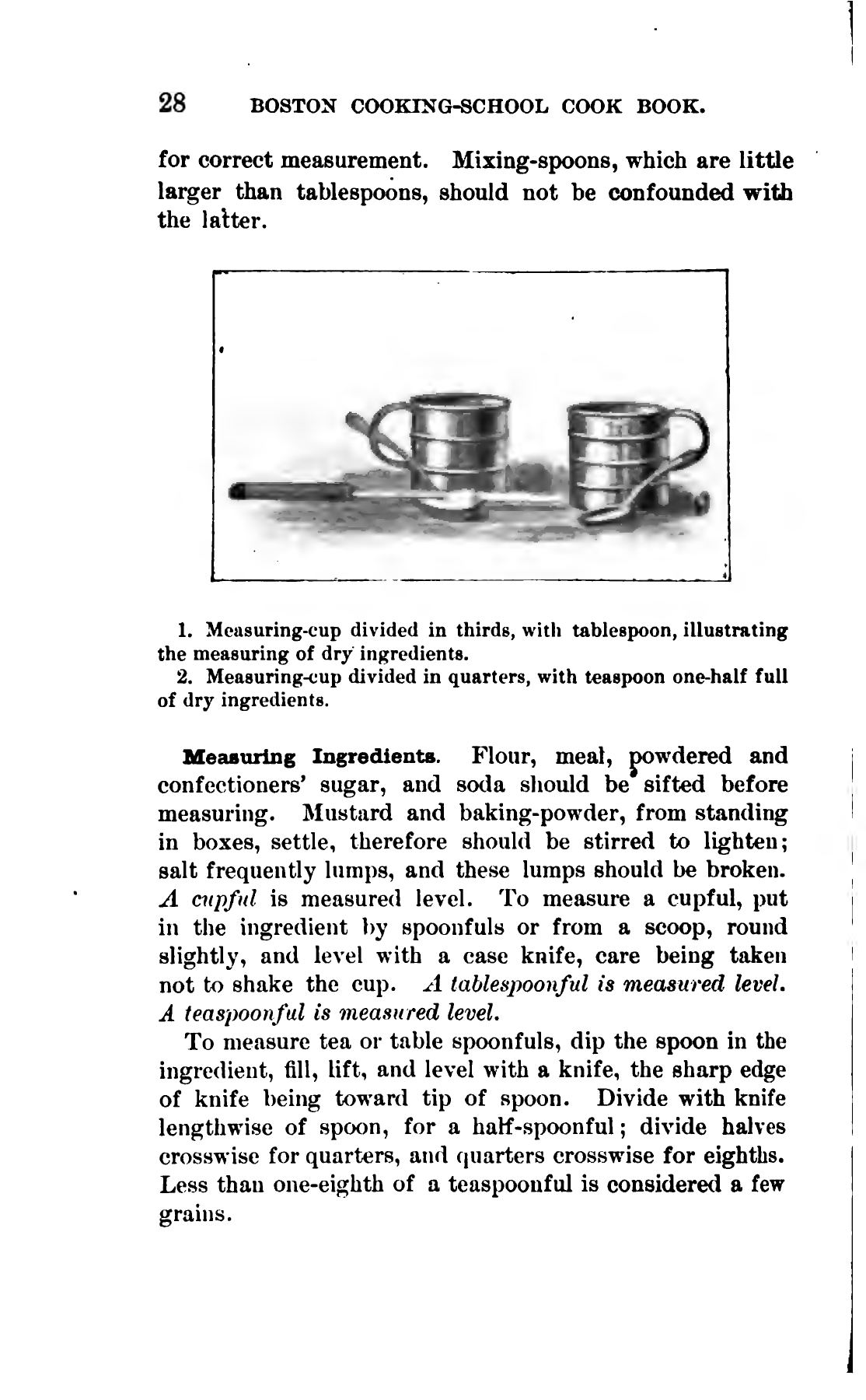
Fannie Merritt Farmer describes tin measuring cups holding half a pint and divided into quarters or thirds. The illustration beside her instructions shows dedicated measuring equipment, not an unspecified drinking cup recruited for the occasion. Farmer, The Boston Cooking-School Cook Book, 1896, pp. 27–28.
Her directions don't stop at buying the right utensil. Dry ingredients are prepared and the cup is filled and leveled without shaking. Liquids fill the cup; solid fats are packed and leveled. Different forms of food receive different handling within the same measuring system. Farmer, 1896, pp. 28–29.
A level line on the cup therefore settles only part of the operation. Shaking flour down before leveling would add a step that her instruction excludes. Leaving spaces in a solid fat measure would omit the packing she requires.
Those differences help explain why a cup illustration belongs beside measuring prose. The reader needs to know both the size of the vessel and how the author expects it to be used.
Keep the operation with the amount
Daniel's teacups and Farmer's tins were both described in books published before the end of World War I. Their coexistence doesn't support one date when household cups disappeared and standardized utensils took over.
Instead, the books offer different teaching arrangements. Daniel gives relationships and qualifies filling. Farmer identifies a purchased measuring vessel and describes how each ingredient enters it. The Beeton revision places liquid relationships and ingredient weights in a qualified table.
For a modern working copy, carry over more than “one cup.” Preserve Daniel's closely or loosely filled flour, the Beeton revision's water-or-milk heading, and Farmer's instruction to level without shaking. Converting the capacity won't recover an operation that has been edited out.