 Forgotten Kitchen
Ingredients
Why Some Mayonnaise Recipes Began with Cornstarch
Cooked cornstarch gave some mayonnaise-style dressings body before all the oil was incorporated. Canada Starch's 1943 Jiffy Mayonnaise used that cooked paste to make a larger advertised batch with less oil than the ordinary mayonnaise printed beside it. Its eggless alternative took a different route, using evaporated milk and no starch.
- Cornstarch
- Mayonnaise
- Wartime cooking
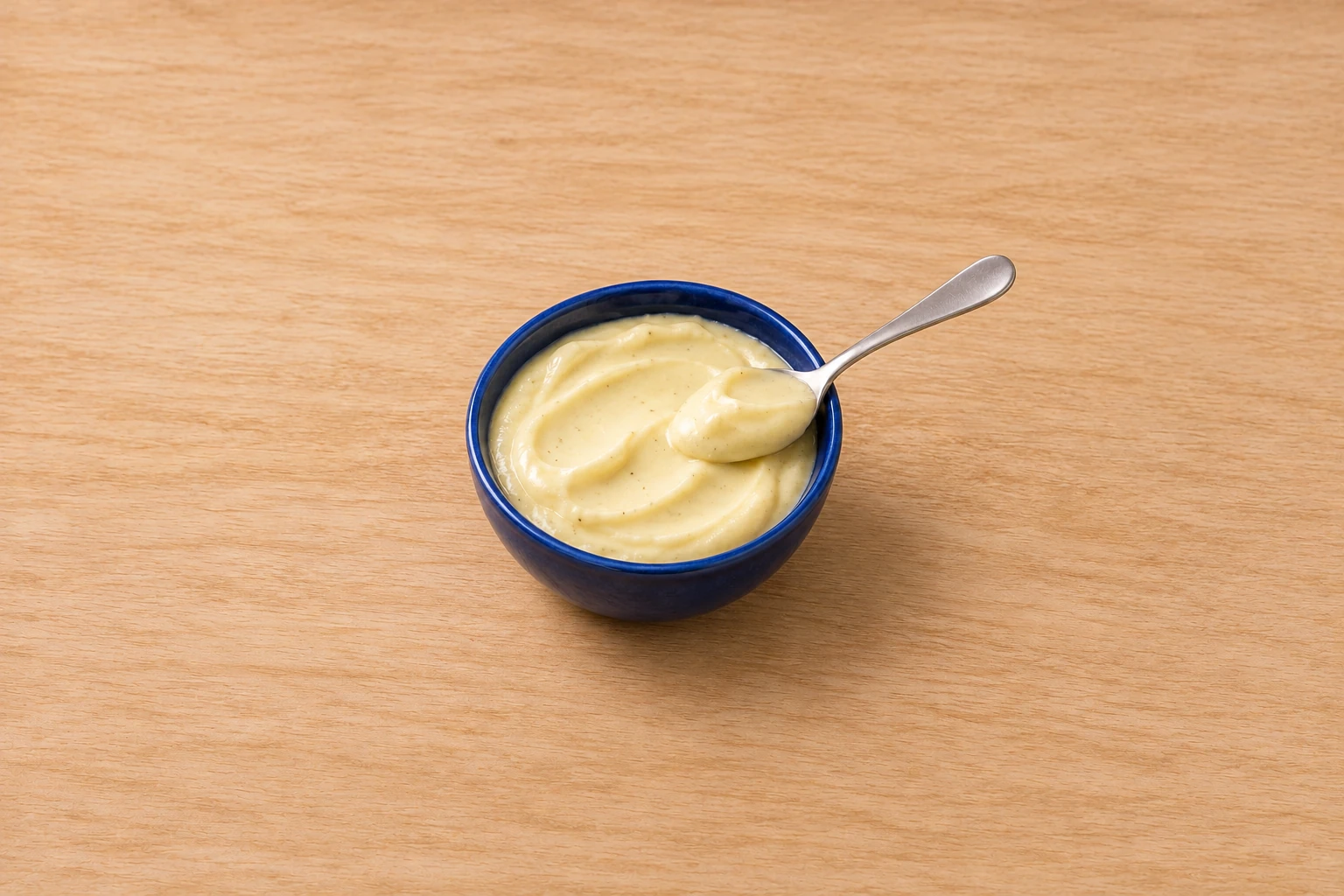
Jiffy still involved a saucepan
Jiffy begins with an egg, sugar, seasonings, lemon juice, vinegar and oil placed in a bowl without stirring. A separate preparation blends cornstarch with cold water, adds boiling water and cooks until clear. The hot paste then enters the bowl all at once, followed by rotary beating and a final addition of Worcestershire sauce.
The recipe crosses the columns of the page. Reading only its beginning loses the paste, heating and beating that explain the dressing. Cornstarch is not a dry spoonful stirred into an otherwise finished mayonnaise. The company asks the cook to make a thickened water phase and combine it with the other ingredients. Canada Starch, Jiffy Mayonnaise, p. 14.
The name promises a convenient approach, but leaves several tasks: prepare the ingredients, cook the paste, beat the mixture and arrange cold storage. Beside another method that adds oil drop by drop, the all-at-once stage might appeal to a particular cook. The printed directions give us the operations without timing a household's work.
Three recipes changed different ingredients
Ordinary Mazola Mayonnaise, on the same page, uses one egg and a cup of oil. It calls for cold ingredients, gradual oil addition and two tablespoons of lemon juice or vinegar. Jiffy keeps the egg but reduces oil to three-quarters of a cup. It uses both lemon juice and vinegar, plus starch and a cup of water in the cooked paste.
That quarter-cup reduction is a straightforward comparison of recipe inputs. It is 25 percent less oil per batch. It does not measure a reduction in the whole dressing's price: starch, water, acid, seasonings and heated work also differ. A cook choosing between them would be choosing between complete formulas.
Eggless Mayonnaise on the preceding page changes another ingredient. Three tablespoons of unsweetened evaporated milk accompany three-quarters of a cup of oil, with seasonings and lemon juice. There is no cornstarch. Beating the oil gradually into the milk mixture is part of this method, followed by the lemon. Eggless Mayonnaise, p. 13.
Evaporated milk is concentrated canned milk, not sweetened condensed milk or the ordinary unsoured milk explained in the sweet-milk reference. Its presence also makes eggless a more precise description than dairy-free. Two recipes can avoid an egg in different ways; in this booklet Jiffy does not avoid one at all.
The advertised pint needs care
The printed yields suggest a dramatic comparison: half a pint for ordinary mayonnaise and a pint for Jiffy. Yet the booklet's own measuring pages complicate those quantities. They give eight fluid ounces for a standard cup and sixteen for a pint sealer; another row equates half a pint of heavy cream with one cup. Booklet, pp. 20–21.
Under that internal relationship, the ordinary mayonnaise's cup of oil already occupies its declared half-pint before the egg and acid are considered. That is reason to treat the yield as a claim requiring measurement. Adding ingredient volumes cannot establish the exact final volume of a beaten dressing, nor tell us what correction an editor intended.
The distinction has a practical consequence. A price per pint needs a pint actually obtained, and a serving comparison needs dressings that serve the intended purpose. Ingredient quantities alone cannot settle either. As with a teacupful, the word for a vessel does not complete the measurement story.
The booklet also sold ingredients
Economy Recipes for Canada's “Housoldiers” came from the Canada Starch Home Service Department. Its foreword is dated March 1943 and carries the printed signature Jane Ashley. The inside cover names a family of corn products, including starch, syrups and Mazola oil. The corporate setting explains why an economical dressing might still feature several of the company's products.
Those two purposes can coexist. A recipe may offer a useful way to stretch an ingredient while also giving a manufacturer another use for its starch. The cover and foreword identify an offer to readers, rather than a set of recorded purchases or meals. The appropriate comparison begins with what the recipe asks the cook to buy and do.
A modern version changes the egg stage
The Jiffy demonstration below cooks the egg with the starch base, then cools that base before adding acid and oil. That is a deliberate change from the historical bowl assembly. The eggless version follows its separate milk-based sequence. Neither modern yield is used to repair the booklet's advertised pint.
Both dressings are prepared for fresh, chilled use. The original eggless recipe's cool-place keeping claim is replaced by refrigeration. A historical icebox helps explain older cold arrangements; a current refrigerator and thermometer govern the handling here.
Cooked-starch Jiffy dressing
Modern adaptation. Estimated yield: one batch, about 600 ml. Allow 20 minutes preparation, about 10 minutes cooking, 30–45 minutes rapid cooling and at least an hour chilling before service, roughly 2–2½ hours overall. Cooling may take longer; keep the mixture cold rather than using the clock as a readiness test.
Ingredients
- 1 large egg
- 32 g cornstarch
- 60 ml cold water
- 180 ml hot water
- 18 g granulated sugar
- 3 g fine salt
- 1 metric teaspoon dry mustard powder
- 1/8 metric teaspoon paprika
- 30 ml lemon juice
- 30 ml plain 5% white vinegar
- 180 ml neutral cooking oil
- A few drops Worcestershire sauce
Equipment: Small saucepan, whisk, food thermometer, a larger bowl for an ice-water cooling bath, hand blender or whisk, and a clean covered refrigerator container. Keep the bath's ice and water outside the food. A metric teaspoon is 5 ml.
Method
- Prepare the ice-water bath. Whisk the egg, cornstarch, cold water and sugar in the saucepan until smooth. Gradually whisk in the hot water.
- Cook over gentle heat, stirring continuously across the bottom, until the mixture thickens and gently bubbles. Check that it reaches at least 160°F (71°C) throughout, then stir over the heat for another minute. Remove the pan from the heat.
- Stir in the salt, mustard and paprika. Set the pan in the ice-water bath and stir to cool promptly, preventing bath water from entering it. Don't leave it on the counter to cool slowly.
- When cool, whisk in the lemon juice and vinegar. Beat in the oil gradually with a whisk or hand blender, then add the Worcestershire sauce. The dressing should be mixed evenly; its thickness can differ from a conventional mayonnaise.
- Transfer promptly to the covered container and refrigerate at 40°F (4°C) or below until thoroughly chilled. Prepare for same-day use and keep refrigerated until serving with salad or cooked vegetables.
Adaptation notes: The modern working cup is 240 ml and the tablespoon 15 ml. Cornstarch and sugar weights are chosen equivalents; salt and mustard are reduced. Cooking the egg in the paste, rapid cooling before oil addition, vinegar strength and modern blending equipment are supplied choices. The historical directions are described above in factual paraphrase; the finished volume here is an estimate, not the advertised pint.
Evaporated-milk eggless dressing
Modern adaptation. Estimated yield: one batch, about 250 ml. Estimated time: 15–20 minutes preparation, followed by about 1 hour refrigeration, or longer until thoroughly chilled.
Ingredients
- 45 ml freshly opened unsweetened canned evaporated milk, chilled
- 180 ml neutral cooking oil, chilled
- 30 ml lemon juice
- 1/2 metric teaspoon dry mustard powder
- 1/4 metric teaspoon paprika
- 1/8 metric teaspoon ground black pepper
- 2 g fine salt
- 4 g granulated sugar
Equipment: Small bowl or narrow blender vessel, whisk or hand blender, thermometer and clean covered refrigerator container.
Method
- Whisk the evaporated milk with the mustard, paprika, pepper, salt and sugar.
- Beat in the cold oil gradually, starting with small additions and incorporating each before the next. Then beat in the lemon juice until evenly combined.
- Transfer promptly to the covered container. Refrigerate at 40°F (4°C) or below until thoroughly chilled; prepare for fresh same-day service and keep cold until needed.
Adaptation notes: The same 240 ml cup and 15 ml tablespoon give 180 ml oil, 45 ml milk and 30 ml lemon juice. Salt and pepper are reduced. Use commercially processed unsweetened evaporated milk, with no substitution of sweetened condensed milk. This dressing contains milk but no egg or starch. Its estimated yield and keeping directions are separate from the original booklet's claims.
The cooked egg endpoint follows FDA egg-safety guidance. For both dressings, use clean equipment, refrigerate promptly and discard portions left out beyond two hours, or one hour above 90°F (32°C), under FDA safe-food-handling guidance. Jiffy contains egg; mustard and Worcestershire can add allergens, including fish. Read the actual labels.