 Forgotten Kitchen
Ingredients
What Is Sweet Milk in Old Recipes?
In the late nineteenth-century American cookbooks discussed here, sweet milk means milk that hasn’t soured. It doesn’t mean milk with sugar added.
- Milk
- Baking
- Ingredient names
Mary J. Lincoln makes the distinction especially clear in a corn cake. Her 1884 recipe calls for a cup of sweet milk, half a cup of sour milk and a tablespoonful of sugar. Both kinds of milk belong in the same mixture; the sugar is a third ingredient. Lincoln, Mrs. Lincoln’s Boston Cook Book, 1884 printing, p. 92.
That little list answers the name question. Making the recipe raises another: what else changes when an author changes the milk?
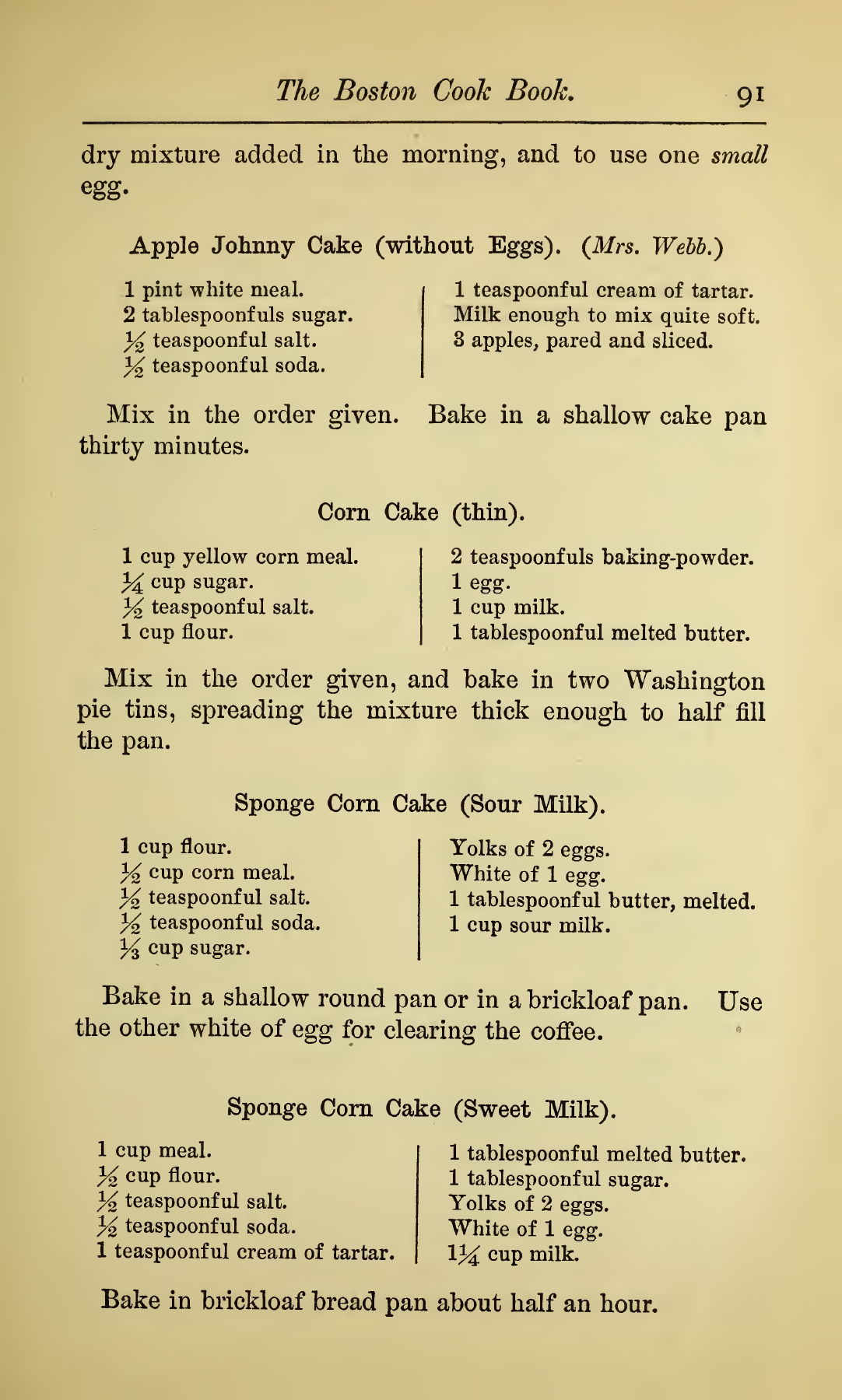
The sugar has its own line
Lincoln’s “Spider Corn Cake (Sour Milk)” is a strong example because the heading alone doesn’t tell the whole story. Read only the title and you might expect sour milk to be its sole milk ingredient. The list asks for sweet milk as well.
On the preceding page, she prints separate sponge corn cakes using sweet and sour milk. Both list sugar independently. Their milk, sugar and leavener allowances differ, so they’re two formulas, each with its own balance. They aren’t instructions to take one finished recipe and exchange the milk cup for cup. Lincoln, 1884, pp. 91–92.
Her earlier discussion supplies the vocabulary behind those recipes. She describes milk in its sweet condition and contrasts it with sour milk. Here, “sweet” identifies the milk’s condition before souring. The sugar line still tells the cook how much sugar to add. Lincoln, 1884, p. 82.
Check the leavener before changing the milk
Lincoln’s “Sour Milk Biscuit” changes more than one ingredient. It uses thick sour milk in place of sweet milk and omits cream of tartar. The omission matters as much as the replacement. Lincoln, 1884, p. 83.
This is where an unfamiliar word becomes a practical cooking question. If you replace the sour milk while keeping every other line untouched, you’re no longer following the change Lincoln describes. Her discussion also recognizes that sour milk varies in acidity; its name doesn’t provide one fixed value.
Read the milk and leavener together. A modern recipe specifying cultured buttermilk and baking soda has made more decisions than a transcription that merely replaces an old ingredient name. Our guides to saleratus and baking powder explain why the leavener’s identity also deserves a check.
For present-day handling, keep milk refrigerated and discard suspicious food. The FDA also cautions that food can be unsafe without looking or smelling spoiled. An old author’s discussion of souring shouldn’t be used to judge the safety of a forgotten carton. FDA food-storage guidance.
Sweet doesn’t specify the fat content
Once the name is understood, it’s easy to give it more precision than it has. “Sweet milk” alone doesn’t say whole, skimmed or reduced-fat. It doesn’t identify pasteurization or another processing treatment, either.
Look for a fuller description in the recipe or the author’s ingredient chapter. If a modern adaptation specifies whole milk, that’s an additional choice made explicit for today’s cook. It isn’t a fat percentage hidden inside the word “sweet.”
The same care helps with an inherited recipe card. A brief list may tell you the milk’s condition while leaving other details unstated. Preserve the distinction between what the card says and what you choose to make the recipe workable.
Buttermilk has a history of its own
Fannie Merritt Farmer defines buttermilk through butter-making: it’s the liquid remaining after the butter has formed. That’s a description of liquid from churning. Farmer, The Boston Cooking-School Cook Book, 1896, p. 12.
A modern cultured product needs its own reading. Cultured milk is made by culturing dairy ingredients; the 2025 United States standard describes that process separately. The name on a carton therefore shouldn’t be treated as proof that its contents are identical to Farmer’s churn liquid. Cultured-milk standard, 2025 edition.
For an adaptation, name the milk product being used and keep its accompanying leavener instructions. That gives the next cook something more dependable than a chain of assumed equivalents.
Condensed milk is a different question
Farmer’s milk discussion also distinguishes fresh condensed milk sold in bulk from canned products. Even the word “condensed” needs its historical context. Farmer, 1896, p. 10.
Modern sweetened condensed milk is both concentrated and sweetened: water has been removed, and sweeteners are part of the product. Those are two changes that Lincoln’s “sweet milk” doesn’t request. Sweetened-condensed-milk standard, 2025 edition.
Read that can’s full name before opening it. The shared word “sweet” doesn’t make it the milk in Lincoln’s corn cake.