 Forgotten Kitchen
Ingredients
What Is Cream of Tartar, and Why Was It Used?
Cream of tartar is potassium bitartrate, also called potassium hydrogen tartrate: an acid salt used in baking and confectionery. In old cookbooks, it can appear beside soda in a biscuit, among the dry ingredients of an egg-white cake, or in a saucepan of sugar. Those companions matter. The same powder isn't doing the same job in all three.
- Cream of tartar
- Baking
- Ingredient history
From a wine deposit to a cooking ingredient
The familiar name gives little help with identification. The FDA's potassium acid tartrate record lists cream of tartar, potassium bitartrate and potassium hydrogen tartrate as names for the same substance. It is a salt of tartaric acid, chemically distinct from free tartaric acid. A recipe naming one hasn't named the other.
Its connection with wine was familiar to nineteenth-century cookbook writers. In her 1896 Boston Cooking-School Cook Book, Fannie Merritt Farmer described argols deposited on wine-cask walls, then explained how the material was dissolved, filtered and recrystallized to obtain commercial cream of tartar. Her account separates the crude deposit from the refined ingredient that reached the cook. Farmer, 1896, pp. 56–57.
That distinction is easily lost in a short description of cream of tartar as something scraped from a barrel. The deposit was source material; refining belonged between the cask and the kitchen. Farmer's explanation makes the ingredient's unusual supply intelligible without making raw barrel scrapings a culinary equivalent.
Baking powder is another separate thing. It combines an alkaline leavener with an acid ingredient, often with starch or another dry material. Cream of tartar can supply the acid in such a mixture, but it isn't the complete mixture. Our baking-powder history follows the prepared product; here, the separate ingredient leads into several different kinds of cooking.
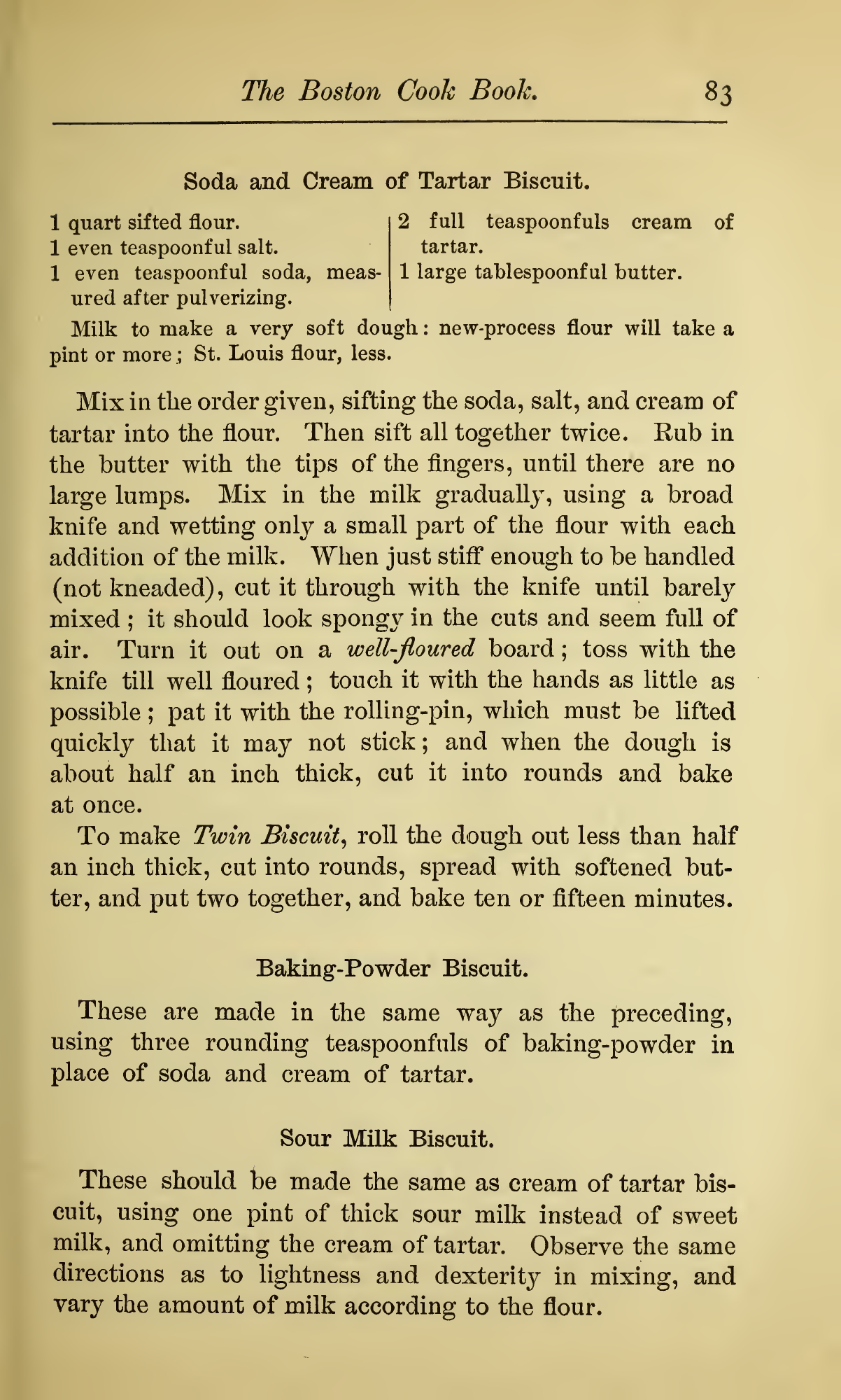
In a biscuit, look for the soda
Mary J. Lincoln's 1884 Boston Cook Book puts three biscuit variations together on one page. The first names soda and cream of tartar separately. The next uses prepared baking powder. The third changes the milk and omits cream of tartar. The layout lets the reader see the relationship without having to search through three chapters. Lincoln, 1884, p. 83.
In the first biscuit, Lincoln directs the cook to sift soda, salt and cream of tartar into the flour, then sift everything together twice. Butter follows, then milk added gradually. The acid and alkaline ingredients are distributed through the flour before liquid enters the bowl.
The partnership explains the leavening. Acid and bicarbonate in solution react to release carbon dioxide, supplying bubbles that help lighten the dough. Cream of tartar provides the acid side; the soda provides the alkaline partner. Older alkaline names need their own care, as the saleratus article explains.
Lincoln's sour-milk variation makes the relationship especially clear. She changes from sweet milk to thick sour milk and leaves out the cream of tartar. The acid-bearing part of the formula has changed with the milk. This is a specific change in her recipe, rather than a general instruction to exchange milk products freely. The meaning of sweet milk is part of that reading: it identifies milk that hasn't soured, rather than milk with sugar added.
In Angel Cake, the order changes
Turn to Farmer's Angel Cake and the soda disappears. Her 1896 ingredient list contains egg whites, sugar, cornstarch, flour, salt, cream of tartar and vanilla. Reading cream of tartar as a small packet of baking powder would leave this cake's method unexplained.
Farmer begins by beating the whites, then adds sugar gradually while continuing to beat. Flavoring follows. Only afterward does she fold in the cornstarch, flour, salt and cream of tartar, which have been mixed and sifted together. The cream of tartar enters with the dry ingredients after the whites have already been beaten. Farmer, 1896, p. 418.
Modern explanations of cream of tartar often emphasize its use in stabilizing egg-white foams. Chemist Joe Schwarcz's McGill University explanation describes how acid limits excessive bonding between egg proteins. That gives useful chemical context for the ingredient's association with egg-white preparations.
Farmer's sequence still deserves to be read as printed. Her directions don't add cream of tartar before whipping, and the modern explanation doesn't establish what she intended by adding it later. What the page does show is an egg-white cake containing the acid without a listed soda partner, incorporated at a different stage from Lincoln's biscuit.
In fondant, the concern is graininess
The sugar pan supplies a more explicit statement of purpose. Introducing fondant in 1896, Farmer says that a small quantity of cream of tartar is included to prevent the sugar from granulating. Her White Fondant ingredient list below combines sugar, hot water and cream of tartar. There is no flour or soda in this preparation. Farmer, 1896, p. 453.
McGill's explanation supplies a modern account: acid can break down some sucrose into glucose and fructose, helping limit the formation of large sugar crystals. That is a textural job, distinct from releasing gas in biscuit dough or affecting an egg-white foam.
Farmer's wording can sound as though fondant should contain no crystals at all. Fondant's smooth texture, however, depends on fine crystals rather than coarse graininess. The important distinction is the size and character of the crystals. In this saucepan, cream of tartar belongs to the management of sugar texture, with neither a soda reaction nor a cake's beaten whites in sight.