 Forgotten Kitchen
Ingredients
What was saleratus?
Saleratus was an alkaline leavener used to help baked goods rise. In an old American cookbook, it can mean a product made from pearlash or baking soda sold under the older name. The two aren't the same substance, even when the label is the same.
- Leaveners
- Pearlash
- Baking soda
That leaves a small puzzle for anyone reading an old recipe: what did the writer expect the cook to buy? A date helps, but the answer may be tucked into the book's general directions. A passage about lumpy soda or a line telling the cook to dissolve pearl ash can be as useful as the ingredient list itself.
The soda sold as saleratus
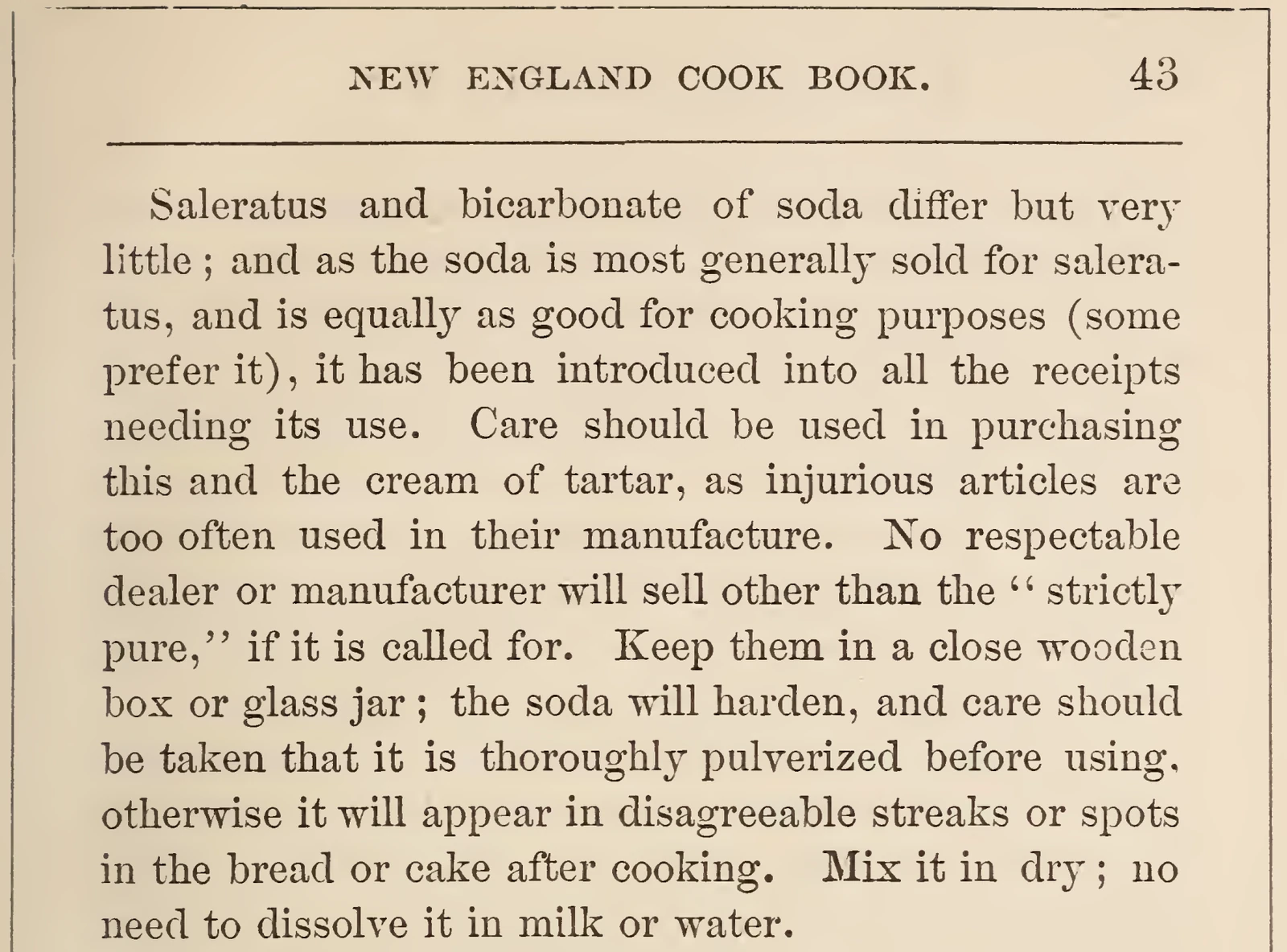
Aunt Mary's New England Cook Book gives a remarkably direct answer in 1881. Its cake directions explain that bicarbonate of soda was commonly sold as saleratus. The author uses soda in the recipes, so the reader doesn't have to guess which material those directions concern. Baking soda is the modern name for bicarbonate of soda.
The same passage gets down to a problem familiar from any powder that has formed lumps in a container. Hardened soda must be thoroughly pulverized, the book says, to prevent disagreeable spots or streaks in bread and cake. It then directs the cook to mix the soda in dry. The ingredient's name, condition and handling all appear together in a few lines. Aunt Mary's New England Cook Book, Boston: Lockwood, Brooks & Co., 1881, “Cake,” p. 43.
A cook following these directions would mix the soda dry, even if the shop called it saleratus. Looking up only the older meaning of the name would miss the author's explicit instructions.
Back to pearl ash, milk and coriander
Amelia Simmons's American Cookery (1796) takes us to an earlier ingredient and a different way of incorporating it. Her “Cookies” call for pearl ash. Sugar is boiled in water and cooled; the pearl ash is dissolved separately in milk. The dough also contains butter and coriander seed. There's more going on here than adding a spoonful of white powder to flour.
Her molasses gingerbread changes the liquid: pearl ash is dissolved in water. It also changes the handling and baking. Simmons calls for kneading the mixture stiff, brushing the surface with egg whites and sugar, and baking in a brisk oven with a warning against scorching. The cookies go into a slack oven. Those are distinct recipes, each with its own instructions for getting the leavener into the dough and baking the result. Simmons, American Cookery, 1796, “Cookies” and “Molasses Gingerbread”.
Compare the dissolved pearl ash with Aunt Mary's dry soda. The difference is worth keeping in view when a short recipe seems to say very little. Its writer may have supplied the rest of the method elsewhere, or assumed the reader already knew it. For the oven language in Simmons's recipes, our guide to a slack oven follows the heat words alongside the food being baked.
What pearlash and soda had in common
Mary J. Lincoln explained the materials in her 1884 Boston Cook Book. Potash came from wood ashes; pearlash was purified potash. Saleratus was prepared by exposing pearlash to carbon dioxide, called carbonic acid gas in her account. She also identified bicarbonate of soda as the soda then used in cooking, distinguishing it from the potash compounds. Lincoln, Boston: Roberts Brothers, 1884, “Soda Biscuit, Muffins, Gems, Etc.,” pp. 80–83.
Their common purpose helps explain how the names could become confusing. A carbonate or bicarbonate leavener can react with an acid to release carbon dioxide. Bubbles of that gas help lighten a mixture. An ingredient sold under a familiar leavening name could therefore have a recognizable job while differing from the material that had carried the name before it.
The acid might already be in the food. In the 1910 revised Boston Cooking-School Cook Book, Fannie Merritt Farmer discusses molasses, sour milk and lemon juice in connection with soda. She also describes soda and cream of tartar as a once widely used pairing, generally superseded by baking powder. Her account of the prepared powder brings soda, acid and a little dry material such as flour or cornstarch into one ingredient. Farmer, 1910 revised edition, pp. 52–53.
Our history of baking powder follows that prepared mixture into patents, advertisements and a biscuit recipe. Saleratus poses a more immediate reading question. Check the edition, look for the author's definition, and read how the leavener is mixed. When the name means the older pearlash-derived material, a printed spoonful alone isn't enough to establish a reliable baking-soda substitution.