 Forgotten Kitchen
Ingredients
Currants, Raisins and Sultanas in Old Recipes
The currants in a historical cake may be small dried grapes. The currants in its author’s jelly recipe may be fresh berries. The surrounding instructions usually tell you which purchase belongs in the kitchen.
- Dried fruit
- Ingredient forms
- Baking
Raisins and sultanas bring another question: how much preparation has already been done? An instruction to stone, clean or dry the fruit can change both the work involved and the stage at which it’s weighed. A modern bag may save that labor without answering every other ingredient question.
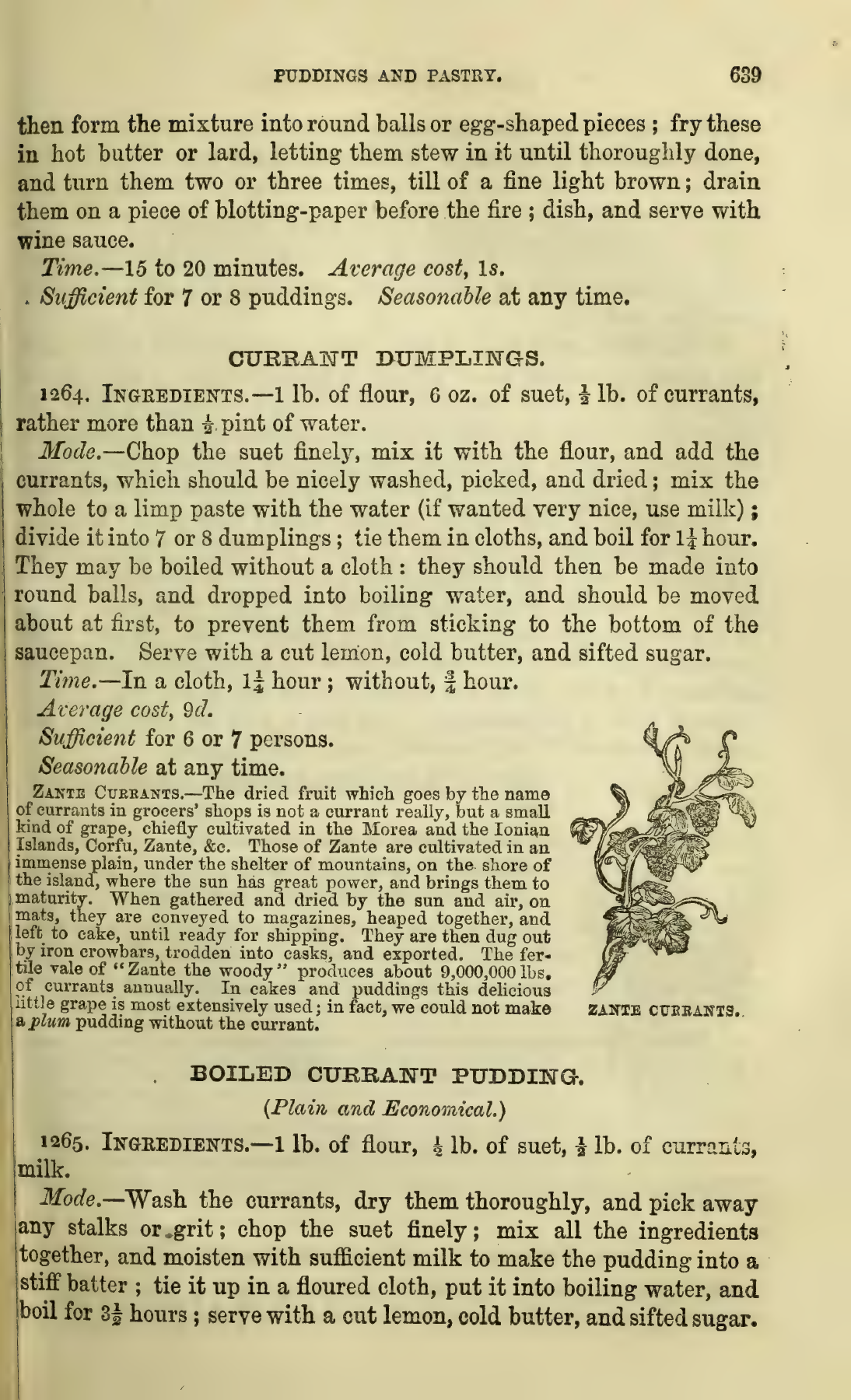
Two meanings of currant in the same book
Beside her pudding recipes, Isabella Beeton explains that grocers’ dried currants are small grapes. Her heading is “Zante Currants.” That note gives a direct identification for the fruit being sold for those mixtures. Beeton, The Book of Household Management, 1861, p. 639.
Elsewhere, her “Red-Currant Jelly” begins with fruit gathered and taken from its stalks, then pressed for juice. July appears as its season. Here, the word belongs to fresh fruit, with a different preparation and purpose. Beeton, 1861, p. 772, no. 1533.
The contrast is more dependable than assigning one meaning to every occurrence of “currant.” Picking through dried fruit for a pudding and stripping fresh fruit from stalks for jelly are different jobs. Read the nouns with their verbs.
| Wording or context | What the source indicates |
|---|---|
| Beeton’s grocers’ or Zante currants | Small dried grapes |
| Beeton’s red currants gathered for jelly | Fresh fruit, removed from stalks and pressed |
| Raisins to be stoned | Fruit whose seeds must be removed |
| Beeton’s sultana discussion | Fruit without stones to remove |
The final two entries concern preparation as well as identity. “Stoned” is an operation; “seedless” describes fruit that won’t need that operation.
Cleaning was a substantial part of the recipe
Eliza Acton gives currant cleaning its own instructions. She rubs the fruit with flour, works it through a colander, rinses it, dries it in a cloth and finishes the drying with gentle heat. Inspection for remaining foreign material follows. Acton, Modern Cookery, in All Its Branches, 1845, pp. 437–438.
Drying isn’t an incidental last word. Acton warns that the fruit should dry gradually because excessive heat will harden it. Her cleaned currants are meant to arrive at the next stage without the surface water from washing.
There are also two different kinds of “stone” to keep apart. The stones among currants at the end of cleaning are unwanted grit or foreign material. Stoning raisins means removing their seeds. Acton isn’t asking the cook to extract a seed from every little currant.
These directions describe the condition of the purchase she expects. They don’t mean that every modern packet needs the same treatment. Check what has already been done before repeating an old cleaning process.
Raisin weight can come after seed removal
Acton’s “Prince Albert’s Pudding” calls for half a pound of jar raisins weighed after stoning. The preparation sits inside the measurement. Acton, 1845, p. 448.
Half a pound bought, then seeded, would leave less fruit than half a pound weighed afterward. There’s no need to invent a standard percentage for the discarded seeds: Acton has already told the cook which amount belongs in the mixture.
When adapting that instruction with seedless fruit, preserve the prepared-fruit target and record the form chosen. It saves the next cook from wondering whether an allowance for seed removal has already been included.
Sultanas offered a related convenience. Beeton’s “Sultana Grape” note draws attention to the absence of stones and the labor that saves. That’s a specific reason to value the fruit before any discussion of flavor. Beeton, 1861, p. 666.
Our Christmas pudding ingredient comparison shows how Beeton and Acton keep the fruit allowances separate.
A seedless purchase resolves the seed-removal question. It doesn’t, by itself, make every named dried fruit interchangeable or turn the separate fruit allowances in a recipe into one combined amount.
Farmer’s packages change the work
By 1896, Fannie Merritt Farmer could distinguish packaged washed currants from fruit bought in bulk. Her cake directions give the packaged fruit a much shorter preparation: picking over and flouring. Bulk currants require more work. Farmer, The Boston Cooking-School Cook Book, 1896, p. 414.
That distinction interrupts an easy picture of the old kitchen. There wasn’t one unchanging preparation routine that every cook followed until modern convenience arrived. Farmer was already telling readers how their purchase altered the job.
On the same page, she describes seeding and cutting raisins, and she objects to covering the raisins with warm water for the cake preparation she’s discussing. Keep that advice attached to its setting. A different recipe may deliberately ask for soaked fruit.
For a working recipe, write down the fruit’s name, whether it contains seeds, and whether its quantity is taken before or after preparation. Then check the packet. Farmer’s washed currants show that saving the cleaning work can be entirely consistent with a historical instruction, provided they’re the fruit that instruction actually describes.