 Forgotten Kitchen
Ingredients
Why Is Mincemeat Called Mincemeat?
Mincemeat has its name because chopped meat really does appear in historical fillings alongside dried fruit, sugar, spice and fat. Beeton’s 1861 recipe lists a pound and a half of lean beef separately from three pounds of beef suet. The meat and the fat are two ingredients, not two names for the same thing. Beeton, The Book of Household Management, 1861, p. 657, no. 1309.
- Mincemeat
- Pies
- Ingredient history
But turn the page and another filling leaves out the chopped beef while retaining suet. The name covers both. The familiar story that meat was used long ago and then disappeared is too tidy for these books.
Tongue, sirloin and an optional addition
Eliza Acton’s own mincemeat recipe specifies unsalted ox-tongue. Beef kidney suet has a separate place in the mixture. She also permits roasted sirloin in place of the tongue, so even this meat-containing filling offers a choice about the meat. Acton, Modern Cookery, in All Its Branches, 1845, p. 427.
The next recipe, “Superlative Mincemeat,” complicates the picture. Its main formula brings together fruit, suet, sugar and brandy without an allowance for chopped flesh. A footnote recommends a small meat addition, or offers macaroons instead. Acton, 1845, p. 428.
Read only the main list and you miss an option. Read only the footnote and you might mistake that option for a requirement. Acton gives the cook several routes within two neighboring recipes.
The macaroons also matter because they aren’t a modern editor’s attempt to remove the meat. They’re part of Acton’s own qualification. Her page already contains a discussion of alternatives, even though the suet remains.
Beeton puts the alternatives next to each other
Beeton’s consecutive recipes make the comparison particularly easy to follow.
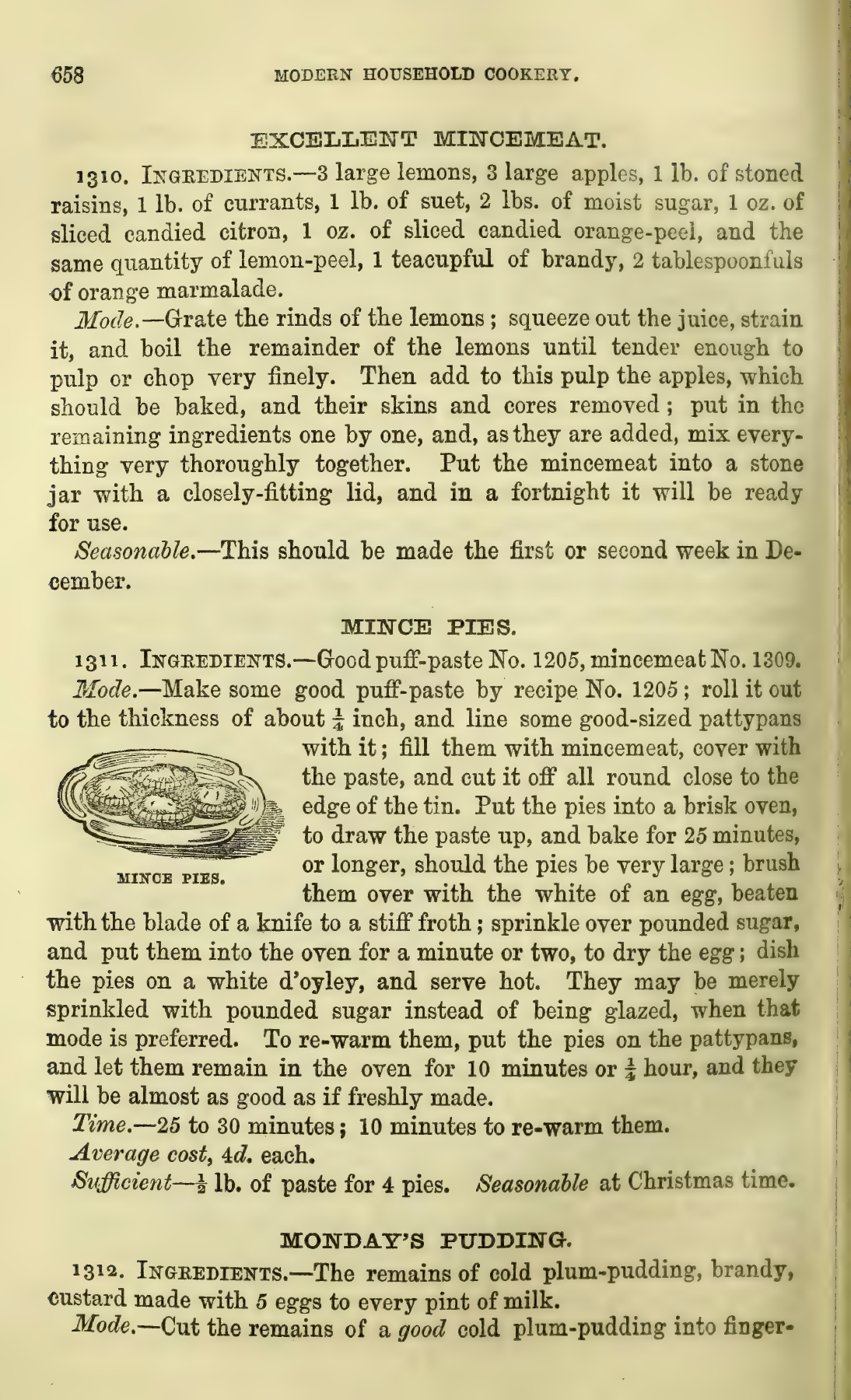
No. 1309, “Mincemeat,” includes lean beef and beef suet. No. 1310, “Excellent Mincemeat,” combines suet, fruit, sugar, peel, brandy and marmalade, with no chopped muscle meat listed. Both belong to the same 1861 book. Beeton, 1861, pp. 657–658.
Then comes “Mince Pies,” no. 1311. Its directions refer specifically to no. 1309, the mixture containing beef. The nearby presence of the other filling doesn’t erase that cross-reference.
That small recipe number can settle a question that the general name leaves open. If you’re following a historical pie entry, find the filling it actually names. An author may have printed several choices while directing this particular pie toward one of them.
The distinctions across the three books look like this:
| Cookbook | Filling with chopped meat | Neighboring alternative |
|---|---|---|
| Acton, 1845 | Her own recipe uses ox-tongue, with roasted sirloin as an alternative | “Superlative Mincemeat” has no flesh in its main list, then offers optional meat or macaroons |
| Beeton, 1861 | No. 1309 lists lean beef and beef suet separately | No. 1310 retains suet but lists no chopped muscle meat |
| Farmer, 1896 | “Mince Pie Meat” includes lean beef and beef suet | “English Mince Meat” lists suet without beef flesh |
These entries give a more specific account than a single before-and-after date. The alternatives were being printed together.
Both forms were still on the page in 1896
Fannie Merritt Farmer’s “Mince Pie Meat” lists four pounds of lean beef and two pounds of beef suet. On the same page, “English Mince Meat” includes suet without an accompanying allowance of beef flesh. Farmer, The Boston Cooking-School Cook Book, 1896, p. 393.
That’s fifty-one years after Acton’s book. Across these examples, fillings with chopped meat and fillings without it continued to appear side by side.
Farmer’s “English” heading is her recipe’s name. It doesn’t tell us what every English cook preferred, any more than the order of Beeton’s entries tells us which filling sold more pies. What the page does show is a choice available to its reader.
A recipe title can preserve a familiar name while the list underneath changes. For mincemeat, the ingredient list is therefore more informative than the assumption that the name must describe one fixed formula.
No chopped beef doesn’t mean no animal fat
Suet is animal fat, and these authors name it separately from tongue, sirloin or lean beef. Removing the chopped flesh doesn’t remove the suet.
That distinction matters when choosing a filling for someone who doesn’t eat meat. Beeton’s “Excellent Mincemeat” may omit chopped beef, but its suet still needs to be considered. Our guide to suet explains the ingredient and the different forms in which it can be supplied.
For a modern vegetarian filling, check the actual fat specified in the recipe or product. A vegetable-suet adaptation can state that choice plainly. The historical words “without meat,” or a list without lean beef, aren’t enough on their own to establish it.
When reading an old mince-pie recipe, follow its filling reference first. Then look for both entries: the chopped meat, if present, and the separately named fat.