 Forgotten Kitchen
Ingredients
What Were Mock Oysters Made From?
Mock oysters could be made from corn or salsify, mixed and fried into small individual pieces. The name often referred to a cooked oyster dish, including its shape, browned surface and place at the table. It did not identify one vegetable or one reason for making the substitution.
- Corn
- Mock foods
- Frying
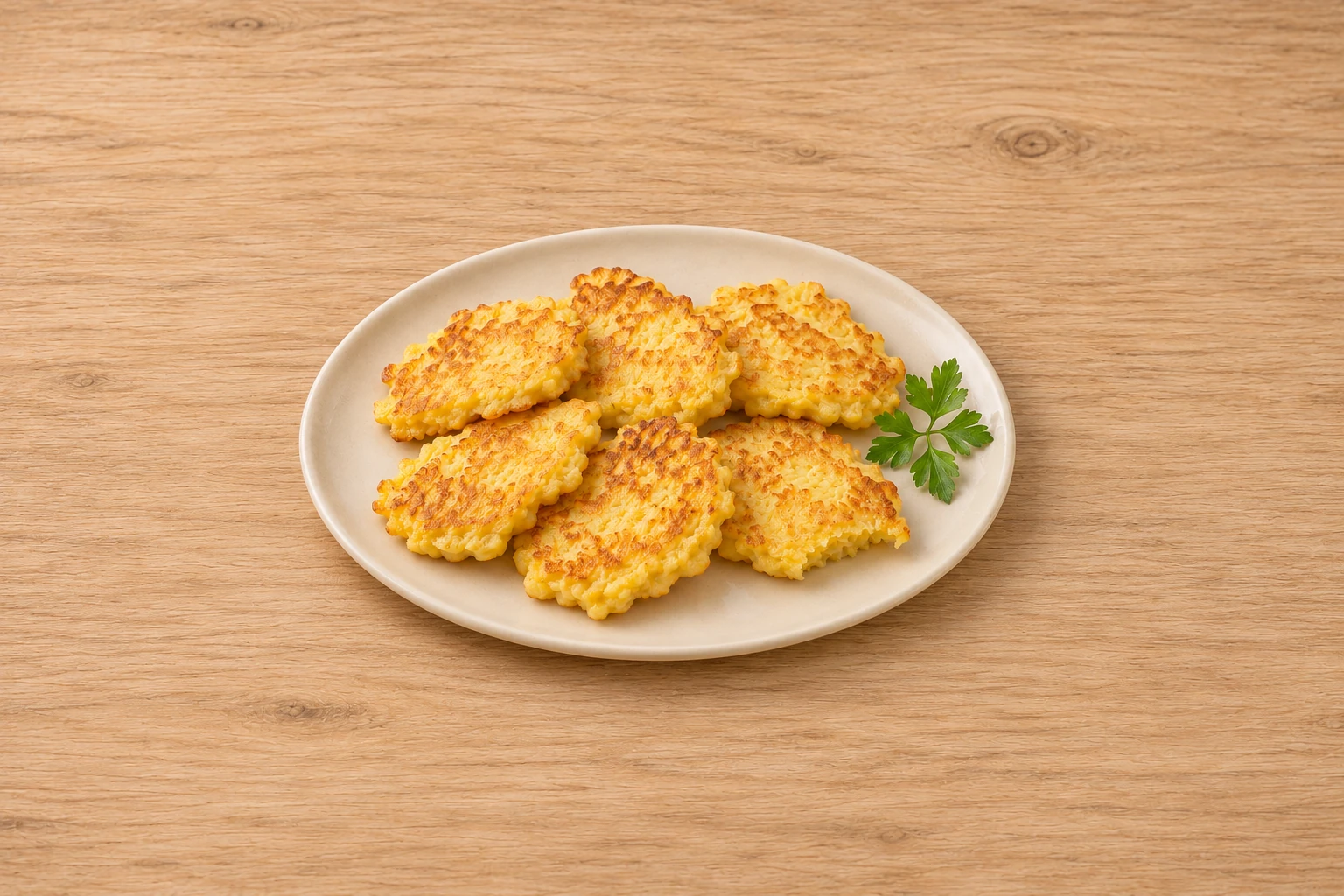
Begin with the fried oyster
Eliza Leslie's 1840 eleventh edition of Directions for Cookery asks for young corn grated as finely as possible. Flour and beaten egg yolks bind the pulp. The cook fries portions in equal amounts of lard and butter, shaping them to resemble fried oysters and sending them to table hot. Leslie suggests breakfast or a dinner side dish. Mock Oysters of Corn, p. 193.
Her actual Fried Oysters, earlier in the same book, makes the comparison more precise. Shellfish are dried, coated using yolk and milk, covered with bread crumbs and browned in butter. The corn version constructs a small piece from pulp instead of coating an individual oyster. Both arrive hot and browned, but they reach that state by different routes. Leslie, pp. 57–58.
That difference explains why a plate of corn mock oysters should look like irregular spooned cakes. A bread-crumb shell, whole kernels pressed into a dense block or a pile of rice would belong to other preparations. The original comparison is with a particular finished dish, rather than with a raw oyster in its shell.
Young corn was an instruction
Leslie ends by insisting that the corn be young. Her sensory claim belongs with that ingredient choice. The page does not establish that dried corn, mature kernels or a bag of frozen corn would give the same result. Grating also retains liquid from the kernels, making the prepared pulp different from a measure of drained whole corn.
Her quantity is eighteen large ears, with six yolks and three large spoonfuls of flour. Ears remain variable natural objects, while the large spoon has no recovered gram equivalent. A modern smaller batch must choose how to interpret both. The teacupful reference follows a related problem: the preparation and filling operation matter alongside the name of the measure.
The Leslie recipe below retains a third of her ear and yolk counts, then supplies a flour weight and thinner pieces. It leaves the corn as fresh grated pulp, rather than pretending that six ears always produce the same measured volume.
Salsify made another kind of cake
Marion Harland's 1883 Common Sense in the Household places Fried Salsify, or Mock Oysters across two pages. The roots are cleaned, soaked, boiled, cooled and mashed, with fibers removed. Milk, butter and egg follow; round cakes are dredged with flour and fried brown. Shape is less oyster-like here, while the preparation of the root does much of the work. Harland, pp. 223–224.
Her neighboring stewed salsify keeps the root in pieces and compares the result with stewed oysters. One vegetable could therefore carry the oyster association through more than one cooking method. The name alone does not settle whether the cook should grate, boil, mash, coat or stew.
The modern Harland salsify cakes are a separate recipe. The two demonstrations on this page stay with corn so that differences in egg, fat and preparation can be compared without introducing a third plant mixture.
Dwight supplied a dietary setting
Henrietta Latham Dwight's 1898 Golden Age Cook Book gives Mock Oysters of Green Corn a measured pint of grated corn, a cup of flour, one egg, butter and milk. Spoonfuls should become oblong cakes that look like oysters; parsley finishes the platter. She also permits canned corn pressed through a colander to separate the hulls. Dwight, p. 67.
The preface gives this recipe a stated context. Dwight addresses people adopting a bloodless diet and argues for protecting animals. That supports reading her corn oysters within a vegetarian project. The recipe still contains egg and dairy. Its milk is an ordinary dairy ingredient, distinct from the sugar implied by some readers' interpretation of sweet milk.
Leslie's lard offers a useful counterexample. A dish called mock oysters could appear in an omnivorous cookbook or a vegetarian one. Dwight's economy arguments in her preface do not supply the price of her cakes, and Leslie does not identify a shortage that caused hers. Their instructions establish recipes and intended uses more securely than household motives.
Similar names, different proportions
Dwight's flour and whole egg make a different mixture from Leslie's small flour allowance and yolks. Her two ounces of butter appear in the list before an instruction to mix well, followed by frying in hot butter. The modern version below puts the measured butter into the mixture and supplies separate pan butter. That makes the allocation explicit.
Leslie's version keeps equal frying fats and a much looser corn base. Neither recipe earns its name by proving that diners could not tell it from shellfish. They show how a familiar cooked form could organize a vegetable dish: a small portion, a browned outside and hot service.
Dwight-style green-corn mock oysters
Modern adaptation. Estimated yield: about 20 small cakes, 5 side portions. Estimated time: 25 minutes preparation and 25–30 minutes batch frying, about 55 minutes total.
Ingredients
- 473 ml finely grated tender fresh sweet-corn pulp, including its liquid, measured after grating
- 120 g all-purpose flour
- 1 large egg, beaten
- 57 g unsalted butter, melted and cooled, for the mixture
- 45 ml pasteurized whole milk
- 1/2 metric teaspoon fine salt
- 1/8 metric teaspoon ground black pepper
- 28 g unsalted butter for frying, plus up to 14 g more if needed
- 5 g fresh parsley, for the platter
Equipment: Coarse grater, bowl, 12-inch nonstick or seasoned skillet, tablespoon, thin spatula and food thermometer. A metric teaspoon is 5 ml.
Method
- Grate enough fresh corn to measure the listed pulp and liquid together. Keep that prepared measure separate from the discarded cobs; no fixed ear count is assumed.
- Mix the pulp, flour, beaten egg, cooled 57 g butter, milk, salt and pepper until the flour is incorporated. Don't taste the raw mixture.
- Heat part of the separate frying butter over medium heat. Drop separated spoonfuls into the pan, gently nudging them into small ovals about 1 cm thick.
- Fry a first small portion for about 3 minutes per side as an initial guide. Turn gently once set underneath and check that the center reaches 160°F (71°C). Lower the heat if the surface browns before the center cooks.
- Continue in uncrowded batches, using the remaining pan butter and optional extra butter only as needed. Keep the same thickness and center check. Transfer to a warm platter, add the parsley and serve hot.
Adaptation notes: The source pint is represented by a modern US pint rounded to 473 ml; flour weight, milk volume, seasoning and portion count are supplied. The 57 g butter follows the two-ounce allowance and is mixed in, with separate measured butter for frying. That allocation resolves an ambiguity in the short source. This version selects fresh corn; it does not combine the canned-corn alternative with the measured fresh pulp.
Leslie-style fresh-corn mock oysters
Modern adaptation. Estimated yield: 12–18 small cakes, 3–4 side portions, depending on the ears and spoonful size. Estimated time: 25 minutes preparation and about 30–35 minutes frying, roughly 1 hour total.
Ingredients
- 6 large ears tender young sweet corn, husked
- 2 large egg yolks, beaten
- 15 g all-purpose flour, plus up to 15 g more only if needed
- 30 g unsalted butter, for frying
- 30 g lard, for frying
Equipment: Grater, bowl, scale, 12-inch nonstick or seasoned skillet, spoon, thin spatula and food thermometer.
Method
- Grate the corn finely into a bowl, keeping the pulp and liquid. Discard the cobs. Beat in the yolks and initial 15 g flour thoroughly.
- Check a small spoonful. If it immediately runs flat, mix in some of the extra flour, a little at a time, using no more than the listed additional 15 g. The mixture is intended for spooning, not rolling by hand.
- Melt part of the butter and lard together over medium heat, preserving equal amounts of each. Spoon in one small portion and nudge into an oval about 1 cm thick.
- Fry about 3–4 minutes per side initially, turning gently after the underside sets. Check the center reaches 160°F (71°C); lower the heat if browning runs ahead of cooking. Check the first portion holds through turning before frying the rest.
- Continue in uncrowded batches with the remaining equal fats. Drain briefly and serve hot.
Adaptation notes: Six ears and two yolks are a third of Leslie's counts. The flour weight, conditional extra allowance, total frying fats and modern portion estimate are chosen quantities. The cakes are deliberately thinner than her near-inch direction. There is no salt in this version because her formula specifies none. Variable ears prevent an exact corn-to-flour ratio from being recovered from the source.
Both versions contain wheat, egg and milk; Leslie's also contains pork fat. Cook each batch through and keep raw batter away from ready-to-eat food. The egg-dish endpoint and prompt refrigeration follow FDA egg-safety guidance. Refrigerate leftovers within two hours, or one hour above 90°F (32°C), and reheat to 165°F (74°C).