 Forgotten Kitchen
Ingredients
What Was Oleomargarine in Old Recipes?
Oleomargarine was a manufactured butter substitute whose ingredients could vary. In an old recipe, the word names a purchased cooking fat rather than one permanent formula. It should not automatically become a modern low-fat spread: the recipe's use, the product's firmness and its suitability for baking still matter.
- Margarine
- Butter
- Wartime baking
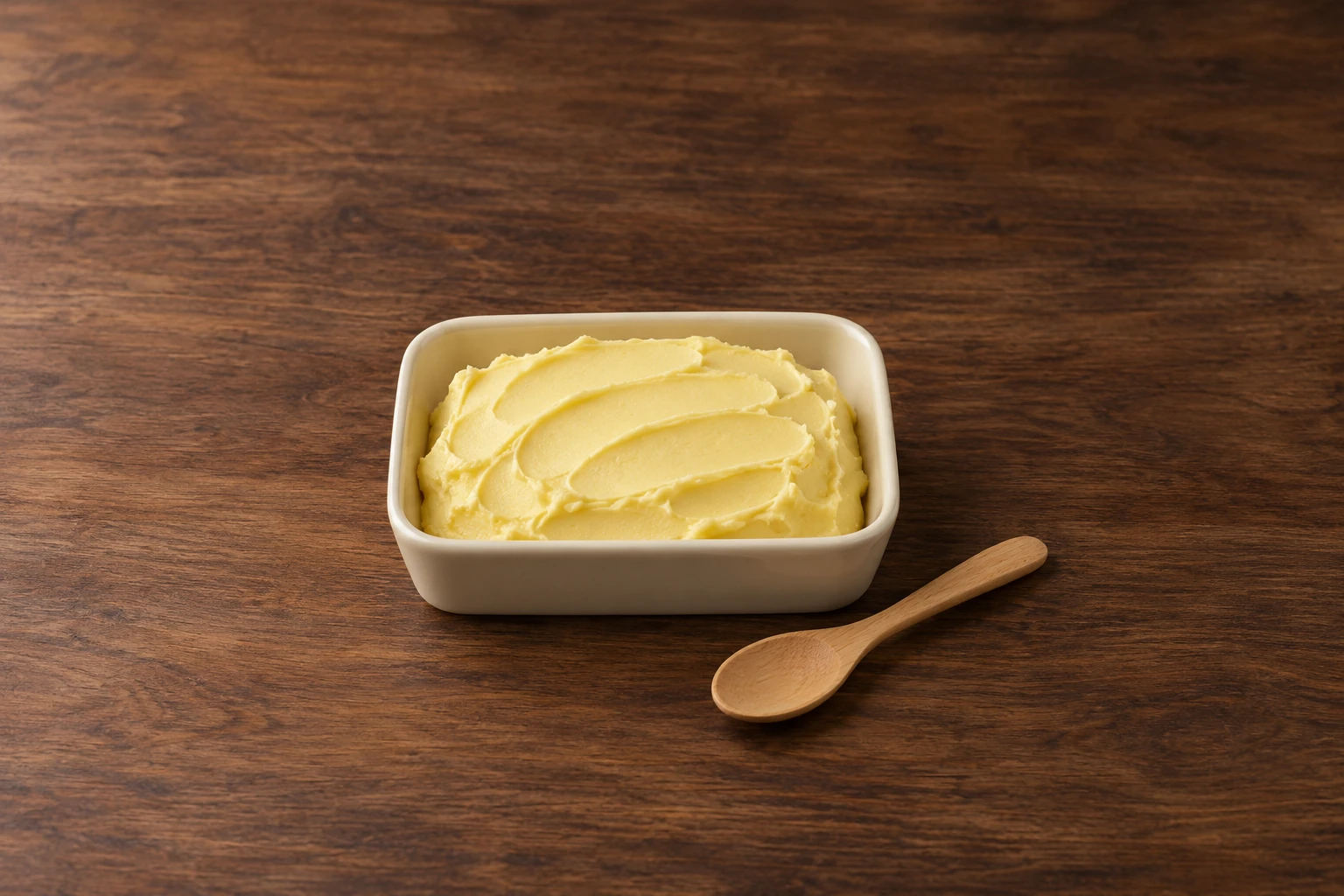
A 1918 cake assigns oleomargarine one job among potato, barley flour, chocolate and eggs. Another cookbook from the same year blends a substitute with butter for the table. These uses make more sense when the commercial product, a declared household mixture and a baked ingredient keep their separate identities.
A substitute could contain real butter
The reported account in McCray v. United States gives an unusually precise example. The Ohio Butterine Company's stated formula included oleo oil, lard, creamery butter, milk and cream, and salt. This is the manufacturing account pleaded in the case, not an independently inspected batch sheet.
Its butter had already been artificially colored a deep yellow. The manufacturer argued that butter was a permitted ingredient, so color arriving inside that butter should not make the finished oleomargarine artificially colored. The Supreme Court disagreed in 1904. Permission to use butter did not make its added coloring disappear in the final mixture. Natural yellow from an ingredient was a separate distinction. McCray, 195 U.S. 27, especially printed pp. 28 and 47–50.
That case also demonstrates why quantities need their labels. The pleaded ingredient list totals 137 pounds. The purchased package at issue weighed fifty pounds. The list and package cannot be treated as the same batch yield, nor can their figures reveal the proportion in a finished pat without knowing what happened during manufacture.
The dispute concerned tax classification, not a household comparison of how cakes rose. It nevertheless makes the ingredient name concrete: this oleomargarine included animal fats and butter alongside dairy liquids. A present-day vegetable baking margarine can be a chosen adaptation ingredient without recreating that product.
An honest label did not settle every restriction
An earlier case concerned a clearly identified sale. In 1893 George Schollenberger sold an unopened forty-pound tub of oleomargarine in Philadelphia. The special verdict recorded that the buyer knew what he was purchasing. In 1898 the Supreme Court protected the interstate original-package transaction against Pennsylvania's prohibition, reversing and remanding the cases. Schollenberger v. Pennsylvania, 171 U.S. 1, printed pp. 3–5 and 24–25.
That decision had a first-sale boundary. It did not permanently remove every restriction on imitation dairy foods. The later 1902 legislation changed the treatment of transported products on arrival, and McCray upheld the differently taxed product in 1904. The historical sequence resists a simple ending in which identifying margarine honestly made every other commercial issue vanish.
Nor do the tax figures supply a retail price. The higher rate on McCray's fifty-pound package corresponds to $5; the lower rate corresponds to 12½ cents. Those are calculated tax amounts, separate from the $50 statutory penalty. They cannot establish what a householder saved by buying or mixing fats. The household recipes that follow were printed in 1918, well after these cases, and are later comparisons rather than food attributed to their participants.
Butter shared its place on the table
Under “Extension of Table Fats,” C. Houston and Alberta M. Goudiss offered a particularly simple option. Soften one pound of butter and one pound of a named substitute, blend thoroughly with a paddle or wooden spoon, and use as butter. Oleomargarine was among the alternatives.
This was a declared mixture with a one-to-one mass relationship. The self-contained item E does not require the milk and gelatin used in other formulas nearby. Importing those steps would create a different preparation. Goudiss and Goudiss, Foods That Will Win the War and How to Cook Them, copyright 1918, printed pp. 80–81, scan leaves 88–89.
A home mixture for the family table also occupied a different context from manufacturing a product for sale. McCray itself discusses that distinction. The courtroom and cookbook therefore should not be forced into one imagined episode, with the household blend presented as a forbidden commercial batch.
A different role inside chocolate cake
Carolyn Putnam Webber's 1918 Two Hundred and Seventy-Five War-Time Recipes puts a quarter cup of oleomargarine into chocolate cake. Mashed potato and barley flour accompany sugar, corn syrup and eggs. The recipe permits chocolate to be omitted and the mixture baked as a loaf or in muffin tins. It supplies no mixing sequence, oven temperature, duration or yield. Webber, “Chocolate Cake,” printed p. 51, scan leaf 58.
Inside this cake, the fat does not have to look like a pat on the table. At the same time, changing fat is only one part of the formula. Potato, syrup and barley flour prevent the cake from becoming a clean experiment in replacing butter alone. A claim that diners could not distinguish the substitution would need evidence the printed recipe cannot provide.
The modern cake keeps those ingredients and supplies the missing practical decisions. Both recipes below use firm margarine sold for baking; its label controls suitability and storage.
Butter-and-baking-margarine blend
Modern adaptation of Goudiss item E. Makes about 200 g before transfer loss. Estimated preparation: 10 minutes plus brief softening and about 1 hour chilling. Equipment: bowl, wooden spoon, scale and covered refrigerator dish.
Ingredients
- 100 g unsalted butter, softened until spreadable
- 100 g firm baking margarine, softened until spreadable
Method
- Put both softened fats in the bowl. Use margarine sold for baking, rather than a low-fat spread.
- Blend thoroughly with the spoon until visually uniform. Do not melt the fats or add coloring.
- Transfer to the covered dish and refrigerate until firm. Soften only the portion wanted for serving.
- Keep refrigerated at 40°F/4°C or below. Make a small batch for use within three days, or sooner if either ingredient's label requires it.
The smaller quantity preserves the source's equal masses. Refrigeration, the short use period and the consistency endpoint are modern handling choices.
Potato and barley chocolate cake
Modern adaptation of Webber's cake, retaining chocolate. Makes one 8-inch/20 cm square cake, about nine pieces. Estimated preparation: 25 minutes; baking: 30–40 minutes, checking from 25; cooling: about 1 hour. Equipment: 8-inch/20 cm square pan at least 2 inches/5 cm deep, parchment, bowls, mixer or wooden spoon and food thermometer.
Ingredients
- 55 g firm baking margarine, softened, plus about 5 g to grease the pan
- 100 g granulated sugar
- 160 g light corn syrup
- 57 g unsweetened baking chocolate, chopped
- 2 large eggs, about 100 g out of shell
- 210 g plain cooked mashed potato, smooth and cooled, with no added milk or fat
- 12 g double-acting baking powder
- 3 g fine salt
- 5 ml vanilla extract
- 135 g barley flour
Method
- Heat the oven to 350°F/175°C. Grease and line the pan. Melt the chocolate gently over hot water and let cool until warm.
- Beat the 55 g margarine with the sugar. Beat in corn syrup, eggs, potato, vanilla and melted chocolate until evenly mixed.
- Combine barley flour, baking powder and salt separately. Fold into the wet ingredients until no dry flour remains. Do not taste raw batter.
- Spread in the pan. Bake about 30–40 minutes, checking from 25, until the center is set and a skewer has no wet batter. The center must also reach at least 160°F/71°C; continue baking if necessary.
- Cool in the pan, then cut into about nine pieces. Refrigerate covered leftovers promptly and use within three days, or freeze. Keep refrigerated at 40°F/4°C or below.
The metric quantities are editorial kitchen choices. Chocolate rounds two ounces to 57 g; the potato and barley-flour masses are specified weighing targets rather than measured historical cup densities. The square pan, mixing order, temperature and time are supplied.
Use pasteurized dairy products and clean equipment. Refrigerate perishables within two hours, or one hour above 90°F/32°C. The FDA's safe-handling guidance supports the temperature and cooling precautions, not a tested storage life for these adaptations.
More ingredient names to untangle
Compare butter the size of an egg, the particular fat called suet, and the different ingredients sold as baking powder.