 Forgotten Kitchen
Measures & Ovens
How Much Is Butter the Size of an Egg?
Mary J. Lincoln asks her reader to put an egg in one tablespoon and pack butter into another until it occupies the spoon in the same proportion. The egg becomes a model for the butter. An apparently casual recipe instruction has acquired a demonstration.
- Butter
- Historical measures
- Baking
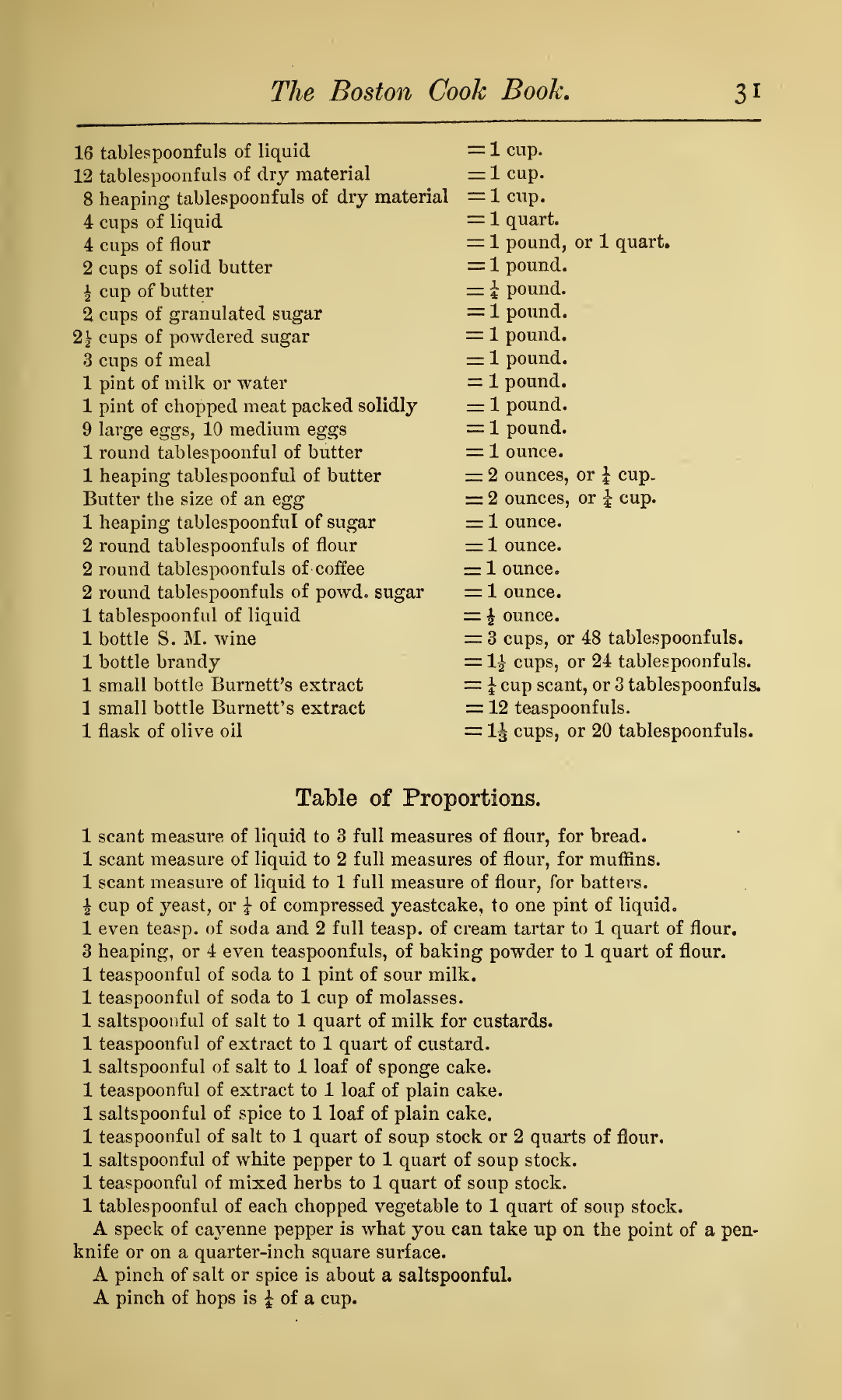
In her 1884 cookbook, butter the size of an egg means about two ounces, a quarter cup or one heaping tablespoonful. A later British household manual gives about one ounce for butter the size of a small egg. The qualifier matters: these aren't two measurements of a demonstrably identical portion. Each statement belongs to its own book.
An egg in one spoon, butter in the other
Lincoln calls egg-sized butter a common expression, then gives alternatives she considers easier to write. Her demonstration follows immediately. It helps the reader connect a familiar object with the quantity that her recipes intend. Lincoln, Mrs. Lincoln’s Boston Cook Book, 1884 printing, pp. 29–30.
She doesn't ask the reader to melt the butter into an eggshell or weigh a particular egg. The comparison is made with an egg resting in a spoon and butter packed into another. Her stated approximate equivalents remain the numerical explanation.
The surrounding instructions are unusually attentive to utensils. Lincoln's kitchen cup holds half a pint. Her measuring spoons are the silver spoons then in general use; she warns that iron mixing spoons vary and tells the reader to select one matching the tablespoon she means.
That context prevents a misleading shortcut. Her heaping tablespoonful of butter isn't an instruction to level off any modern spoon labeled tablespoon and expect two ounces. The utensil and its filling instruction both belong to the measure.
Round and heaping are different measures
Lincoln's table separates three butter descriptions:
| Wording in Lincoln's table | Stated equivalent |
|---|---|
| One round tablespoonful of butter | One ounce |
| One heaping tablespoonful of butter | Two ounces, or a quarter cup |
| Butter the size of an egg | Two ounces, or a quarter cup |
These are weight ounces. The table puts the egg comparison beside the heaping spoonful, not the round one. Lincoln, 1884, p. 31.
The distinction is consistent with the care she takes elsewhere over filling words. Even or scant, rounded and heaping measures receive separate explanations. Liquid fills a spoon to its brim; dry material has its own handling. A tablespoon is therefore more than the name stamped on a utensil.
Dropping “heaping” while modernizing a recipe loses information. So does copying the two-ounce equivalent without saying whose definition it is. Lincoln supplies an approximate answer for her teaching system; she doesn't certify every egg comparison in every cookbook.
Her table is best read beside the prose. The table makes the relationships easy to find, while the preceding pages explain the cup, selected spoon and demonstration that make those relationships intelligible.
Judgment was something to learn
Lincoln begins her measuring discussion by challenging the claim that good cooks never measure. They do, she says, through judgment and experience. Readers who haven't acquired those qualities should use spoons, cups or scales. Lincoln, 1884, p. 28.
The two-spoon exercise fits that approach. A cook can learn what an intended portion looks like, but the book doesn't demand that a beginner recognize it unaided. Lincoln provides a visual comparison and stated equivalents together.
Her account also changes the tone of the old instruction. Egg-sized butter needn't be treated as evidence that the author was indifferent to quantities. Here, the author notices the phrase, explains it and gives the learner a way to remember it.
A small egg in the 1906 revision
The new revised edition of Mrs. Beeton's Book of Household Management, published in London in 1906, gives a different, qualified comparison: butter or fat about the size of a small egg weighs approximately one ounce. Its introduction describes the equivalents as rough guides for ordinary purposes and acknowledges variation, including egg size. Mrs. Beeton's Book of Household Management, 1906 revision, pp. 126–127.
Keep “small” attached to that ounce. Lincoln's unqualified egg comparison and this small-egg comparison aren't interchangeable wording. Nor does the later revision establish what an egg meant in Beeton's original 1861 edition.
The two books don't tell us why their estimates differ, and there's no need to invent an explanation involving historical hens or butter density. They give different statements with different qualifications.
If an inherited recipe supplies no definition, neither statement automatically identifies its intended portion. Record the comparison as written. If a modern adaptation selects a weight, identify that choice and its source instead of presenting it as a recovered measurement of the unknown author's egg.
Before melting or after?
Lincoln also distinguishes two ways of measuring butter. A tablespoonful of melted butter is measured after melting. A tablespoonful of butter melted is measured before melting. Lincoln, 1884, p. 30.
Here the ingredient stays the same while the order of operations changes. Resolving “egg-sized” isn't the last reading decision if the sentence also specifies what happens before or after measuring.
On a working recipe, retain the whole instruction: the size qualifier, whether the spoon is heaping, and whether the butter is measured before melting. Lincoln's own explanation needs all those words to travel with its quantity.