 Forgotten Kitchen
Ingredients
Why an Old Rice-Flour Loaf Still Needed Wheat
The wheat arrives halfway through an old rice-flour loaf recipe, with no weight beside it. After making a cooked rice pap and adding yeast, the reader must knead in enough wheat flour to make bread dough. More wheat follows after the first rise. The heading names rice flour; the method reveals a mixed-flour loaf.
- Rice flour
- Bread
- Recipe instructions
The 1863 Confederate Receipt Book gives both a specific loaf and a general pap rule, and they do not fit together neatly. Its rice-flour blanc mange offers a second task for the same ingredient: thickening milk for a dessert served from a cup.
Follow the second loaf through the page turn
The selected loaf begins under “Another” on printed page 25 and continues onto page 26. It is a second preparation, distinct from the preceding loaf. The appendix follows Elizabeth B. Lewis’s letter reporting earlier publication in Charleston.
A quart of rice flour is first moistened with warm water, then stirred with boiling water until the mixture boils. Once it cools, yeast and salt enter. Wheat flour is kneaded in to make bread dough. After rising, the dough receives more wheat flour, stands warm for half an hour and is baked. A thinner mixture baked in rings is offered as a muffin alternative. Confederate Receipt Book, pp. 25–26.
The unweighed wheat additions leave the rice-to-wheat ratio open. There is no reliable wheat-saving percentage to calculate from this formula. Its half pint of liquid yeast also differs from today’s instant dry yeast, whose strength cannot be inferred from the old volume.
Pap meant a cooked preparation
Pap here is a thick mixture cooked from rice flour and liquid before the dough is mixed. The warm wetting, boiling water and stirring belong to its preparation; whole cooked rice would introduce a different ingredient.
The later general rule calls for a well-boiled pap made from all the milk and water and half the flour, cooled perfectly before other ingredients are added. The writer describes it as a support that prevents flour settling and asks for a final stir before cooking. General rule, p. 27.
The specific loaf starts by cooking its stated rice flour, then adds wheat; the general rule refers to half the flour without identifying a fixed total. Both instructions matter. The general rule does not settle how much wheat the loaf needs or which flour belongs in that half.
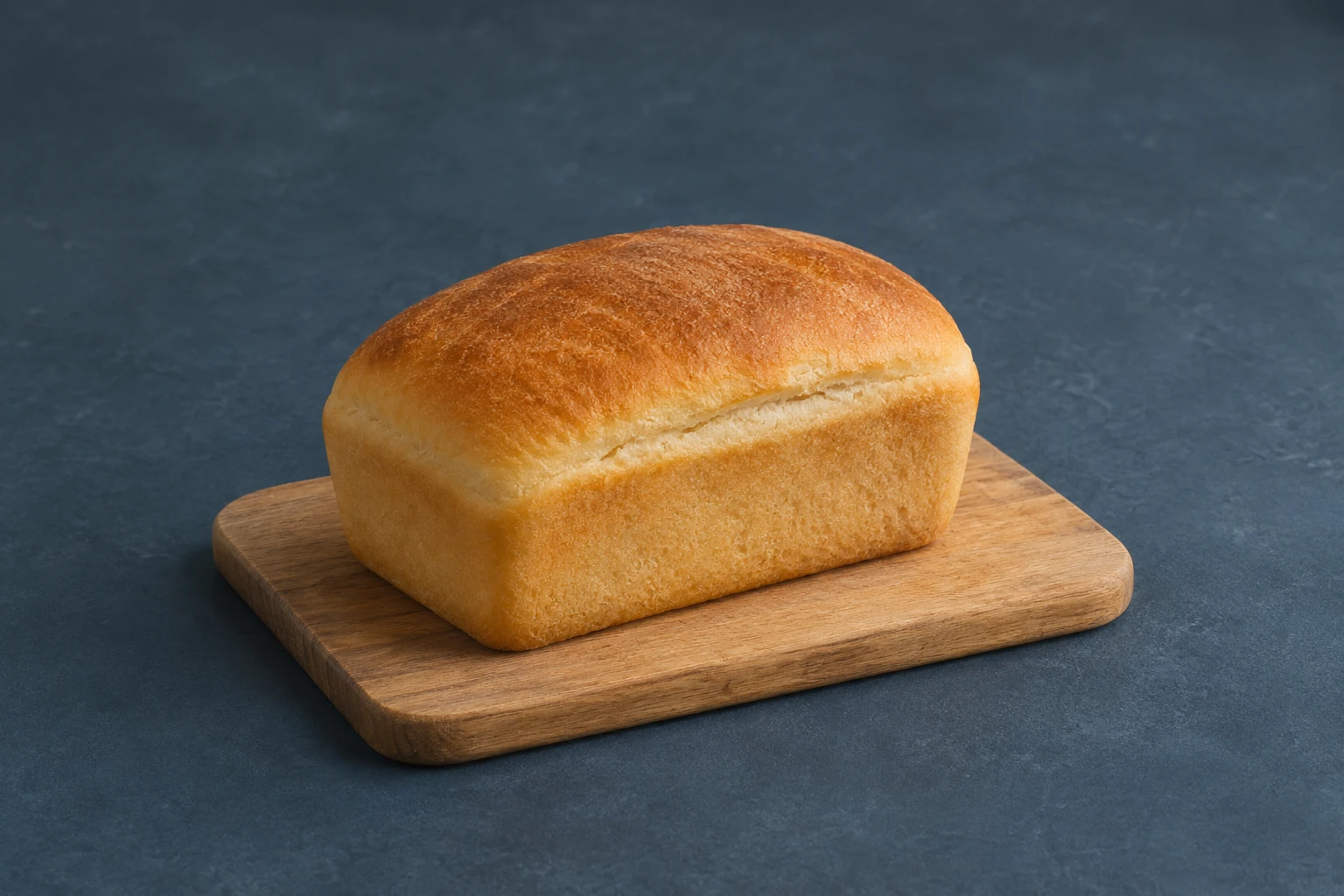
The small loaf below supplies a modern formulation: 100 grams rice flour, 250 grams wheat flour, measured water and instant yeast, with adjustment flour weighed separately. It contains wheat and is unsuitable for someone who needs to avoid it.
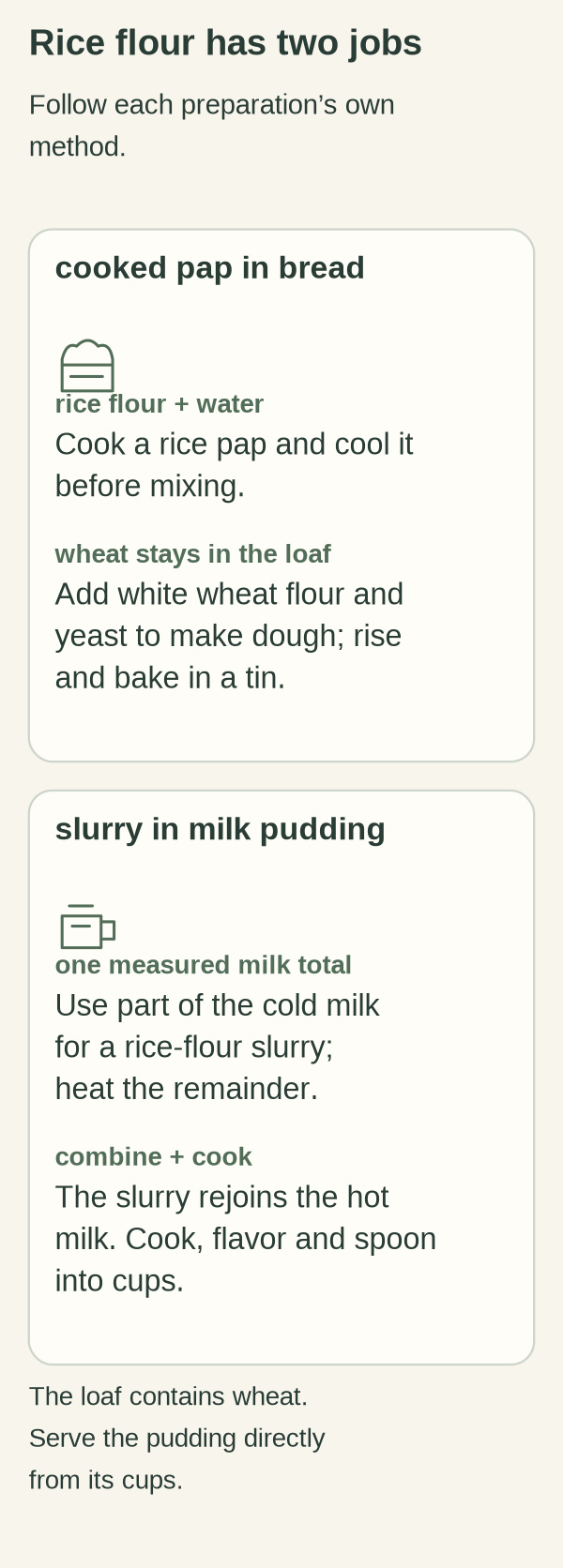
The milk pudding follows its own instructions
Rice Flour Blanc Mange begins on page 26 and continues on 27. Rice flour is smoothed with cold milk before joining the sweetened, flavored milk in the boiling pan. The mixture cooks for about fifteen minutes and goes into molds to cool.
That specific method cooks the whole rice-flour addition in milk. It differs from the general instruction to cook half into pap, cool it and add the remainder. Reading the named recipe through its continuation preserves the actual sequence.
The dessert below reuses TuneMyRecipe’s measured version: plain white rice flour, a cold-milk slurry and rose water added after cooking. Small cups make it a spooned pudding. The rice-flour blanc mange recipe gives the same formula in its existing recipe format.
The weights-and-cups reference explains why a vessel name alone cannot recover an ingredient weight. Here the unstated wheat quantity matters even before a conversion begins. For shopping, the two preparations lead to clear choices: wheat flour and yeast for the loaf, plain white rice flour and culinary rose water for the pudding.
Wheat-and-rice pan loaf
Makes 1 small loaf, approximately 8 slices. Allow about 25 minutes of active preparation plus pap cooling, approximately 1–2 hours for the first rise, 30–60 minutes for the second rise, 40–50 minutes for baking and cooling before slicing. Rising times depend on the dough and room.
Equipment: saucepan, whisk, mixing bowl, spoon, greased small loaf tin approximately 18 × 10 cm internally, wire cooling rack and optional food thermometer.
Ingredients for the loaf
- 100 g plain white rice flour
- 270 ml drinking water, divided into 100 ml, 120 ml and 50 ml
- 250 g strong white wheat flour
- Up to 20 g extra strong white wheat flour, only if needed for adjustment
- 4 g instant dry yeast
- 4 g salt
- 2 g neutral oil for greasing the tin
Cooking the pap and making the dough
- Whisk the rice flour with 100 ml cool water in a saucepan. Bring a separate 120 ml water to a boil, whisk it into the slurry and cook over low heat, stirring, until thick. Set the pan in a cold-water bath and stir until the pap is no warmer than 35°C. Keep bath water out of the mixture.
- Mix the 250 g wheat flour with yeast and salt. Add the cooled pap and remaining 50 ml water. Knead to a soft, tacky dough. If too wet to handle, add only as much of the reserved flour as needed, up to 20 g, and note the amount used. Don't taste raw dough.
- Cover and let rise until visibly expanded, provisionally 1–2 hours. Grease the tin with the oil. Fold and gently shape the dough, put it in the tin and leave until puffy, provisionally another 30–60 minutes.
- Bake in a preheated 190°C/375°F oven for approximately 40–50 minutes, until well browned and set inside without wet paste. About 95°C at the center, if checked, is a bread-quality cue. Cool on a rack before slicing.
The oven temperature, pan, yeast and flour ratio are modern choices. The source’s flour addition after rising becomes an optional adjustment before the first rise. The 2 g tin oil is a supplied greasing allowance, separate from the dough. Use additional tins for larger batches; ingredient scaling does not scale the rises or baking time.
Rose-scented rice-milk cups
Makes 4 small dessert cups, approximately 120 ml each. Allow about 5 minutes to prepare, 20 minutes to heat and cook, and additional time if serving chilled.
Equipment: medium saucepan, whisk and four shallow heatproof dessert cups holding at least 150 ml each.
Ingredients for the pudding
- 500 ml pasteurized whole milk, divided
- 30 g plain white rice flour
- 30 g granulated sugar
- ½ US teaspoon culinary rose water
- Up to a further ½ US teaspoon culinary rose water, optional
Thickening the milk and filling the cups
- Set out the shallow cups. Whisk the rice flour with enough of the measured cold milk for a smooth, pourable slurry, about 60 ml from this 500 ml batch. The remaining measured milk goes into the saucepan; no extra milk is added. Don't taste the uncooked slurry.
- Put the remaining milk and sugar in the saucepan. Heat over medium-low heat, stirring, until the sugar dissolves and the milk gently simmers.
- Whisk the slurry again and pour it into the simmering milk while whisking. Return to a gentle bubbling simmer, reduce heat as needed and cook for about 15 minutes, stirring regularly and scraping the bottom and corners. The mixture should be smooth and thickened; avoid a hard boil.
- Remove from the heat and stir in the first ½ teaspoon rose water. Taste a little cooked pudding on a clean spoon and add any optional extra only if wanted. Divide among the cups, keeping each portion approximately 120 ml. Serve warm or refrigerate promptly; cover once chilled and serve directly from the cups.
Use food-grade culinary rose water, rather than rose oil, perfume or concentrated essence. The pudding contains milk and is served directly from its cups.
Cooking, cooling and source notes
Flour mixtures must be cooked before tasting; see FDA flour guidance. Refrigerate pudding promptly in its shallow cups, within 2 hours of cooking or 1 hour above 90°F/32°C, and maintain the refrigerator at 40°F/4°C or below. FDA handling guidance supports prompt refrigeration and shallow portions. Don't leave pudding on the counter until completely cold.
The named recipes, page continuations and general rule are from the 1863 Confederate Receipt Book, pp. 25–27.