 Forgotten Kitchen
Measures & Ovens
Why Old Cookbooks Used Both Weights and Cups
Amelia Simmons gave directions for a light cake baked in small cups in her 1796 American Cookery. The ingredients, however, included pound weights and glassfuls. Those cups were baking vessels. Elsewhere in the same book, teacups measured ingredients alongside pounds. Old cookbooks could accommodate both weights and cups because authors used them for different jobs, chose measures for convenience, and taught readers how to fill their utensils.
- Weights and measures
- Cookbooks
- Kitchen utensils
Several measures could share one recipe
Simmons's Christmas cookie recipe makes the coexistence particularly clear. Flour, butter and sugar appear in pounds; powdered coriander seed and milk appear in teacups. The reader isn't choosing between an entirely weighed recipe and an entirely cup-measured one. Both forms of quantity belong to the same preparation. Simmons, American Cookery, 1796, p. 35.
Her small-cup cake presents a different reading problem. A cup mentioned in the heading doesn't necessarily measure anything in the ingredient list. Here it tells the cook what to bake the mixture in, while weights and glassfuls describe what goes into it. Searching an old book for the word cup would collect these two uses together unless someone read the recipes. Simmons, 1796, p. 37.
Mixed quantities weren't confined to this American example. Alexis Soyer's A Shilling Cookery for the People, in an 1854 printing with a London and New York imprint, begins its spiced beef with four pounds of meat and a pint of water. Teaspoons supply seasoning; a teacupful measures bread raspings added later. One covered pan brings together a weighed joint, a liquid measure and smaller spoon and cup quantities. Soyer, 1854, recipe 226, p. 87.
That recipe doesn't explain why Soyer selected every unit. It does show what a tidy division between American cups and British weights would leave out: a published recipe using several ways to state quantity at once. Its dual imprint also makes it a poor candidate for a story about an exclusively national readership.
Convenience was Lincoln's stated reason
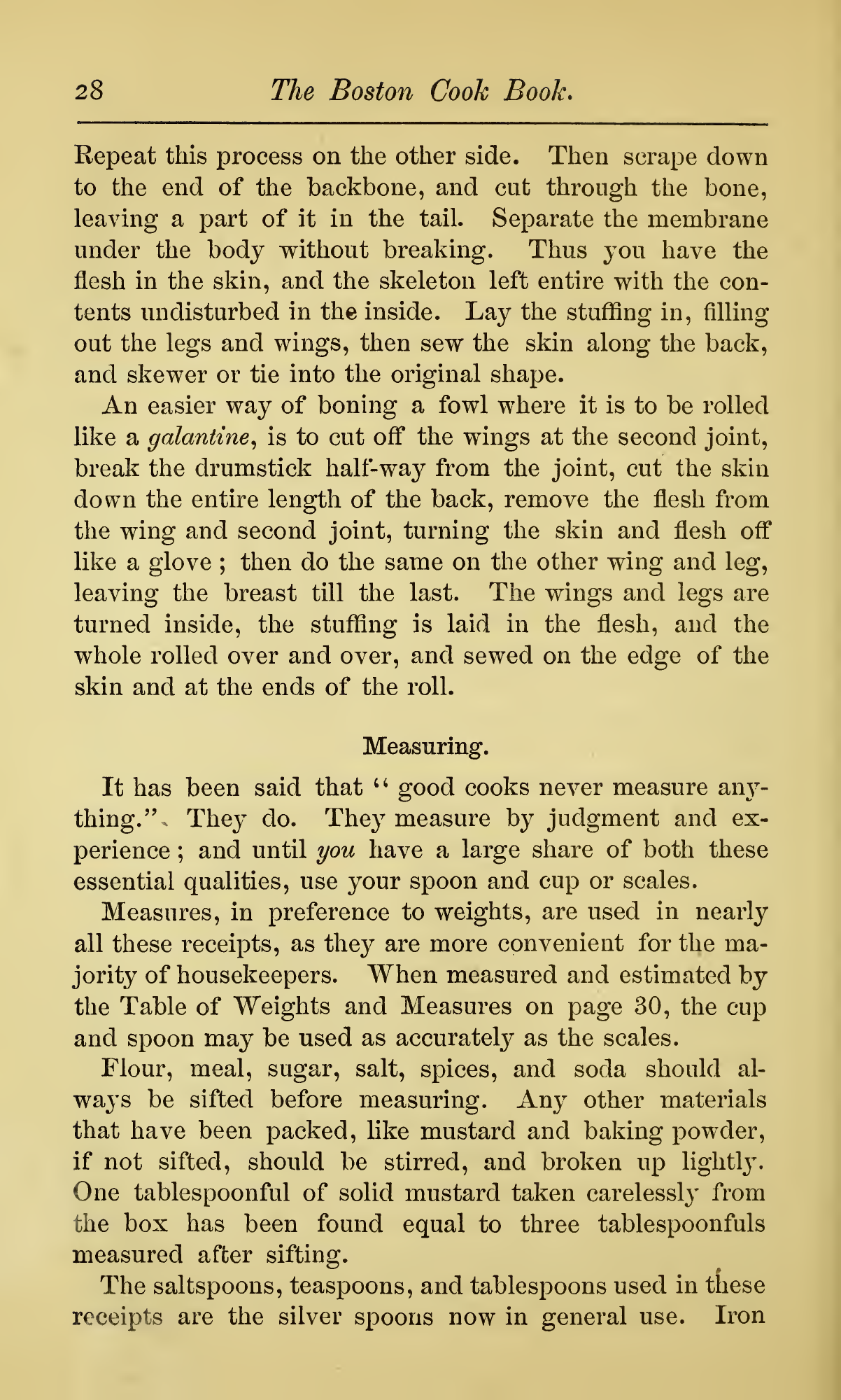
Mary J. Lincoln did explain her preference. In the 1884 printing of Mrs. Lincoln's Boston Cook Book, she says measures predominate because she considers them more convenient for most housekeepers. This is a reason supplied by the author for her own recipes. It doesn't tell us how many households owned scales, what they cost, or why every other writer chose differently. Lincoln, Mrs. Lincoln's Boston Cook Book, 1884 printing, p. 28.
Convenience, for Lincoln, didn't mean abandoning deliberate measurement. She challenges the idea that good cooks never measure: their judgment and experience allow them to assess quantities. A beginner who hasn't developed those abilities should use a spoon and cup or scales. The experienced eye and the measuring utensil belong to the same discussion of learning.
She even maintains that cups and spoons, used with her weights-and-measures table, can match the accuracy of scales. That's Lincoln's assessment, rather than a modern comparison of equipment. What matters to her argument is the combination: the utensil, the instructions and the table work together. Preferring measures doesn't require erasing weights from the book.
Lincoln's egg-sized butter demonstration takes up the visual side of that teaching. An amount recognizable to an experienced cook can be explained to someone still learning what it looks like.
A full measure needed instructions
Once a writer chose cups, there was still work to do. Lincoln identifies her kitchen cup as holding half a pint and describes how a dry cupful should be lightly filled, then leveled without shaking the contents down. The vessel supplies a capacity; the filling operation supplies another part of the instruction. Lincoln, 1884, p. 29.
Fannie Merritt Farmer's 1896 The Boston Cooking-School Cook Book likewise acknowledges experienced visual judgment while providing definite guides for readers who need them. She recommends half-pint tin measuring cups divided into quarters or thirds. Her cup and spoon instructions specify level measures. Farmer, 1896, pp. 27–28.
The distinction between the two books is more interesting than a supposed invention date. Lincoln had already taught deliberate cup measurement, but her ordinary dry spoonful was rounded; Farmer specifies a level spoonful. A reader following either author needs the appropriate filling rule. Putting an identical modern utensil beside both texts wouldn't make those instructions identical.
The teacupful reference follows the separate question of how authors defined vessels and their contents. Here, Farmer's weight table supplies the telling detail: a book so explicit about measuring cups also printed relationships between measures and weights. Cups and weighing remained connected on its pages. Farmer, 1896, p. 32.
One cup could organize the work
Lincoln's convenience becomes especially tangible when she describes the order of measuring. In one sequence, flour comes first, butter follows, and sugar helps carry butter adhering to the cup into the mixing bowl. In an alternative sequence, melted butter is measured last. Her aim is to let one cup serve throughout without washing between ingredients. Lincoln, 1884, p. 30.
This is more than a list of equivalents. The cup has become part of the arrangement of work: what goes into it first, what follows, and how its contents reach the bowl. Lincoln's measuring chapter attends to the cook's movements as well as the numbers. A cup can hold an amount, teach an amount and save a change of utensils, all within the same book.