 Forgotten Kitchen
Ingredients
When an Old Recipe Says “The Same”: Finding a Tamale’s Missing Base
A tamale instruction can be complete as a variation and incomplete as a recipe. In Carrie V. Shuman’s 1893 Favorite Dishes, Tamales de Chile replaces sugar, cinnamon and raisins with meat, chile and salt. The dough, husks and steaming method appear in the sweet tamales more than a hundred pages away.
- Tamales
- Masa harina
- Recipe instructions
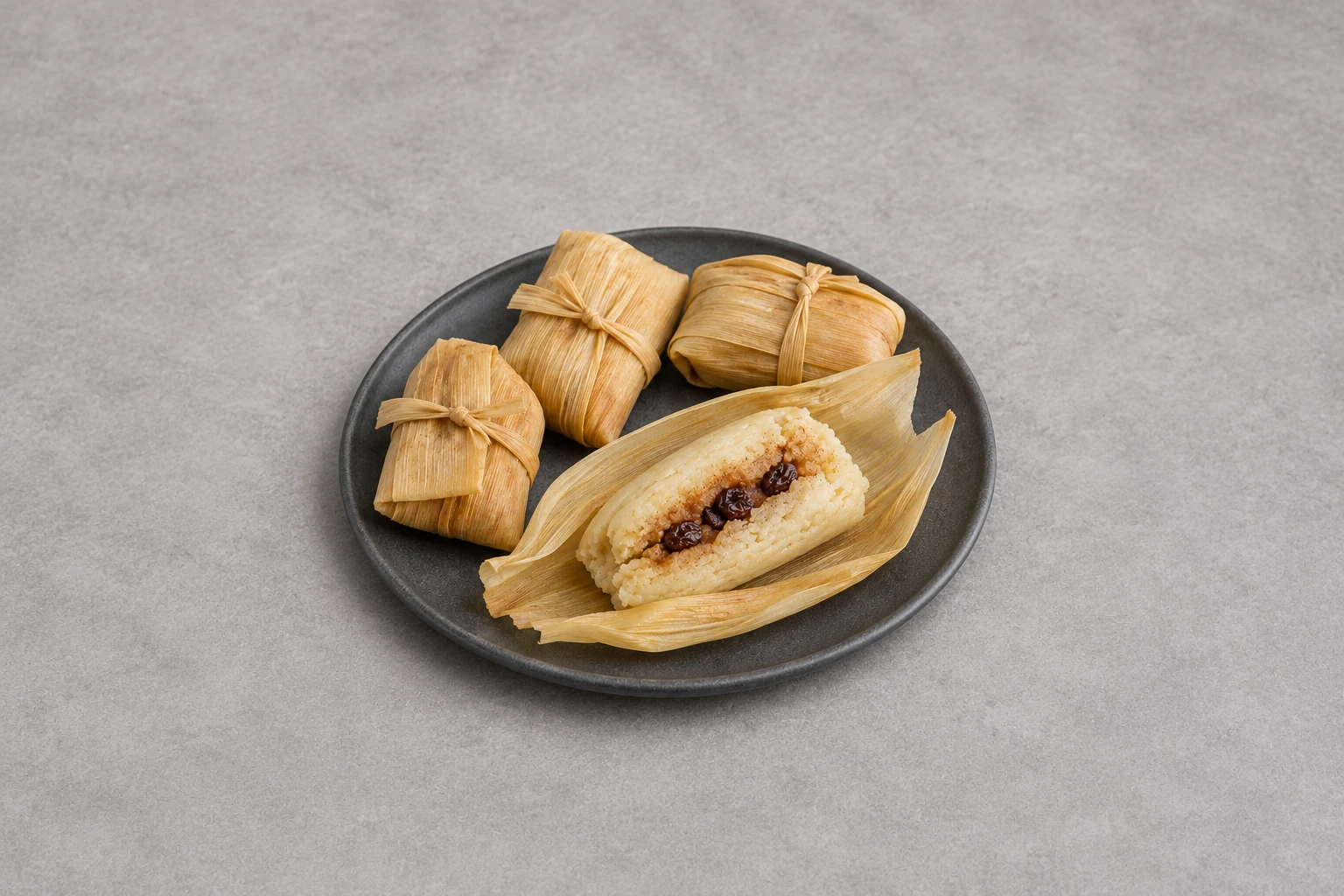
For the modern examples below, buy commercial nixtamalized masa harina intended for tamales. Both use that flour, lard and water for the dough; one has cinnamon and raisins, the other cooked beef and prepared chile sauce.
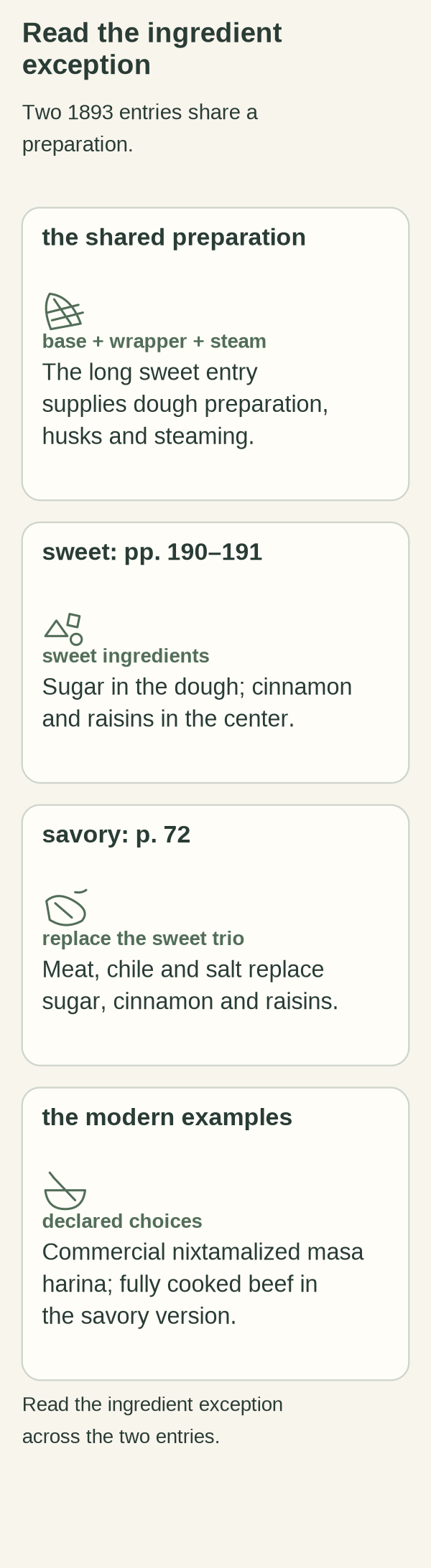
The ingredient exception points across the book
Tamales de Chile appears on printed page 72, following Pollo con Arroz and Pollo con Tomates. Neither chicken dish contains the sweet ingredients that the tamale instruction tells the reader to leave out.
Its opening word, “Lomismo,” can be read as “the same.” The useful clue is the ingredient exception: find the preparation that uses sugar, cinnamon and raisins. Tamales de Dulce begins on printed page 190 and continues on 191, supplying corn preparation, grinding, beating, filling, wrapping, tying and steaming. The matching ingredients, headings and attribution support a shared base, although the savory entry prints no page reference. Shuman, Favorite Dishes, pp. 72 and 190–191.
What the sweet preparation supplies
The sweet entry begins with white corn prepared as nixtamal, then washed and ground very finely on a metate. The masa is beaten in a cajete. A piece rising on water indicates readiness in the historical text; fat and sugar follow. Cinnamon and raisins go inside, and corn husks enclose the dough before tying and steaming.
The savory instruction keeps that operation while replacing the sweet trio with meat, chile and salt in the middle. Its brief exception makes much more sense beside a complete tamale preparation than beside the nearby chicken dishes.
Both entries carry the formal attribution to Señora Don Manuel Chaves of New Mexico; the printed signature identifies Vicenta Labadie de Chaves. Her name belongs with both preparations, including the longer sweet entry that supplies so much of their practical detail.
A later recipe changes the sequence
The 1903 Landmarks Club Cook Book groups a tamale base and variations nearby. Its water-float test follows lard addition; the 1893 sweet entry places the test before fat and sugar. Its fillings also differ. Those material differences make it a comparison rather than a source of missing quantities for the earlier recipe. Landmarks Club Cook Book, pp. 3–4.
The small batches below use commercial masa harina in place of the historical corn treatment and grinding. Water, lard, filling amounts, soaking and steaming times are supplied modern choices. They omit the float test and use the cooking cues in their complete methods.
The savory version chooses fully cooked shredded beef and mild prepared red chile sauce where the source leaves the meat and chile preparation open. Keep its filling separate from the cinnamon-raisin mixture: the exception replaces the sweet ingredients entirely.
The wrapper has a cooking job
A softened husk folds around the dough and leaves it room to expand. Steam reaches the parcels above the simmering water. Choose a covered steamer large enough to hold them with space for circulation, and replenish its water without flooding the food.
The husks are removed before eating. For the beef version, use a food thermometer to check the reheated filling as well as checking that the masa is fully cooked. More parcels may need another steamer batch; the ingredient count does not determine the cooking time.
Sweet cinnamon-raisin tamales
Makes approximately 6 small tamales. Allow about 45 minutes for husk softening, mixing and assembly, 60–75 minutes or longer for steaming, and a 10-minute rest. Some preparation overlaps.
Equipment: mixing bowl, spoon or spatula, covered steamer holding the parcels above simmering water, and tongs. Use food-grade dried corn husks.
Ingredients for the sweet parcels
- 120 g commercial nixtamalized masa harina for tamales
- 180 ml warm drinking water, plus measured teaspoonfuls only if needed
- 30 g plain lard, softened
- 25 g granulated sugar
- 30 g raisins, without alcoholic soaking
- ¼ US teaspoon ground cinnamon
- 6 large food-grade dried corn husks, plus husk strips for tying
- Hot water for soaking the husks and water for the steamer, separate from the dough water
Making and steaming the sweet tamales
- Soften clean husks and tying strips in hot water for about 30 minutes; drain. Mix the masa harina with the measured 180 ml warm water and rest for 15 minutes. Beat in the softened lard and sugar until evenly combined. If needed for spreading, add water a measured teaspoon at a time and record the extra.
- Divide the dough among six husks, leaving margins. Mix raisins with cinnamon and divide between the centers. Fold dough around the filling, fold the husks around the dough and tie loosely enough to leave room for expansion.
- Arrange above simmering water in the covered steamer, with room for steam to circulate. Steam for approximately 60–75 minutes, maintaining the water level. Extend cooking until the dough is fully cooked, set and releases from the husk; follow longer cooking directions on the masa package where applicable.
- Rest for 10 minutes. Open carefully to avoid escaping steam and remove the husks before eating.
Cooked-beef chile tamales
Makes approximately 6 small tamales, using ready-cooked beef. Allow about 45 minutes for preparation and assembly, 60–75 minutes or longer to steam, and a 10-minute rest. Cooking the beef from raw is outside this recipe.
Equipment: mixing bowl, spoon or spatula, covered steamer, tongs and food thermometer.
Ingredients for the savory parcels
- 120 g commercial nixtamalized masa harina for tamales
- 180 ml warm drinking water, plus measured teaspoonfuls only if needed
- 30 g plain lard, softened
- 100 g fully cooked, plain shredded beef, kept refrigerated until needed
- 15 g mild prepared red chile sauce
- ¼ US teaspoon salt
- 6 large food-grade dried corn husks, plus husk strips for tying
- Hot water for soaking the husks and water for the steamer, separate from the dough water
Filling and steaming the beef tamales
- Soften clean husks and tying strips in hot water for about 30 minutes, then drain. Mix masa harina with the measured warm water, rest for 15 minutes and beat in softened lard. Add measured teaspoonfuls of water only if needed for spreading. Mix the cooked beef, chile sauce and salt in a separate bowl.
- Divide dough and filling into six portions. Spread dough on each husk with margins, place filling in the center and enclose it in dough. Fold the husks and tie loosely. Do not add the sweet recipe’s sugar, cinnamon or raisins.
- Steam above simmering water in a covered steamer for approximately 60–75 minutes, checking and replenishing water without flooding the parcels. Continue until the masa is fully cooked and set and the center of the beef filling reaches 165°F/74°C. Check with a food thermometer; longer cooking may be needed.
- Rest for 10 minutes, open carefully and discard the husks before eating.
Handling and source notes
Don't taste uncooked dough. Wash hands and utensils after handling flour, and cook the dough fully. The FDA’s flour guidance explains why raw flour mixtures need cooking. The beef endpoint follows the official leftovers temperature.
Serve promptly. Refrigerate perishable leftovers in shallow containers within 2 hours, or 1 hour above 90°F/32°C, and keep the refrigerator at 40°F/4°C or below, following FDA handling guidance.
Adapted from Tamales de Dulce, pp. 190–191, and Tamales de Chile, p. 72, in Shuman’s Favorite Dishes (1893).