 Forgotten Kitchen
Measures & Ovens
What Is a Gill in Old Recipes?
A gill is a quarter pint in the US liquid and Imperial conventions. The sizes differ: a US liquid gill is about 118 milliliters, while an Imperial gill is about 142 milliliters. That's four US fluid ounces or five Imperial fluid ounces, respectively.
- Gills
- Historical measures
- Liquid measures
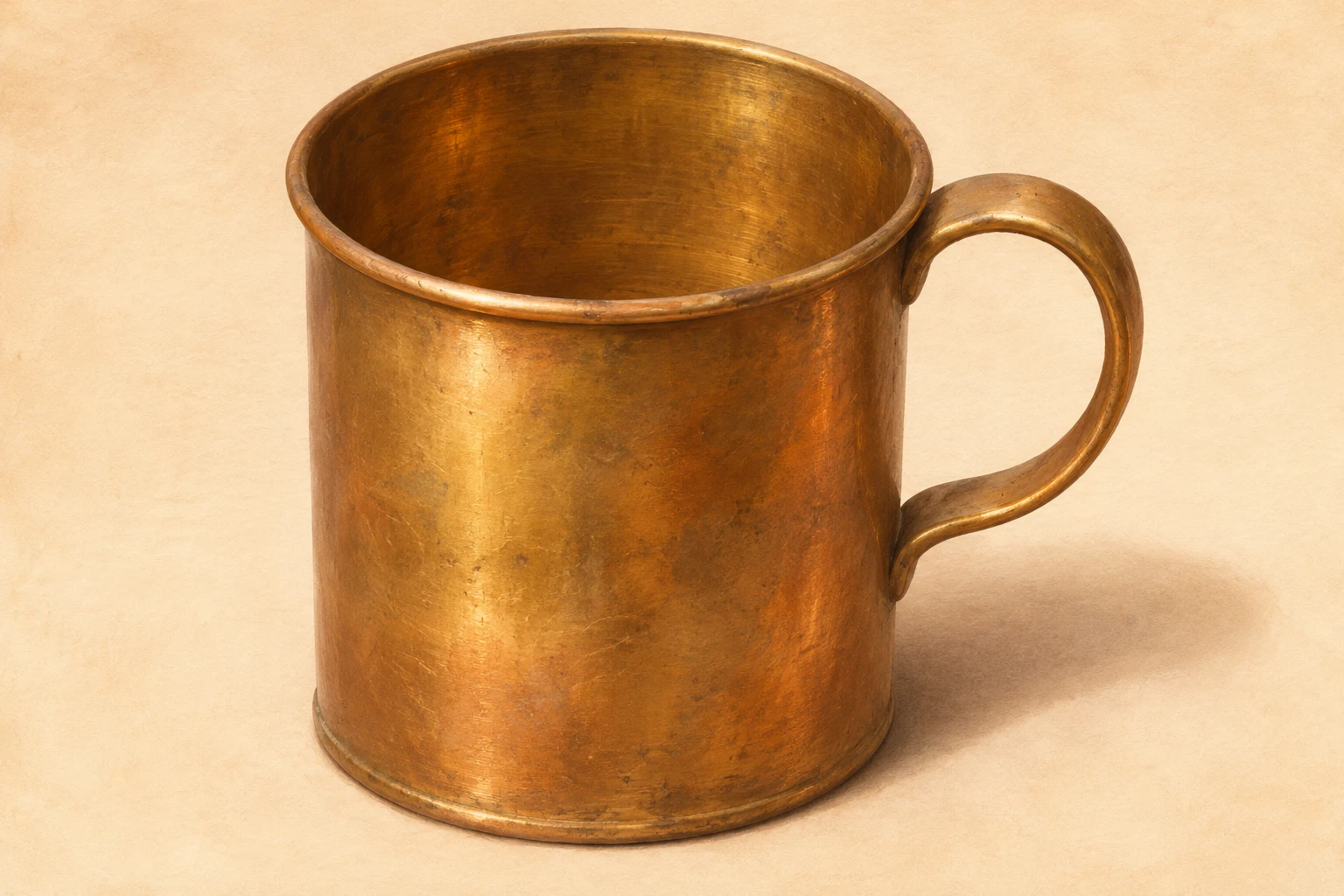
The question for an old recipe is therefore a quarter of which pint? A cookbook may define its own measuring equipment and relationships. Those instructions can be more useful than assigning a modern system from the author's country alone.
| Named measure | Relationship | Approximate capacity |
|---|---|---|
| US liquid gill | Quarter US liquid pint; four US fluid ounces | 118 ml |
| Imperial gill | Quarter Imperial pint; five Imperial fluid ounces | 142 ml |
The rounded capacities follow the separately listed units in NIST's conversion factors. The word “fluid” matters: these are volumes, not ounces weighed on a scale.
Leslie wanted a set of small measures
Eliza Leslie begins her 1837 Directions for Cookery with equipment that would make small quantities easier to pour. She recommends tin measures with spouts or lips, ranging down to half a “jill.” Her spelling differs from the usual modern form, but her relationship is explicit: two gills are half a pint. Leslie, Directions for Cookery, 1837, p. 9.
That makes four gills to the pint she is describing. It also shows that a gill wasn't necessarily an amount left to a cook's eye or an improvised drinking glass. Leslie expected readers to obtain measuring vessels, including one smaller than a full gill.
The spout is a practical detail. Her recommendation is about transferring a measured liquid as well as holding it. A small quantity can be defined in a table and still need a utensil that lets the cook put it where it belongs.
On the following page, she relates a half-jill to a common wineglass and four wineglasses to a half-pint or common tumbler. Household glass names enter a network of stated relationships. They don't replace the need to read those relationships. Leslie, 1837, p. 10.
A later British table confirms its own fraction
The 1906 London revision of Mrs. Beeton's Book of Household Management also gives four gills to a pint. Its measuring discussion separates liquid relationships from weight tables and introduces the equivalents as rough guides for ordinary purposes. Mrs. Beeton's Book of Household Management, new revised edition, 1906, p. 126.
The fraction is easy to remember. The system still needs its name. Four US fluid ounces and five Imperial fluid ounces shouldn't be compared as though “ounce” guaranteed the same unit in both phrases.
Nor does the liquid amount alone give the weight of an ingredient. A gill of one liquid doesn't establish the weight of a gill of another. A modern adaptation that supplies grams has added an ingredient-specific conversion, not merely another spelling of gill.
Our teacupful reference considers the same distinction between a vessel's capacity and the way an ingredient fills it.
Kitchiner names a wine pint
An earlier English book makes the system question particularly important. William Kitchiner's fourth edition of The Cook's Oracle, published in 1822, describes Lyne's graduated glass as a wine pint divided into sixteen ounces. The book names a measuring instrument and the pint it represents. Kitchiner, The Cook's Oracle, fourth edition, 1822, p. 31.
Calling the book English doesn't turn that stated wine pint into the later Imperial pint. Nor do sixteen divisions, without their source context, authorize assigning the capacity of a different modern pint.
Kitchiner's glass and Leslie's tins make a useful comparison in equipment. Both authors give their readers something more specific than an unqualified household vessel. One describes a graduated glass; the other recommends separate small measures. Their statements need to travel with the recipes.
The task isn't to replace every old measure with a single standard historical set. It's to identify the convention the author actually supplied before choosing a modern quantity.
One recipe doesn't match Leslie's introduction
Leslie's own book contains a discrepancy worth retaining. Her chicken-salad dressing specifies a jill or a wineglass and a half of vinegar. Earlier, the introduction equates half a jill with one common wineglass, which would make a full jill two such glasses. Leslie, 1837, p. 148.
The two statements don't agree. They don't tell us whether a different glass was intended, an error occurred or some other explanation applies. Silently replacing one with the other would hide the evidence instead of resolving it.
For a modern adaptation of that particular dressing, an editor would need to select and document a quantity. The introductory table remains relevant, but it cannot erase the recipe's alternative wording.
When reading another gill instruction, identify the edition and look for its measuring section first. Keep the pint system named, and preserve a genuine discrepancy when one remains. Leslie's little spouted half-jill measure is a reminder that the vessel itself may be the most concrete clue the author gives.