 Forgotten Kitchen
Measures & Ovens
What Did Slow, Moderate and Quick Oven Mean?
A quick oven could hold a large venison pasty for three hours. In Hannah Glasse's 1747 cookbook, quick describes the heat, not a promise that dinner will be ready soon. Slow means gentler heat in a direct recipe comparison; moderate comes with its own qualification about heat and color. These words become much more informative when we read what the author puts beside them.
- Oven heat
- Baking
- Historical recipes
Quick could still take hours
Glasse makes the contrast especially clear in her directions for potted eels. She allows half an hour in a quick oven, longer in a slow one, and adds that the size of the eel must guide the baking. Here the same preparation can use different heat. The word slow changes the expected duration, but Glasse doesn't supply a second time that can simply replace the first. Size remains part of the judgment. The Art of Cookery, Made Plain and Easy (1747), p. 117.
Her venison pasty shows why quick can't be read as a duration on its own. The large pasty takes three hours in a quick oven. Both directions belong to the bake: sustained time and strong heat can appear together. Reading only the adjective would lose the scale of the food; reading only the hours would lose the heat instruction.
On the same page, her Shropshire pie requires a quick oven with a further limit: “but not too fierce an Oven.” Quick isn't permission to make the oven as hot as possible. Glasse still finds it useful to qualify the word inside the recipe. Glasse, 1747, p. 73.
Moderate had a color attached
For her French Biskets, Glasse asks for a moderate oven, specifies that it shouldn't be too hot, and wants a fine color on top. The visible finish belongs to the instruction as much as moderate does. Glasse, 1747, p. 140.
This is a different kind of help from the eel's time allowance. There, she connects heat with duration and size. Here, she connects it with the surface the cook is meant to achieve. The recipes don't each contain a hidden temperature definition waiting to be extracted. They distribute useful information among several details.
The distinction matters when an old recipe is reduced to a short ingredient list and a baking line. Keeping the adjective while dropping the color instruction can make the direction look less informative than it was. Our slack-oven article follows another example of that relationship, where the stage of a pastry's preparation changes the heat it needs.
Rolls and loaves did not share a test
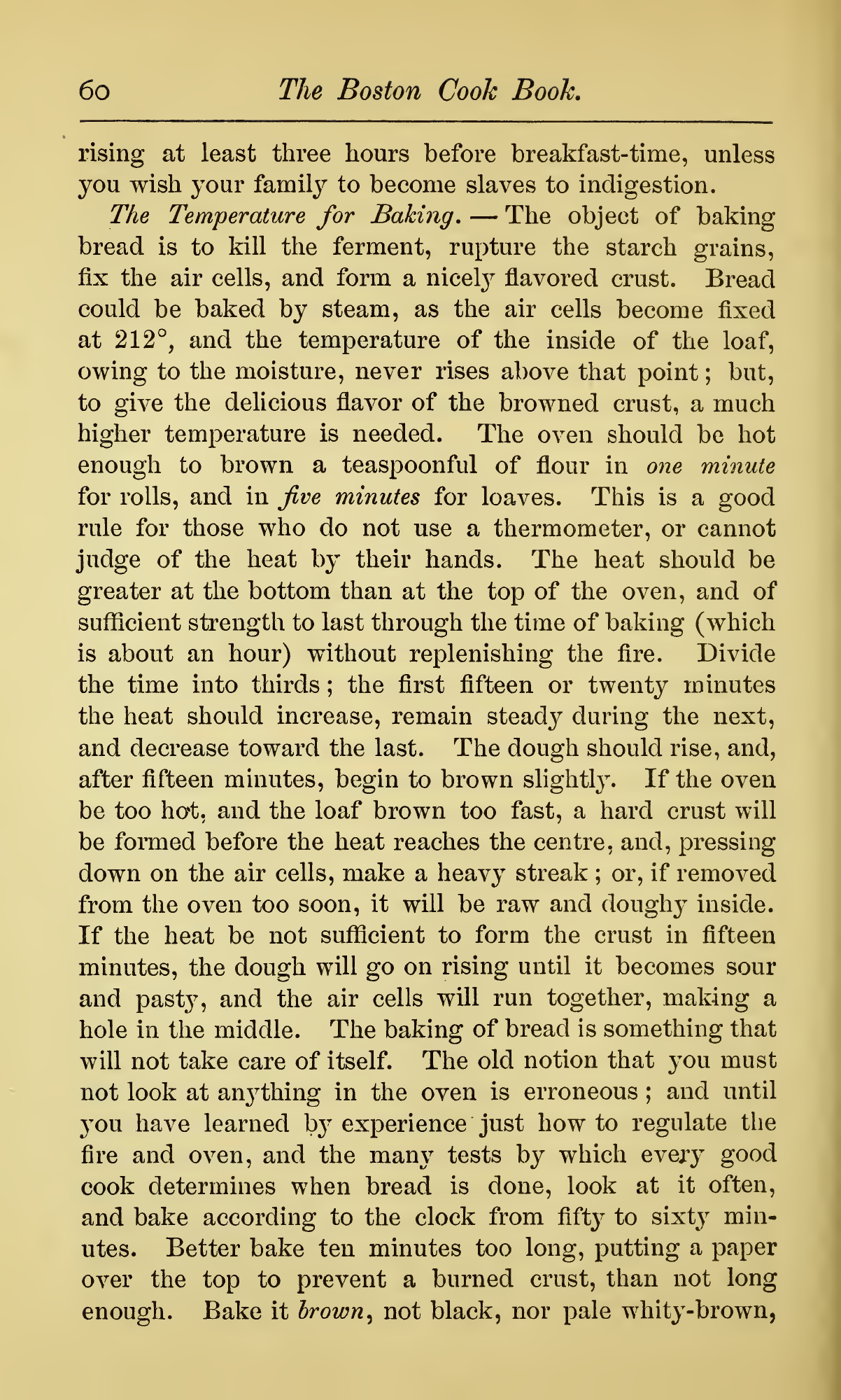
Mary Lincoln's 1884 Boston Cook Book gives a strikingly specific comparison. In her bread discussion, the oven for rolls should brown a teaspoonful of flour in one minute; for loaves, in five. She offers this rule for people who don't use a thermometer or can't judge the heat with their hands. Mrs. Lincoln's Boston Cook Book (1884), p. 60.
The important distinction is between the foods. One minute isn't Lincoln's definition of quick, and five minutes isn't her definition of slow. The timed comparison answers a narrower question about the oven heat she wants for rolls and loaves. These are descriptions of a historical practice, rather than flour or hand tests to reproduce in a modern oven.
Lincoln also describes a changing bake. She divides the time into thirds, with heat increasing first, remaining steady next and decreasing toward the end. Her instruction includes greater heat at the bottom than at the top. A single starting temperature would leave that pattern unexplained.
This is separate from the order in which different dishes enter an oven, explored in cooking before stoves. Lincoln is describing changes during the bread's own baking time. Even after the loaf goes in, the heat instruction has more than one stage.
A thermometer did not settle every author's question
Lincoln's mention of thermometer users is easy to pass over. It matters because descriptive heat words don't, by themselves, prove that oven thermometers were unknown.
Fannie Merritt Farmer makes the distinction explicit in the 1896 Boston Cooking-School Cook Book. Her bread discussion favors experience for judging oven heat and says that the oven thermometers made so far haven't proved practical. That is Farmer's assessment in this book, not a date for their invention or a survey of who owned one. She also distinguishes biscuits from loaf bread by calling for more heat for the biscuits. Farmer, 1896, p. 55.
The revised 1906 Mrs. Beeton's Book of Household Management puts several approaches together. Its baking discussion mentions special oven thermometers, gives numerical temperatures for food categories, and includes paper, flour and hand judgments on the same page. Its bread instruction includes lowering the heat afterward. The instruments and numbers coexist with other ways of judging the oven. 1906 revised edition, p. 114.
For choosing a present-day setting, TuneMyRecipe compares later published ranges in its oven-temperature guide. The earlier passages answer a different question: what information accompanied the heat word? Glasse's large pasty supplies an unusually clear answer. The oven is quick, the bake lasts three hours, and neither instruction cancels the other.